


If you’ve noticed declining organic traffic or reduced click-through rates despite your best SEO efforts, you’re not alone. The search landscape is undergoing a monumental shift, driven by generative AI. Search engines are no longer just lists of links; they are answer engines that provide direct, conversational results. This is where Generative Engine Optimization (GEO) comes in. It’s a new approach focused on achieving AI search visibility by using structured content, entity-based SEO, and semantic search principles.
Businesses still relying on outdated SEO strategies risk becoming invisible as AI-driven indexing and answer engines become the primary way users find information. What you will lean in this article is how to scale your business by adopting practices aligned with the rise of generative engine optimization for SEO strategy.
Key Takeaways
- Why generative engine optimization, AI search visibility, and entity-based SEO redefine traditional keyword-based strategies.
- How declining organic traffic and loss of visibility in AI-generated results limit growth in modern search environments.
- How entity mapping, structured data, and schema markup strengthen authority, trust, and machine understanding.
- Why visibility now depends on structure, context, and entities—not rankings alone.
Why This Concept Matters
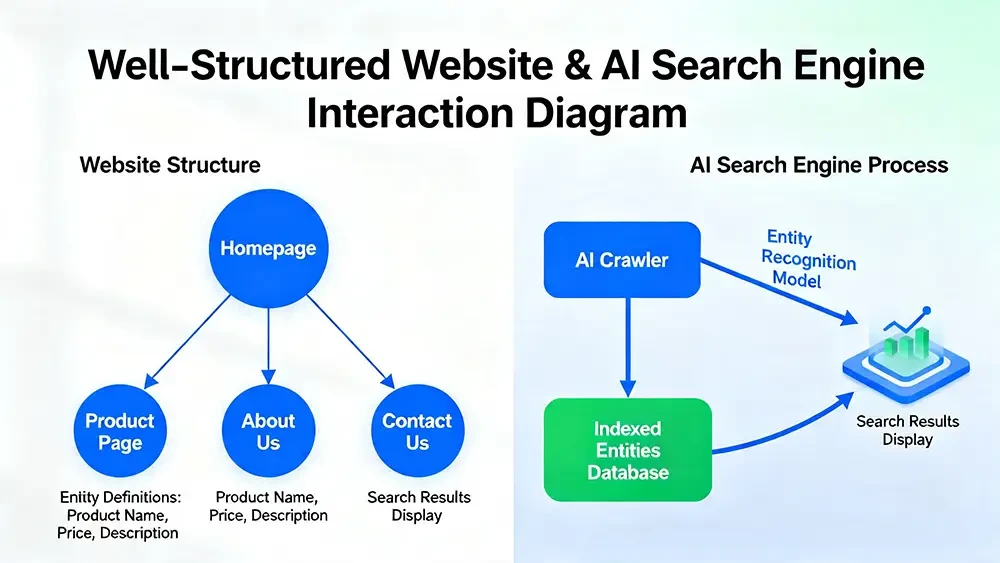
Modern search systems, powered by sophisticated AI, no longer just match keywords to pages. They strive to understand the real world by identifying entities—people, organizations, concepts, and products—and the relationships between them.
Content optimized only for keywords lacks the contextual and structural depth these systems need to validate information and use it in a generated answer. To appear in these valuable, direct-answer experiences, your content must be structured for machine understanding, which is why building a comprehensive profile with the AI Visibility Engine to map out key entities is fundamental to modern digital strategy.
This is particularly critical for service-based companies, where local business visibility depends on structured data, consistent listings, and strong Google Business Profile signals that influence whether your business is selected in location-based AI results.
Real-World Example
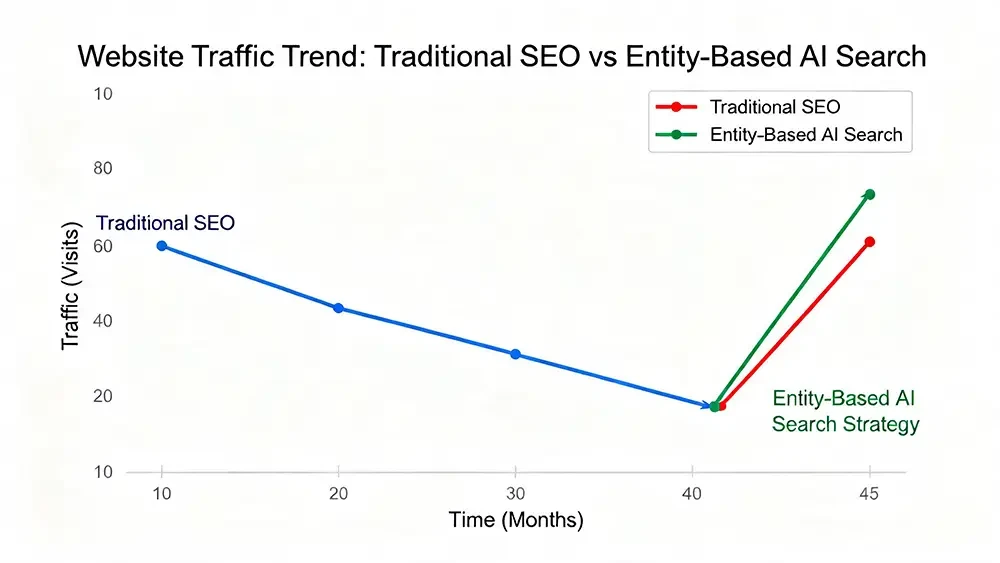
A consulting firm, long dominant in search results for several high-value keywords, began to see a steady decline in website traffic. They discovered that AI-powered search results were now answering user queries directly at the top of the page, making a click to their website unnecessary. In response, the firm shifted its strategy. They restructured their core content to align with entity-based SEO principles, using structured data to clearly define their services, expertise, and authority. Soon after, their key insights began appearing within the AI-generated summaries, restoring their visibility and positioning them as a primary source in the new search ecosystem.
To fully capitalize on this visibility, businesses need CRM and automation systems that capture, qualify, and nurture leads generated from AI-driven search, ensuring that increased exposure leads to real revenue.
Common Mistakes
Many businesses fail to adapt to this new reality, making critical errors that render them invisible to AI. Common mistakes include:
- Focusing exclusively on traditional keyword rankings while ignoring visibility in answer engines.
- Ignoring the implementation of structured data (schema markup) to define content for machines.
- Producing generic, unstructured content that lacks clear authority and context.
- Failing to explicitly define the business’s core entities (who you are, what you do, where you operate).
- Not ensuring your site has a responsive web design for an optimal user experience across all devices, which is a foundational trust signal.
What You Should Aim For
Success in the age of AI-driven search is measured by new metrics. Your goal is to achieve AI visibility aligned with the rise of generative engine optimization for SEO strategy – one that delivers sustained search relevance and improved lead quality. This includes:
- Clear entity definition and alignment: AI systems must unambiguously understand who you are and what you offer.
- Structured, machine-readable content: Your information must be organized so that AI can easily parse, validate, and feature it.
- Intent-matched information architecture: Your site structure should directly answer the questions your audience is asking.
- Consistent visibility across search and answer engines: Your brand should appear in traditional results and AI-generated summaries.
- Trust signals AI systems recognize: Authority is built on clear, consistent, and well-structured information, and it’s crucial to be understanding why responsive website design is critical for reaching users on smartphones and tablets.
Supporting Data & Research
Accepted principles in computer science and information retrieval confirm the shift toward entity-based understanding. For years, search engines have been building massive knowledge graphs—vast databases of entities and their relationships—to power more relevant results. The integration of large language models and generative AI is the next logical step in this evolution. These systems rely on semantic understanding, which evaluates the context and intent behind a query, not just the words themselves. To be included as a trusted source, content must be structured in a way that feeds this understanding, which requires adopting a new content architecture. This method of organizing information for machine readability is associated with the rise of generative engine optimization for SEO strategy. It is the difference between getting referred by the LLMs and losing leads to competitors who adopt these practices.
Frequently Asked Questions
What is Generative Engine Optimization (GEO)?
GEO is the practice of optimizing your digital presence to be visible and authoritative within AI-powered generative search results and answer engines. It focuses on structure, context, and entity definition over traditional keyword rankings.
How is GEO different from traditional SEO?
Traditional SEO primarily focuses on ranking web pages for specific keywords. GEO focuses on structuring information so that AI systems can understand it, trust it, and feature it directly in generated answers.
Why is my website traffic dropping even with good rankings?
Traffic may be dropping because users are getting their answers directly from AI-generated summaries at the top of the search results page, reducing their need to click through to individual websites.
What is an "entity" in the context of SEO?
An entity is a well-defined person, place, organization, product, or concept that a search engine can uniquely identify and understand. Defining your business as a clear entity is crucial for AI visibility.
Do I still need keywords with AI-driven search?
Yes, but their role has changed. Keywords help establish topical relevance and align with user intent, but they must be supported by deep, structured content and clear context, not just placed on a page.
What is structured data and why does it matter for GEO?
Structured data (like schema markup) is a standardized format for providing information about a page and classifying its content. It’s a machine-readable language that helps AI systems understand your content accurately.
How can I get my business featured in AI-generated answers?
By creating high-quality, structured content that clearly defines your expertise and entities, directly answers user questions, and is marked up with appropriate schema to ensure machine readability.
Is Answer Engine Optimization (AEO) the same as GEO?
AEO is a core component of GEO. While AEO focuses specifically on getting featured in answer boxes, GEO is a broader strategy for overall visibility and authority within the entire AI-driven search ecosystem.
What's the first step to adapt my strategy for AI search?
The first step is to clearly define your core business entities: who you are, what you specialize in, your services, and your location. This forms the foundation for all other structuring efforts.
Will this trend of AI in search continue to grow?
All indicators suggest that AI integration into search is not just a trend but a fundamental evolution. Its role is expected to expand, making adaptation essential for long-term digital survival.
Webpuzzlemaster AI Visibility Services
Webpuzzlemaster Digital Marketing Agency helps businesses transition from traditional SEO to AI-driven visibility strategies that align with how modern search engines operate. We build structured, entity-based content systems designed to improve discoverability in both search results and AI-generated answers. Our approach ensures your business remains competitive as search continues to evolve.
Delivered by Webpuzzlemaster Digital Marketing Agency, led by Ruth Kuttler and architect of the AI Visibility Engine,™ maps your company’s key entities, services, and expertise as a generative engine optimization strategy. From there, we build a machine-readable content architecture using advanced schema markup and structured data. This process transforms your website into an authoritative source that AI systems can trust and feature, ensuring you gain and maintain visibility in the new era of search.
About the Author
Ruth Kuttler, AI Visibility Engineer™ & Digital Strategy Architect, specializes in developing and implementing forward-thinking digital strategies that bridge the gap between business objectives and the technical demands of modern search. Her goal is to meet demands associated with the rise of generative engine optimization for SEO strategy.
Ruth’s work focuses on creating future-proof, entity-based systems that ensure clients thrive in the evolving landscape of AI-driven discovery. She architects robust content and data structures that deliver sustained visibility and authority.
Your Next Step
If your SEO strategy is still focused primarily on rankings and traffic, you may already be losing visibility in AI-driven search environments. Generative search is changing how users find and evaluate businesses, and those who adapt early will gain a measurable advantage. Now is the time to assess your content structure, authority signals, and overall strategy to ensure your business remains visible and competitive.