


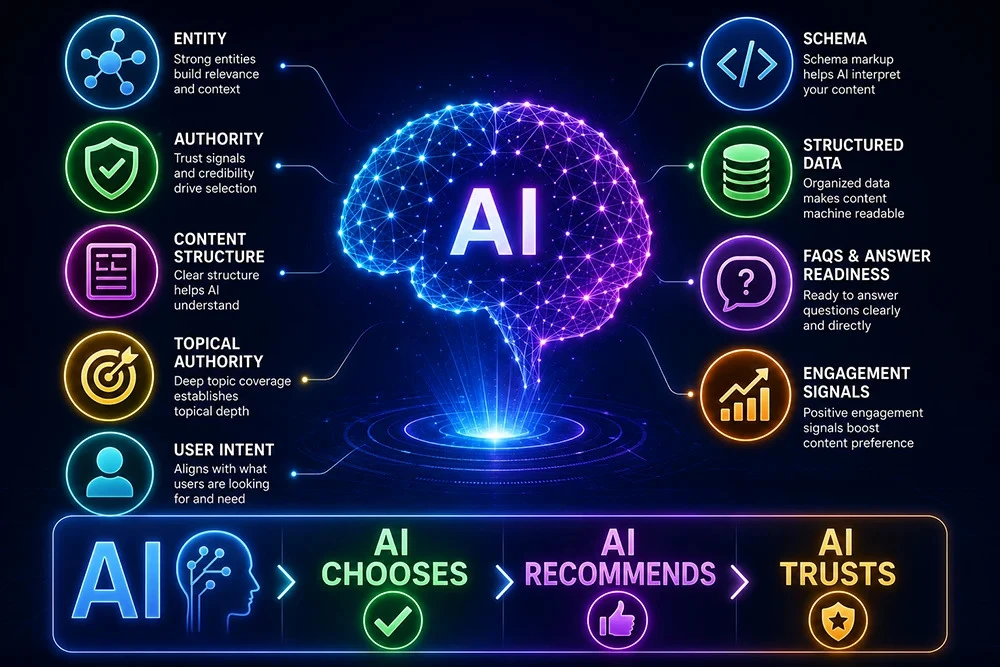
In the rapidly evolving landscape of digital search, the rules of visibility have shifted. Modern search engines and AI-powered answer engines are no longer just scanning for keyword density; they are evaluating entity optimization, semantic relevance, topical authority, structured content, schema markup, content relationships, citation signals, trust indicators, AI retrieval systems, answer engine optimization, contextual relevance, and user intent alignment.
For many business owners and marketers, this transition is a source of significant frustration. You may have invested heavily in high-quality content, only to find that it fails to generate the visibility you expect. This disconnect often stems from a reliance on traditional SEO tactics that ignore the fundamental ways AI systems now process information. Understanding these hidden signals AI uses to choose your content is no longer optional; it is the key to maintaining a competitive advantage in an era where AI determines which content deserves to be surfaced in search results. Businesses that combine AI visibility with systems designed to create sustainable growth and stronger customer relationships in local markets are better positioned to build long-term authority and resilience.
Key Takeaways
- Why entity optimization and semantic relevance change traditional keyword strategy
- How AI-driven search helps solve the pain points of low visibility and poor engagement
- How knowledge graphs, schema markup, and E-E-A-T principles reinforce performance
- What this shift means for authority, content structure, and long-term rankings
Why This Concept Matters
To understand the hidden signals AI uses to choose your content, you must first recognize that AI retrieval systems operate on a foundation of entities rather than just strings of text. An entity is a person, place, object, or concept that the AI can uniquely identify and relate to other entities within a knowledge graph. When you optimize for entities, you are providing the AI with a clear map of your expertise. Instead of focusing on how many times a keyword appears, AI evaluates the context, the depth of your topical coverage, and the strength of the relationships between your content pieces.
By utilizing structured content and schema markup, you explicitly tell the AI what your content is about, who wrote it, and how it fits into the broader industry context. This semantic approach ensures that when a user asks a question, the AI recognizes your content as a trustworthy, authoritative source, significantly increasing the likelihood of your information being selected for an AI-generated answer.
Real-World Example
Consider two companies operating in the same niche. Company A publishes articles targeting specific keywords, hoping to rank through sheer volume and repetition. Their content is isolated, lacking clear connections to other topics or authoritative sources.
Company B, however, takes a different approach. They use structured headings, implement schema markup to define their brand entities, and build content clusters that cover a topic from multiple angles. They use consistent internal linking to show the AI how their pages relate to one another.
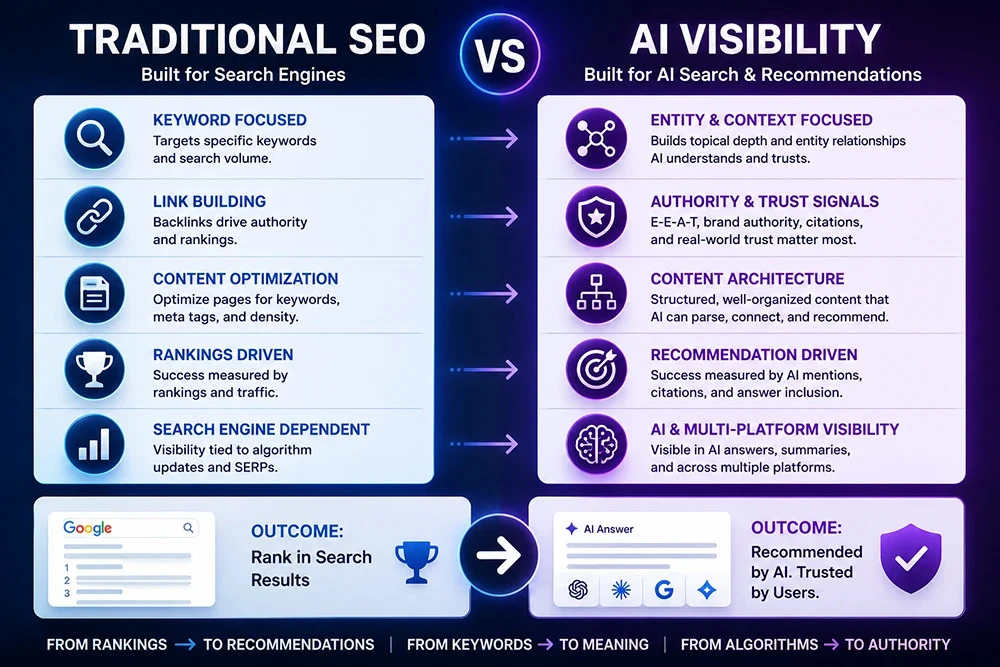
When an AI system evaluates a user query, it looks for the most comprehensive and authoritative answer. Because Company B has established clear contextual relationships and demonstrated deep topical authority, the AI system repeatedly surfaces its content in generated answers, while Company A remains buried in traditional search results and fails to capture the attention of modern, AI-assisted users. Company B’s success illustrates the growing difference between traditional SEO and AI search visibility, where AI systems carry more weight than isolated keyword optimization.
Common Mistakes
Many businesses continue to struggle because they rely on outdated tactics that no longer align with how AI processes information. The most common mistakes include focusing exclusively on keyword volume, publishing isolated articles that do not form part of a larger topic cluster, and ignoring the power of schema markup.
Furthermore, inconsistent branding across platforms, weak internal linking, and a failure to demonstrate expertise, experience, authoritativeness, and trustworthiness (E-E-A-T) can severely limit your visibility. When your content lacks a clear structure or fails to provide the AI with the necessary signals to verify your authority, you are essentially invisible to the systems that power modern search experiences. Avoiding these pitfalls requires a shift in mindset from “ranking for keywords” to “building an authoritative entity.”
What You Should Aim For
Successful AI-driven SEO is defined by semantic depth and clear content architecture. You should aim to create a digital presence that acts as a reliable source of truth for your industry. This involves developing a clear hierarchy of information, where pillar pages provide broad coverage, supporting articles dive into specific sub-topics, and an engineered network of interconnected content built on a high-performance website designed for discoverability and conversions that reinforce authority after AI recommendations.
By strengthening your content relationships and ensuring your brand is consistently represented across the web, you build the trust indicators that AI systems value and reward. The desired outcome is not just a higher ranking, but a consistent presence in AI-generated answers, which builds long-term authority and drives qualified traffic to your business. When you focus on providing value through structured, authoritative, and contextually relevant content, you align your business with the way AI search is designed to function.
Supporting Data & Research
Industry trends consistently show that search engines are moving toward a “zero-click” future where the answer is provided directly on the search results page. This shift to strategies that improve visibility in AI-generated answers and recommendations is driven by the need for efficiency and accuracy. Research into AI retrieval systems indicates that content which is well-structured, uses schema to define entities, and demonstrates high levels of topical authority is significantly more likely to be cited as a source.
Furthermore, the consistency of citation signals—how your business is described and linked to across the web—plays a critical role in how AI determines your trustworthiness. By aligning your content strategy with these technical requirements, you ensure that your business complies with hidden signals AI uses to choose your content and remains relevant as search behavior continues to evolve.
Frequently Asked Questions
What are the primary AI ranking signals?
AI systems prioritize topical authority, entity clarity, semantic relevance, and trust indicators like E-E-A-T. They look for structured data that helps them understand the context and relationships within your content.
How does answer engine optimization differ from traditional SEO?
Traditional SEO focuses on ranking for specific keywords in blue links. Answer engine optimization focuses on providing clear, structured, and authoritative information that AI can easily extract and present as a direct answer to a user query.
Why are entity relationships important for AI visibility?
Entities allow AI to understand the “who, what, and where” of your content. By mapping these relationships, AI can determine how your content connects to broader topics and whether you are a credible authority on the subject.
What is topical authority and how do I build it?
Topical authority is the depth and breadth of your coverage on a specific subject. You build it by creating comprehensive content clusters that address all aspects of a topic, ensuring your site is seen as a go-to resource.
Does schema markup really help with AI search?
Yes, schema markup provides the machine-readable context that AI needs to categorize your content correctly. It helps the AI understand the specific attributes of your business, products, or services.
How do trust signals influence AI rankings?
Trust signals, such as consistent business information, author credentials, and high-quality citations, help AI verify that your content is accurate and reliable, which is essential for being featured in AI responses.
What is semantic SEO?
Semantic SEO is the practice of optimizing content for meaning and intent rather than just keywords. It focuses on how concepts relate to each other to provide a more comprehensive answer to user questions.
How do knowledge graphs affect my visibility?
Knowledge graphs are the databases AI uses to understand entities. If your business is well-defined within these graphs, you are more likely to be recognized as an authority and surfaced in relevant search results.
Why is content structure critical for AI?
AI systems need a clear hierarchy to parse information efficiently. Using proper headings, lists, and structured data helps the AI identify the most important parts of your content for answering user queries.
How can I improve my AI search visibility?
Focus on building topical authority, implementing schema markup, ensuring consistent brand information, and creating content that directly answers the questions your audience is asking.
Webpuzzlemaster SEO Services
Delivered by Webpuzzlemaster Digital Marketing Agency, led by Ruth Kuttler, our team excels at transforming your digital presence into an authoritative entity that AI systems trust and prioritize. The experience and philosophy behind Webpuzzlemaster’s AI-driven search strategies and content architecture ensures that your business is clearly understood by search engines. Our focus on semantic relationships and answer engine optimization is designed to secure a dominant position for our clients in the modern search landscape.
We specialize in AI visibility systems, SEO strategy, structured content development, schema implementation, authority building, conversion-focused websites, automation workflows that connect discovery, engagement, and customer retention, and local business growth solutions.
About the Author
Ruth Kuttler, AI Visibility Engineer™ and Digital Strategy Architect, applies strategies shaped by ongoing training from leading industry experts and real-world implementation across client projects. Specializing in AI visibility, entity-based optimization, content architecture, and advanced search strategy, Ruth helps businesses improve discoverability across both traditional search engines and AI-driven platforms. Her work focuses on understanding the hidden signals AI uses to choose your content, enabling businesses to build stronger semantic relevance, topical authority, and entity relationships that improve long-term visibility. A commitment to building sustainable, authority-driven digital ecosystems is combined with technical precision and a deep understanding of how AI interprets, connects, and values content.
Your Next Step
Schedule an AI Visibility Strategy Session to evaluate your current visibility, identify opportunities for improvement, and understand how a strategic approach supports AI search visibility and long-term business growth