

In high-intent search environments where local service businesses operate, traffic is only half the battle. The Website Performance & Conversion Engine is a user experience strategy that addresses common audience pain points like high website traffic with low conversions and poor mobile usability. It’s a framework built on the understanding that speed, stability, UX clarity, and intent-based design determine whether your website traffic converts into qualified leads or is simply wasted. Without a clear conversion path and friction reduction, even the most visible website will fail to generate revenue, leaving business owners with unqualified leads and confusing navigation that frustrates potential customers.
Key Takeaways
- Why user experience strategy, website performance optimization, and conversion rate optimization directly impact lead quality and conversion.
- How high website traffic with low conversions, high bounce rates, and low ROI are symptoms of a broken user experience.
- How Core Web Vitals, content hierarchy, and strategic CTA placement improve user flow and decision clarity.
- Why performance is a prerequisite for success in SEO, paid advertising, and emerging AI-driven search visibility.
Why This Concept Matters
For local businesses, a customer’s first impression is often digital. Page speed, layout stability, mobile usability, and clear user paths directly influence trust and engagement, especially in high-intent moments when a user needs a service now. A slow, confusing website creates friction and doubt, causing potential customers to leave before they ever contact you. A fast, intuitive experience, however, builds credibility and guides users seamlessly toward a conversion. This is why it’s crucial to focus on how a high-performance website and conversion experience engine is built, as it forms the foundation of all digital marketing efforts.
Real-World Example
A local plumbing company invested heavily in SEO and ranked on the first page for several valuable keywords. They received steady traffic, but their lead volume remained disappointingly low. An audit revealed the core issues: the mobile site took over eight seconds to load, the phone number was buried at the bottom of the page, and a generic “Learn More” button led to a confusing services page. Visitors were arriving with urgent needs but were met with slow performance and unclear messaging. By optimizing image sizes to improve load time, placing a clickable phone number in the header, and changing the primary call to action to “Request Emergency Service,” the business saw a 40% increase in qualified leads within a month without any change in traffic.

Common Mistakes
Many businesses make critical errors that sabotage their conversion potential. The most common mistakes include:
- Designing for aesthetics over clarity: A beautiful site that is hard to navigate will not convert.
- Prioritizing traffic instead of conversions: High traffic numbers are meaningless if visitors don’t become customers.
- Ignoring the mobile user experience: With the majority of local searches happening on mobile, a poor mobile site is a critical failure.
- Creating cluttered page layouts: Too much information or competing calls to action overwhelm users.
- Relying on rankings alone: Achieving a high rank is just the first step; you must convert the traffic you earn, which means re-evaluating what it takes to make local business marketing work in 2025.
What You Should Aim For
Success is measured by tangible outcomes that contribute directly to your bottom line. Your goals should include:
- Fast, stable load performance: Pages should load quickly and be visually stable to meet Core Web Vitals standards.
- Clear value proposition above the fold: Visitors should immediately understand what you do and why they should choose you.
- Friction-free user journeys: Navigation should be intuitive, guiding users to their desired goal with minimal clicks.
- Strong trust and credibility signals: Display reviews, testimonials, and security badges to build confidence.
- One primary conversion goal per page with tracking: Every page should have a single, clear objective that is measured and analyzed.

Supporting Data & Research
Accepted industry principles confirm the importance of performance and UX. Google’s Core Web Vitals (CWV) are ranking factors because they measure real-world user experience, including loading speed, interactivity, and visual stability. Research into mobile behavior shows that users have little patience for slow or clunky sites, often abandoning them within seconds. Furthermore, cognitive principles of attention and decision-making highlight that a clear content hierarchy and a single, prominent call-to-action reduce cognitive load, making it easier for users to convert. A high-performance website is a non-negotiable prerequisite for digital success, especially when ensuring your content is structured for the modern SEO stack for AI search visibility.
Frequently Asked Questions
What is a UX framework?
A UX framework is a structured approach to designing a website that prioritizes the user’s needs and goals, ensuring the experience is intuitive, efficient, and effective at guiding them toward conversion.
Why is website speed so important for my local business?
Speed directly impacts user satisfaction and conversion rates. A slow website frustrates users, especially those on mobile devices with urgent needs, causing them to leave for a competitor’s faster site.
How do I know if my website has a bad user experience?
High bounce rates, low time on page, low conversion rates, and user feedback are all indicators. If you get a lot of traffic but few leads, your UX is likely a problem.
What are Core Web Vitals?
They are a set of specific metrics Google uses to measure a webpage’s overall user experience, focusing on loading speed (LCP), interactivity (INP), and visual stability (CLS).
Can a good design also have bad UX?
Absolutely. A visually appealing website can still be slow, confusing to navigate, or have unclear calls to action, resulting in a poor user experience that fails to convert.
What's more important: getting more traffic or improving conversions?
Both are important, but improving conversions from your existing traffic often provides a higher and more immediate return on investment. A high-converting site makes all your traffic-generating efforts more valuable.
How can I make my website more mobile-friendly?
Focus on a responsive design that adapts to all screen sizes, ensure text is readable without zooming, make buttons and links easy to tap, and optimize images for fast mobile loading.
Where is the best place to put a call to action?
Your primary call to action should be placed prominently “above the fold” so it’s visible without scrolling. It should also be repeated further down the page where relevant.
How does user experience affect my search rankings?
Google’s algorithms reward websites that provide a good user experience. Metrics like Core Web Vitals, mobile-friendliness, and user engagement signals (like bounce rate) can influence your visibility in search results.
What's the first step to improving my site's conversion rate?
Start with an audit. Analyze your website’s speed, mobile usability, and the clarity of your messaging and calls to action to identify the biggest points of friction for your users.
Webpuzzlemaster Website Performance Services
Website performance optimization, UX and conversion strategy, Core Web Vitals improvements, mobile-first website design, lead-focused UX audits, conversion optimization consulting
Delivered by Webpuzzlemaster Digital Marketing Agency, led by Ruth Kuttler, Webpuzzlemaster transforms underperforming websites into high-speed, conversion-focused assets. We diagnose and fix performance bottlenecks, refine user journeys for maximum clarity, and implement a conversion architecture that turns visitors into qualified leads. Our data-driven approach ensures every optimization is measurable, effective, and geared toward creating a powerful local business growth engine in competitive markets. We build websites that don’t just attract traffic—they generate revenue.
About the Author
AI Visibility Engineer™ & Digital Strategy Architect:
As a specialist in high-performance WordPress development, the author architects digital experiences that excel in both technical execution and user-centric design. With deep expertise in UX principles and conversion strategy, they focus on building websites that are not only fast and stable but also intuitively guide users toward business goals. This unique blend of technical SEO and conversion optimization ensures clients achieve measurable growth and a strong return on their digital investment.
Your Next Step
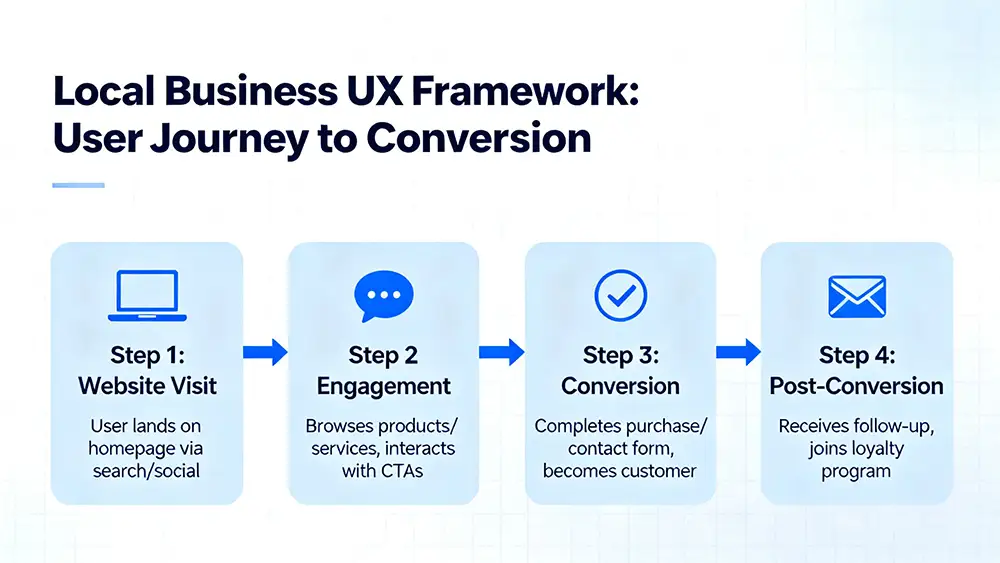
If your website attracts traffic but doesn’t consistently turn visitors into qualified leads, the gap is almost always UX—not visibility. The next step is to evaluate how real users experience your site: page speed, content hierarchy, clarity of messaging, trust signals, and the friction points that cause hesitation or drop-off. A conversion-focused UX framework aligns performance, design, and intent so every visit has a clear purpose. When UX is structured correctly, you don’t need more traffic—you extract more value from the traffic you already have.