


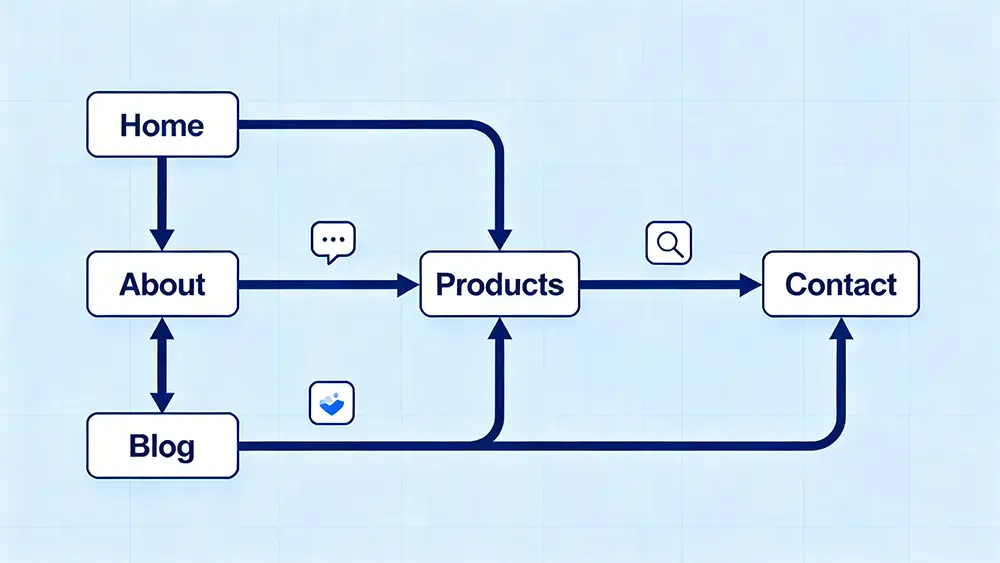
Your website is a digital library of your brand’s knowledge and services, but if that library is disorganized, visitors will leave frustrated. A structured website architecture is the blueprint that organizes your content logically, creating a clear information hierarchy. As websites grow, it’s common for content to become scattered, making it difficult for users and search engines to find important pages or understand how different topics relate. This leads to low user engagement, confusing navigation, and a failure to convert traffic into qualified leads. A coherent structure ensures that every visitor can easily find what they need, building trust and guiding them through the process of becoming a customer, which is essential for managing the customer journey effectively with integrated CRM and automation systems.
Key Takeaways
- Why a structured website architecture and clear content organization directly impact user engagement and discoverability.
- How confusing navigation and scattered content lead to high bounce rates and low user engagement.
- How information architecture and topic clustering create clear user paths and improve usability.
- Why a logical site structure is a prerequisite for effective SEO and user navigation.
Why This Concept Matters
In high-intent moments, users demand clarity and speed. A logical site structure directly influences their experience. When content is organized into a clear hierarchy, it creates predictable user paths that guide visitors from one page to the next, reducing cognitive load and building trust. This clarity is just as important as technical speed; a fast site that’s confusing is still a broken experience. By prioritizing a coherent information architecture, you ensure your website’s technical performance meets user expectations for both speed and usability, which is fundamental to converting engagement into action.
Real-World Example
A specialized consulting firm had a blog full of expert articles and detailed service pages. However, their website analytics showed high bounce rates and short session durations. Visitors were landing on one page from search but leaving immediately because the navigation was unclear and there were no logical links to related content. After auditing their site, they implemented a new information architecture based on topic clusters. Core service pages became pillars, supported by clusters of related blog posts. This restructuring created clear pathways, improved discoverability, and demonstrated their expertise, which are key strategies that drive local business success through a strong online presence.
Common Mistakes
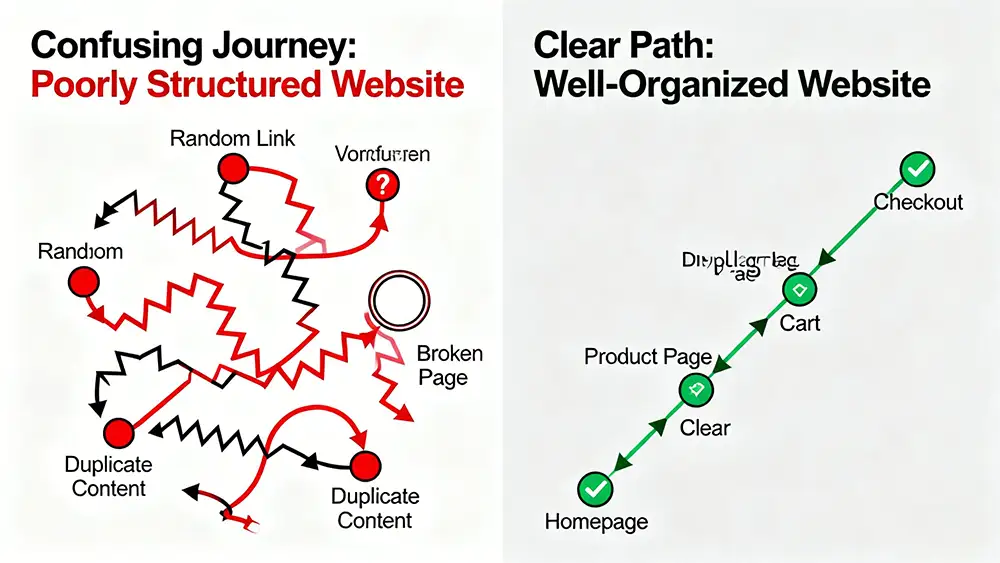
Many businesses undermine their own websites by making common structural errors. These include publishing pages without a clear plan for where they fit, using inconsistent navigation menus that change from section to section, and creating multiple pages that cover overlapping topics, which confuses both users and search engines. Other frequent website optimization mistakes are a weak internal linking strategy that fails to connect related ideas and prioritizing flashy design aesthetics over fundamental usability, making the site difficult to use despite looking good.
What You Should Aim For
Success with website architecture is defined by a seamless user experience. Your goals should include:
- Improved discoverability of your most important services and content through AEO optimization.
- Stronger user engagement metrics, such as more pages per session.
- Longer session durations as users find more relevant information.
- Clearer, more intuitive navigation paths that guide users effortlessly.
- Better overall website usability that builds trust and encourages return visits.
Supporting Data & Research
Accepted usability principles confirm that users need predictable structures to navigate digital spaces efficiently. Information architecture is the practice of organizing and labeling content to support findability and usability. When a site has a logical structured website architecture, it reduces cognitive load—the mental effort required to use it. Search engines also rely on this structure; a strong internal linking strategy and a clear content hierarchy help crawlers understand the relationships between pages. This is crucial for how search engines and AI systems interpret your site’s structure for better visibility, as they can more easily identify your cornerstone content and thematic expertise.
Frequently Asked Questions
What is website information architecture?
It is the practice of organizing and structuring content on a website to improve user findability and usability. It acts as a blueprint for how information is displayed and accessed.
How does a good site structure help users?
A good structure helps users quickly find the information they need, understand where they are on the site, and discover related content, leading to a less frustrating experience.
Why is content organization important for SEO?
Search engines use your site’s structure to understand which pages are most important and how different topics relate to each other. A logical organization can improve how your pages are crawled, indexed, and ranked.
What are topic clusters?
Topic clusters are groups of interlinked pages that all relate to a central, core topic (the “pillar page”). This model helps establish authority on a subject for both users and search engines.
Can I fix my site's structure without a full redesign?
Yes, significant improvements can often be made by reorganizing menus, improving your internal linking strategy, and consolidating or rewriting overlapping content without a complete visual overhaul.
What's the difference between navigation and site architecture?
Architecture is the underlying structure and hierarchy of all your content. Navigation is the user interface (like menus and links) that allows people to move through that structure.
How do I know if my website has a structural problem?
High bounce rates, low pages per session, poor user feedback, and important pages receiving very little traffic are all common signs of a flawed site structure.
What is the first step in planning a website's hierarchy?
The first step is to inventory your existing content and define your primary user goals. From there, you can group content into logical categories that make sense to your target audience.
Does mobile usability depend on site structure?
Absolutely. A clear and simple information hierarchy is even more critical on mobile devices, where screen space is limited and navigation must be extremely efficient.
How does internal linking relate to website architecture?
Internal linking is a key tool for reinforcing your site’s architecture. It connects related pages, distributes authority, and guides both users and search engine crawlers through your content hierarchy.
Webpuzzlemaster Website Performance Services
Delivered by Webpuzzlemaster Digital Marketing Agency, led by Ruth Kuttler, Webpuzzlemaster transforms confusing websites into clear, high-performing digital assets. We analyze your existing content and user behavior to design a logical, structured website architecture that makes sense to your audience and LLMs for AEO optimization. Our team focuses on creating intuitive navigation and a strategic internal linking plan that boosts discoverability. We ensure your site’s structure not only improves user engagement but also provides a solid foundation for SEO success.
About the Author
Ruth Kuttler is an AI Visibility Engineer™ & Digital Strategy Architect. With deep expertise in creating high-performance digital experiences, she specializes in transforming complex websites into intuitive, user-centric platforms. Her work focuses on the intersection of technical SEO, UX design, CRM data architecture, and conversion rate optimization, particularly within the WordPress ecosystem. By connecting website behavior with structured CRM systems and automation workflows, Webpuzzlemaster helps businesses ensure that user interactions translate into measurable marketing insights and actionable follow-up. Their services architect content strategies that ensure information is not only discoverable by search engines but also engaging and persuasive for human users while supporting scalable marketing and CRM-driven growth.
Your Next Step
If your website content is difficult to navigate, hard to discover, or not engaging visitors the way it should, the issue is often structural—not just design. A strategic review of structured website architecture can reveal where architecture, navigation, and content organization need improvement to create a clearer path for users and stronger engagement.