

If your content ranks well in traditional search but disappears in AI-generated answers, you’re facing a common and frustrating challenge. Many businesses suffer from inconsistent visibility because their content isn’t built for modern discovery. The AI Visibility Engine™ addresses this by implementing a structured content architecture. In today’s digital landscape, AI-driven search, answer engines, and generative results rely on semantic understanding, entities, and contextual relationships—not just keywords. A structured approach ensures your content is machine-readable, making it a prime source for AI systems to use when answering user queries.
Key Takeaways
- Structured content architecture redefines traditional keyword-based SEO by focusing on meaning and relationships, not just search terms.
- Content that ranks but lacks structure often fails to appear in AI-generated answers, limiting visibility where it matters most.
- A clear content hierarchy, logical internal linking, and schema-aligned structure strengthen your authority, trust, and machine understanding.
- Modern visibility depends on structure, context, and entities, as AI systems prioritize comprehension over simple keyword matching.
Why This Concept Matters
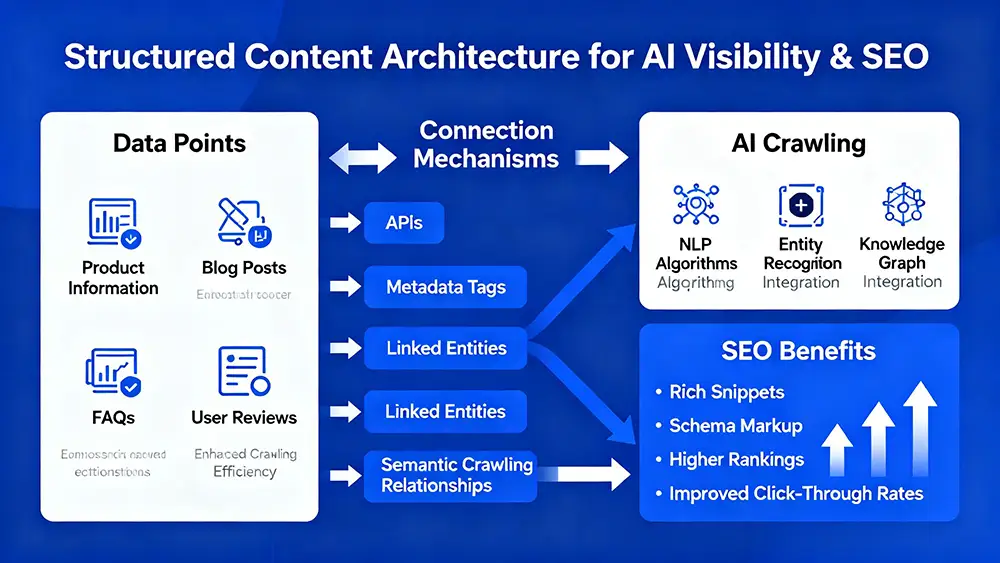
Modern search systems have evolved beyond ranking a list of webpages. They now function as understanding engines, evaluating entities (people, products, concepts), their relationships, and the context surrounding them to deliver direct answers. Content optimized only for keywords fails this test because it lacks the semantic depth required for an AI to synthesise a comprehensive response. A structured content architecture provides a clear, logical roadmap for machines to follow, defining what your content is about, who it’s for, and why it’s authoritative. This evolution requires a new approach, one that involves embracing AEO, GEO, and structured content for AI search to stay competitive.
A local service business invested heavily in SEO and achieved strong keyword rankings for terms like “best plumber near me.” However, they noticed a steady decline in website traffic. The reason? AI-driven search results began providing users with direct answers, complete with business hours, service lists, and customer ratings, pulling this information from competitors’ websites. While the business’s content was keyword-rich, it was unstructured. In contrast, their competitors used entity-based optimization and schema markup, making their data easy for AI to parse, package, and present as the definitive answer, effectively bypassing the need for users to click through to a website.
Common Mistakes
Many businesses unknowingly sabotage their AI visibility by clinging to outdated practices. Common mistakes include:
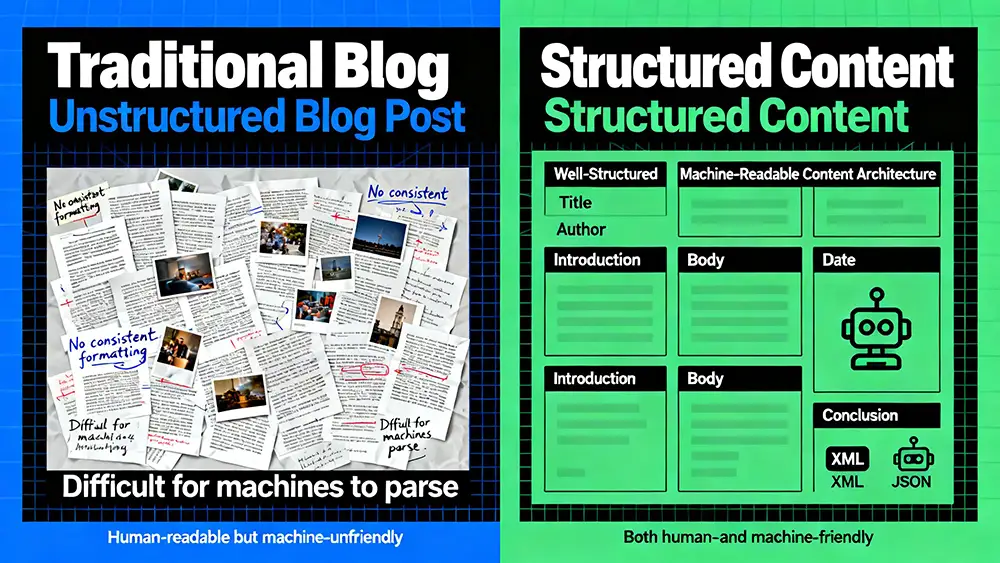
- Publishing unstructured blog posts: Creating long walls of text without clear headings, lists, or semantic organization.
- Relying solely on keywords: Focusing on keyword density while ignoring the underlying intent and contextual relationships.
- Ignoring entity relationships: Failing to connect content in a logical way that defines what your brand is and what it offers.
- Over-optimizing for rankings: Chasing traditional ranking signals instead of focusing on clarity and machine comprehension.
These mistakes are particularly damaging for local businesses that need clear, authoritative signals to stand out, which is why many now seek innovative local SEO services designed to beat competitors in a crowded market.
What You Should Aim For
Success in the age of AI search is defined by clarity and authority. Your goal is to create a digital presence that both humans and machines can understand and trust. This includes:
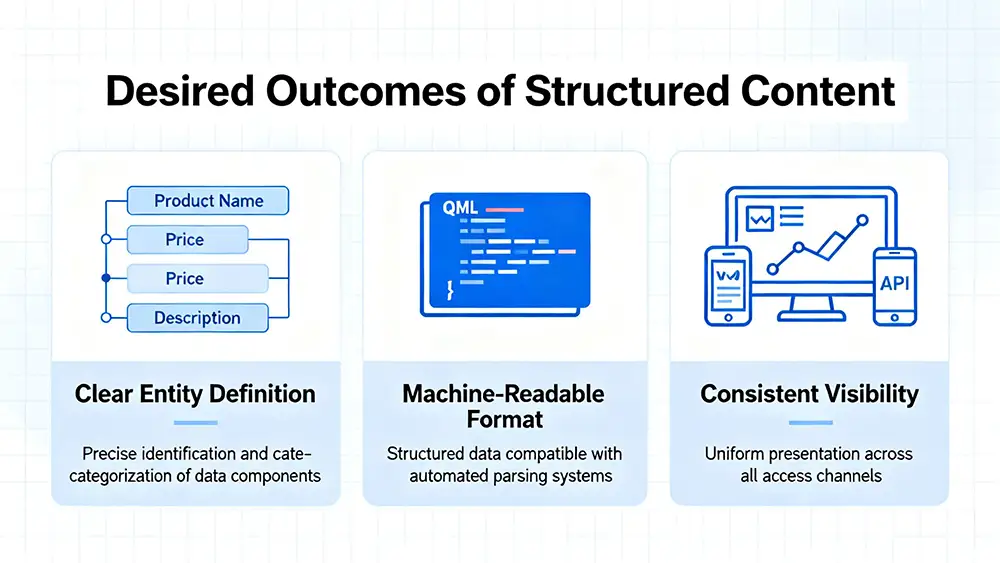
- Clear entity definition and alignment: Explicitly defining who you are, what you do, and who you serve.
- Structured, machine-readable content: Using schema, logical hierarchies, and semantic HTML to make your content easy to parse.
- Intent-matched information architecture: Organizing your website around the questions and needs of your audience.
- Consistent visibility across search and answer engines: Appearing reliably wherever your audience seeks information.
- Trust signals AI systems recognize: Building authority through consistent, well-structured, and interconnected content.
Ultimately, the goal is to create a fast, high-performing website that retains more visitors and converts more leads because it delivers value in a way that both users and machines understand.
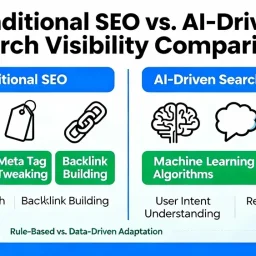
Accepted principles in computer science and information retrieval confirm that search is moving decisively toward semantic understanding. AI systems, including large language models, are trained to recognise patterns, context, and relationships within data. Structured content, particularly when enhanced with schema.org vocabulary, provides explicit contextual signals that help these systems categorise and validate information with higher confidence. Unlike keyword-based indexing, which primarily matches strings of text, entity-based indexing builds a knowledge graph of your digital presence. This makes it easier for an AI to see your business not just as a collection of pages, but as an authoritative entity on a specific topic. It’s crucial to understand how traditional SEO that optimizes for algorithms differs from AI search, focusing on semantic understanding, to adapt your strategy effectively.
Frequently Asked Questions
What is a structured content architecture?
A structured content architecture is a method of organizing your website’s information in a logical, hierarchical, and machine-readable format. It focuses on defining entities and their relationships to help AI and search engines understand your content’s meaning.
How does structured content help with AI visibility?
AI systems need to understand content, not just index keywords. Structured content provides the clear, contextual signals that AI uses to formulate answers, making it more likely your information will be featured in generative results.
What is the difference between SEO and Answer Engine Optimization (AEO)?
SEO traditionally focuses on ranking webpages in search results. AEO focuses on making your content the source for direct answers provided by AI and voice search platforms.
Can I have good SEO but bad AI visibility?
Yes. Your pages might rank high in traditional search results, but if the content is unstructured, AI systems may not be able to parse it to generate an answer, making you invisible in AI-driven results.
What is entity SEO?
Entity SEO is the practice of optimizing your content around concepts, people, places, and things (entities) rather than just keywords. It helps search engines build a deeper understanding of your brand and expertise.
Why is semantic search important for my business?
Semantic search is how modern search engines understand user intent and the meaning behind queries. Optimizing for it ensures you connect with users based on what they mean, not just what they type.
Is keyword research still relevant with AI search?
Yes, but its role has evolved. Keyword research is now used to understand user intent, topics, and questions, which then informs your structured content architecture, rather than for simple keyword stuffing.
What is the first step to creating a structured content plan?
The first step is to define your core business entities. Clearly identify what your business is, the services or products you offer, your location, and the expertise you hold.
How does schema markup fit into this?
Schema markup is a form of code (microdata) that you add to your website to provide explicit information to search engines. It’s a powerful tool for translating your content into a machine-readable format.
Will AI replace traditional search engines?
AI is not replacing search engines but transforming them into answer engines. The familiar search bar will remain, but the way results are delivered will continue to shift toward direct, synthesized answers.
Webpuzzlemaster AI Visibility Services
Webpuzzlemaster helps businesses design structured content architectures that align SEO, AI visibility, and answer engine discovery into a single, sustainable system.
Delivered by Webpuzzlemaster Digital Marketing Agency, led by Ruth Kuttler. our approach involves a deep analysis of your business entities, customer intent, and competitive landscape. We then design and implement a content framework that uses semantic structure and machine-readable signals to build lasting authority. This ensures your expertise is not just seen but understood by AI systems, positioning you as the definitive answer for your audience.
About the Author
Ruth Kuttler is an AI Visibility Engineer™ and Digital Strategy Architect focused on structured content systems that align SEO, AEO, and AI-driven discovery.
Ruth specializes in translating complex business offerings into clear, machine-readable entities that search and answer engines can easily interpret. Her work focuses on building digital platforms where content is architected for both human engagement and AI comprehension. This dual focus helps clients achieve sustainable visibility in an evolving digital landscape.
Your Next Step
If your content feels scattered, underperforming, or invisible in AI-driven results, it’s time to stop publishing randomly and start architecting strategically. Structured content isn’t about writing more — it’s about building authority with intention.
The next step is to assess whether your current content structure clearly communicates expertise, entity relevance, and service alignment to both search engines and AI systems. When your architecture is intentional, visibility compounds. When it’s not, even strong content underperforms.
If you’re ready to turn your website into a structured authority engine instead of a collection of disconnected pages, book a strategy session and we’ll map out the architecture required to strengthen both SEO performance and AI visibility.