

Introduction
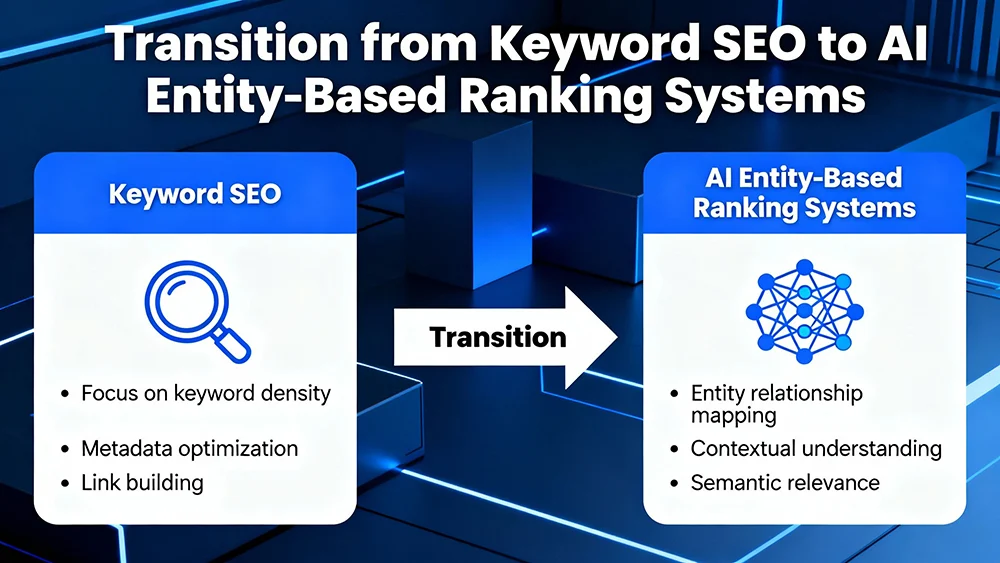
The rise of the AI Visibility Engine™ marks a seismic shift in how search engines select businesses for top rankings. Gone are the days when stuffing pages with keywords was enough. Now, AI entity-based SEO, entity recognition, semantic search, contextual relevance, intent modeling, knowledge graphs, and structured content architecture have taken center stage. For local businesses, professional service firms, and B2B companies, the landscape of modern discovery platforms such as search and answer engines is driven by AI—where visibility depends on how clearly a business’s core entities and relationships are defined. This transition addresses audience pain points like ranking volatility, declining organic traffic, and confusion about what search engines actually reward. In a world where keyword reliance fades, clarity and context reign supreme for sustainable, future-proof visibility.
Key Takeaways
- Why AI entity-based SEO, semantic search, entity recognition, and contextual relevance redefine keyword-based SEO
- How the AI Visibility Engine™ solves challenges like ranking volatility, missed traffic, and keyword-based underperformance
- How do supporting concepts such as entity mapping, topical authority, schema, structured data, advanced internal linking, and answer engine optimization strengthen discoverability and search intent alignment
- What this new paradigm means for content structure, authority, trust, and cross-platform ranking
Why This Concept Matters
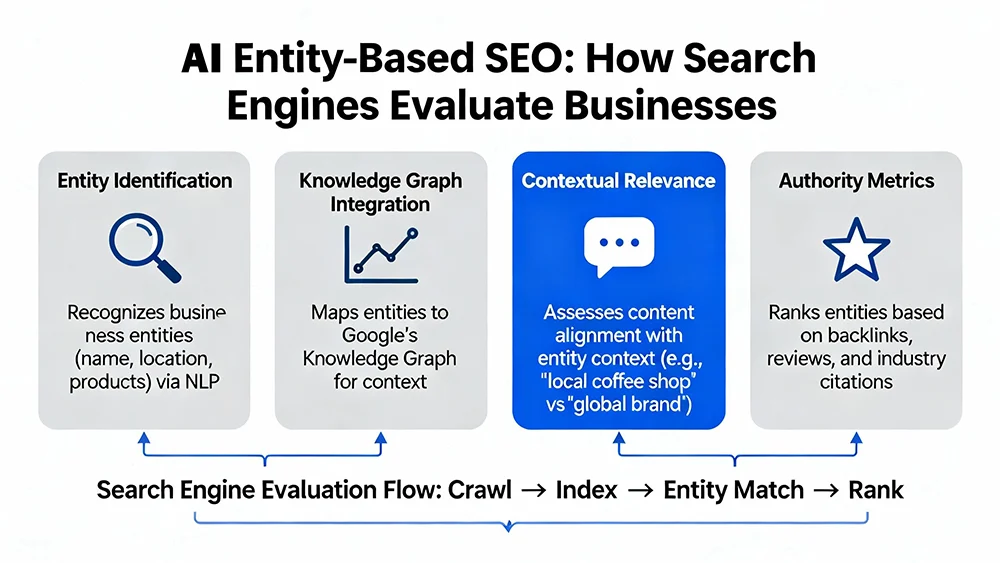
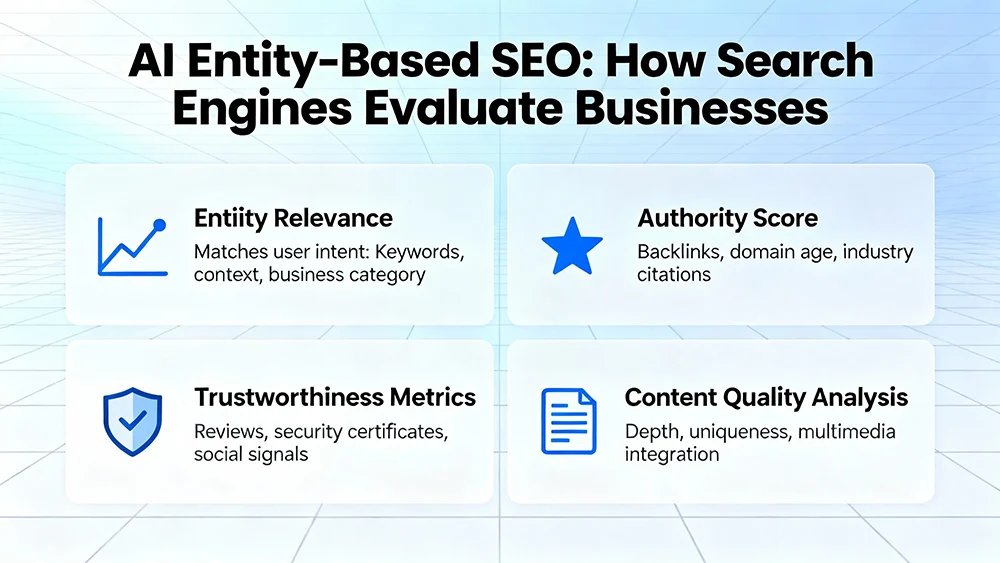
AI entity-based SEO is revolutionizing digital marketing. Modern search systems don’t simply count keywords; they evaluate entities, context, relationships, and the nuances of user intent. Through advanced capabilities—entity recognition, semantic analysis, and knowledge graphs—AI understands the true meaning behind content and actively rewards businesses that organize information around distinct entities and their relationships.
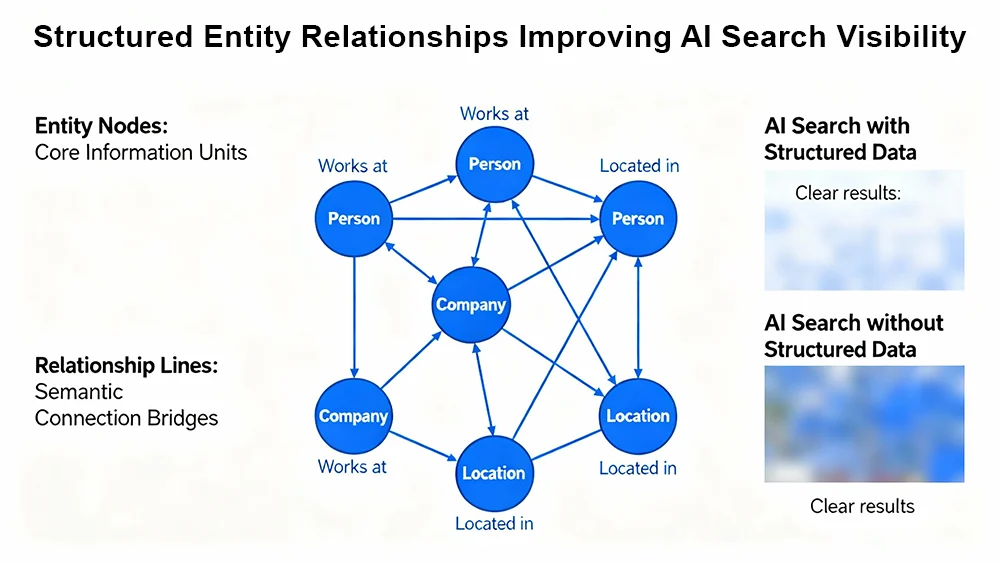
Entities are the tangible things—your business, your services, specific products, locations, and even your team—that carry meaning. AI connects these dots, looking for structured clarity and context. Relational context (how your business, services, and locations are interlinked) becomes a major ranking signal, outpacing simple keyword repetition. This shift especially impacts local businesses and B2B companies, where competing for visibility means standing out in an AI-evaluated landscape. Structured content, entity mapping, and intent-driven design are now essential, pushing brands toward higher trust, authority, and discoverability.
Real-World Example
Take, for example, a business that relies heavily on keyword-optimized pages. They regularly publish blog posts targeting trending industry terms, hoping to outrank competitors. Despite their efforts, rankings stagnate—and competitors with fewer keywords, but clearer entity signals and organized content, consistently rise.
Real change begins when the business restructures its web content. Instead of scattered keyword repetition, they focus on clarifying: who they are, what services they offer, specific locations they serve, and any key relationships or differentiators. They implement schema and structured data, establish an intuitive internal linking strategy, and map out content to cover all relevant topics and relationships. The result?
Search engines—and AI-powered answer systems—now understand, trust, and prioritize their brand. Rankings climb. Qualified, high-intent traffic flows in. This scenario plays out repeatedly, proving that AI-driven search rewards precise entity signals and contextual clarity over raw keyword volume.
Common Mistakes
Many businesses still fall into classic SEO traps:
- Over-optimizing for keywords, sacrificing natural readability and context
- Publishing disconnected content that leaves search engines confused about core business offerings
- Weak entity clarity—failing to define what the business is and does in clear, structured language
- Ignoring internal linking, missing chances to reinforce relationships between key pages
- Failing to add structured data (schema) to crucial web assets
- Leaning on outdated SEO tactics that no longer move the needle in AI-driven search environments
These mistakes result in content that underperforms, even as competitors optimize around stronger entity and intent signals. The outcome: declining rankings and missed visibility, particularly across AI-powered answer engines where precision and context matter most.
What You Should Aim For
Here’s what successful AI-driven visibility looks like:
- Clear entity signals—Your business, services, products, and expertise are unmistakably defined and mapped.
- Structured content architecture—Content is organized for both users and machines, using schema and internal linking to highlight entity relationships.
- Intent-aligned pathways—Visitors and search engines find logical, intuitive routes through your offerings, matching real user needs.
- Strong semantic coverage—You address the full spectrum of related concepts and topics, building topical authority.
- Visibility across search and answer engines—Your business appears not just in search—but in AI-generated answers, featured snippets, maps, and discovery platforms, securing durable, high-intent traffic.
Supporting Data & Research
While concrete statistics are best sourced from independent research, the industry-wide consensus is clear: AI search algorithms now prioritize structured data, semantic clarity, and relationship mapping above keyword density. Google’s advances in natural language processing (like BERT and Knowledge Graphs) and the rise of answer engines underscore this shift. Leading studies suggest that the best-performing content in AI-driven search environments is:
- Highly structured and enriched with schema markup
- Rich in clear entity signals and linked concepts
- Designed for answer extraction and contextual search
- AI’s capacity to model user intent and recognize relationships makes entity-based SEO the backbone of modern digital visibility strategies.
Frequently Asked Questions
What is AI entity-based SEO?
AI entity-based SEO is a strategy that optimizes website content around clear, machine-readable entities (like businesses, services, products, and locations) instead of just keywords. This helps search engines and AI understand and trust your brand.
Why are entities more important than keywords in modern SEO?
Entities convey meaning and relational context. AI and search systems now reward clarity and relationships over mere keyword use, improving visibility in both search results and answer engines.
How does entity mapping impact rankings?
Entity mapping organizes content so that search engines fully understand the who, what, and where of a business. Strong mapping leads to better topical authority and improved rankings.
What role do knowledge graphs play in SEO?
Knowledge graphs connect entities and their attributes. When your content fits into these graphs, you’re more likely to be recognized as an authority by search and AI-powered systems.
Why is structured data (schema) critical for AI visibility?
Schema makes it easier for AI to interpret, display, and rank your content. It enables features like rich snippets, knowledge cards, and improved answer engine placement.
What does answer engine optimization mean?
Answer engine optimization ensures your content is structured, clear, and comprehensive enough to appear in featured snippets, voice search, and AI-generated answers.
How does internal linking help entity-based SEO?
Strategic internal links highlight relationships between topics and services, reinforcing your site’s structure and clarifying key entities for search algorithms.
Are traditional keyword tactics still useful?
Keywords matter for context but are not enough alone. Authority now comes from entity clarity, topical depth, and structured architecture that aligns with search intent.
What’s the impact of ignoring entity SEO?
Failing to provide clear entity signals results in missed rankings, lost traffic, and absence in AI-powered answers, leaving your brand invisible to future customers.
How can businesses get started with entity-based SEO?
Begin with an entity audit: map your core services, products, and locations. Build structured content architectures, implement schema, and strengthen your internal linking to reinforce relationships and intent alignment.
Webpuzzlemaster SEO Services
AI Visibility Engine™ services including entity-based SEO strategy, structured content architecture, internal linking frameworks, schema implementation, and AI-ready optimization designed to improve rankings across search and answer engines.
Led by Ruth Kuttler, Webpuzzlemaster Digital Marketing Agency delivers expert, AI-driven optimization for businesses serious about competing and winning in modern AI-powered discovery environments. Each strategy is tailor-built to maximize clarity, authority, and reach. Their proven systems help companies realize consistent rankings and durable growth across both classical search and emerging answer engines.
About the Author
Written by Ruth Kuttler, AI Visibility Engineer™ & Digital Strategy Architect – Ruth Kuttler is a recognized authority in AI, SEO, and advanced digital strategy. Her experience in designing powerful, future-proof SEO systems helps businesses adapt, thrive, and lead in an ever-evolving digital marketplace. She brings deep knowledge of AI-powered search, content engineering, and business growth.
Your Next Step
BOOK AN AI VISIBILITY CONSULTATION
Get a strategic assessment of how AI systems interpret your brand, content, and entities—and walk away with a clear roadmap to improve rankings, authority signals, and long-term discoverability.