


The digital landscape is evolving faster than ever, especially for local businesses, professional services, healthcare providers, retailers, and regional brands striving for high-intent search visibility. Many in your position are feeling the pressure: organic traffic is flat or declining, keyword rankings are volatile, and it’s tough to break into prominent AI answer boxes. Meanwhile, competitor content seems to get the AI spotlight you’re vying for, wasting your time and resources on content that falls short.
Enter the AI Visibility Engine™—a holistic approach that harnesses the power of AI visibility, entity-based SEO, semantic search, answer engine optimization (AEO), and dual-engine optimization (for Google and Bing/Copilot). This new paradigm doesn’t just focus on keywords but connects structured content, entity mapping, and contextual relationships that enable AI-driven search engines to understand, trust, and favor your business. As AI shapes the way consumers seek and receive answers, your ability to compete hinges on aligning with these modern frameworks.
Key Takeaways
What you’ll learn:
- Why AI visibility, AI Visibility Engine, entity-based SEO, semantic search, answer engine optimization, and dual-engine optimization are redefining keyword strategy
- How the AI Visibility Engine™ directly addresses pain points like flat traffic, inconsistent rankings, and poor AI answer box visibility
- How supporting concepts like structured content architecture, topical authority hubs, and internal linking frameworks dramatically improve discoverability and intent alignment
- What this shift means for building semantic structure, logical hierarchy, and digital authority—all critical for thriving in today’s answer-driven search landscape
Why This Concept Matters
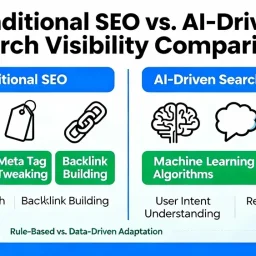
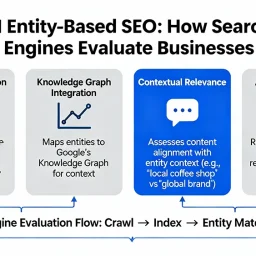
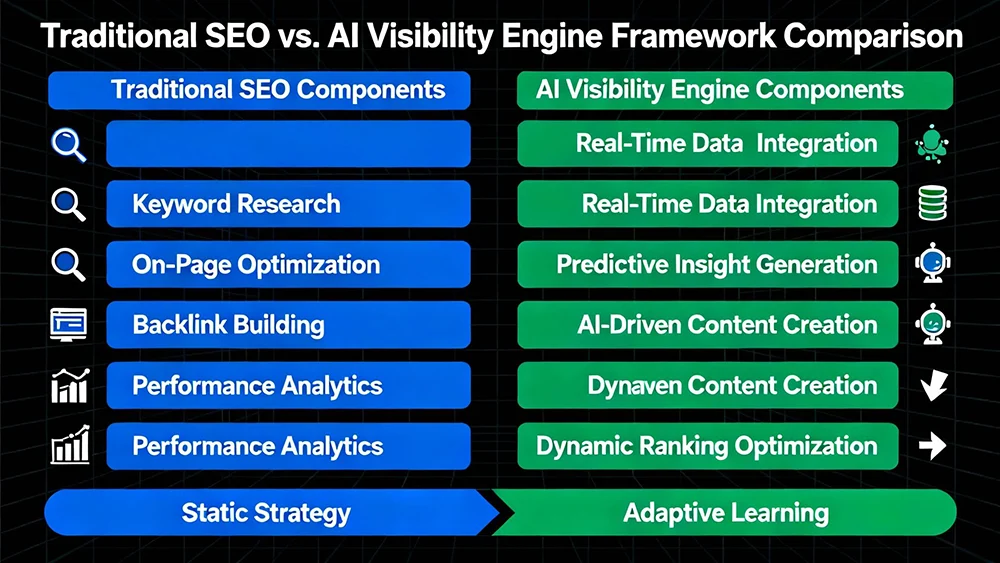
Traditional SEO relied on keyword frequency, backlinks, and technical on-page factors. Today, search engines powered by AI assess your entire digital presence through a deeper lens. The AI Visibility Engine™ is designed around core AI SEO practices such as entity-based optimization and semantic search. These engines don’t just parse keywords: they evaluate entities (distinct concepts and people, places, services), relationships among topics, context of your content, and how well it aligns with user intent.
Google, Bing, and especially AI-powered answer engines like Copilot are trained to seek structured information and map the relationships between your business, your offerings, and the broader topical landscape. If your website lacks semantic depth, well-defined entities, and contextual structure, you’re invisible to these intelligent systems.
The AI Visibility Engine™ ensures you’re building content and data in a way that modern search and answer engines prefer. It increases your chances of being present not just in traditional rankings but also in highly coveted AI-generated answers—exactly where today’s prospective customers are making decisions.
Real-World Example
Imagine a regional service business that spent years investing in classic keyword-targeted content and sporadic blog posts. Despite previous SEO wins, their rankings started slipping, and traffic plateaued. Even worse, their visibility in AI-powered answer engines was almost nonexistent—while competitors with less history appeared prominently in AI answers and knowledge panels.
Upon examining their strategy, they realized AI search and answer engines now prioritized well-structured, entity-rich, and authoritative content. They embraced the AI Visibility Engine framework:
- Mapped Out Key Entities: Identified and clarified their service categories, brand expertise, locations, and related topics—building structured profiles for each.
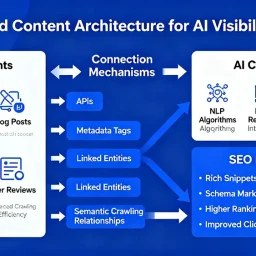
- Rebuilt Content Architecture: Organized their web content into topical authority hubs, ensuring every piece was interlinked and reinforced by related subtopics and FAQs.
- Added Layered Internal Linking: Connected content throughout their site to build context, reinforce themes, and guide users (and AI) along clear intent-aligned pathways.
- Employed Structured Data: Incorporated schema and structured markup so AI engines could easily parse details and relationships.
Soon after, they observed:
- Rapid emergence in AI-generated answer boxes
- Steady improvements in both Google and Bing/Copilot rankings
- Return of qualified, high-converting leads
- Sustainable, multi-channel search visibility—the kind that doesn’t evaporate overnight
Common Mistakes
Many businesses still fall into classic SEO traps, missing out on the power of modern AI search. Examples include:
- Obsessing over keyword density rather than mapping and clarifying core entities
- Publishing isolated one-off blogs with no clear topical hierarchy or authority hubs
- Ignoring key entities and failure to establish relationships among content, resulting in missed ranking and answer box opportunities
- Weak or absent internal linking frameworks, letting content languish unseen
- Repetitive or thin content that lacks semantic value and depth
- Treating Google as the only engine that matters, overlooking Bing, Copilot, and their rising AI answer engines
Clinging to outdated, siloed content often results in flatlined or declining organic traffic, content that never breaks through, and wasted resources that don’t drive real results.
What You Should Aim For
To thrive in today’s search environment, aim for:
- Entity-rich Topical Architecture: Clearly identify and map all key entities central to your brand, services, and industry niches, then build content organized around these entities.
- Structured Content Hierarchy: Design your website and content with explicit hierarchy—category pages, subtopics, FAQs, and supporting resources that reinforce main topics.
- Intent-aligned Pathways: Connect user journeys throughout your site so both humans and AI engines can follow natural information paths from one question to the next.
- Semantic Depth & Topical Authority: Go beyond superficial topics by providing in-depth, authoritative answers within your subject areas. Demonstrate real expertise and comprehensive coverage.
- Visibility Across Both Search & Answer Engines: Optimize for both traditional search and AI answer engines like Copilot and Bing, not just Google. This expands reach and future-proofs your digital presence.
- Consistent Authority Signals: Use structured data, schema, and smart internal linking to signal trust, expertise, and relevance to AI-powered algorithms.
These practices collectively drive multi-engine consistency, stable rankings for critical high-intent topics, and better quality leads. The AI Visibility Engine approach ensures you’re designing your digital strategy to work with the machines interpreting and recommending your business.
Supporting Data & Research
Industry trends clearly indicate a monumental shift:
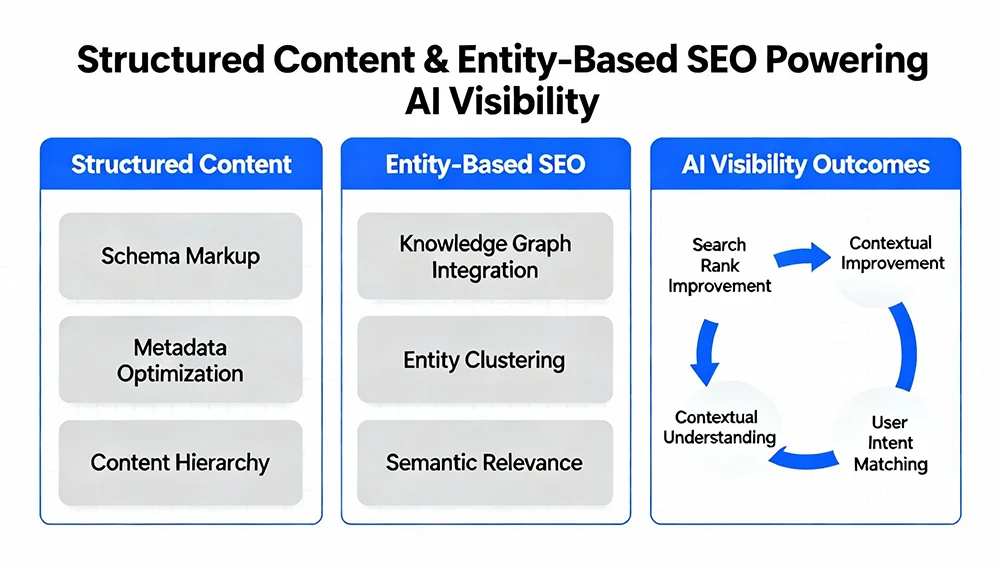
- AI-powered search engines increasingly favor structured content and clear entity mapping. It’s not about keyword stuffing, but about having well-organized knowledge graphs, schema, and topical hubs.
- Answer Engine Optimization (AEO) is rising. Over half of searchers now prefer direct, AI-generated answers, especially on newer platforms and mobile assistants.
- Semantic relevance is surpassing mere keyword matching. Engines reward sites that demonstrate topic authority, coherence, and real expertise on mapped entities.
- Internal linking frameworks are essential for telling AI how content relates. They strengthen both user journeys and machine understanding.
- Dual-engine SEO (Google + Bing/Copilot) is the future. Neglecting Bing’s AI and Microsoft Copilot means missing out on growing answer engine audiences. Multi-engine strategies are proving vital for competitive visibility.
Forward-thinking businesses are investing now to revamp their content architectures around these principles, rather than risk falling behind as search transitions into its AI-first era.
Frequently Asked Questions
Why isn’t traditional SEO enough in 2025?
Because AI engines prioritize entity structure, relationships, and semantic context, not just keyword frequency or backlinks.
What is the AI Visibility Engine?
A systematic framework that merges entity SEO, structured content, and answer engine optimization for visibility across Google, Bing, Copilot, and beyond.
How does AI visibility work?
It’s about aligning your content ecosystem so AI search and answer engines can understand, trust, and promote your brand as an authoritative answer source.
What’s the difference between keyword SEO and entity SEO?
Keyword SEO targets specific phrases; entity SEO maps and clarifies core concepts, relationships, and context for better semantic alignment.
What is Answer Engine Optimization (AEO)?
AEO is optimizing your site so AI-powered engines (like Bing and Copilot) can extract, assemble, and feature your content in instant answers.
Why do I need a dual-engine SEO strategy?
Google isn’t the only game in town—focusing on both Google and Bing/Copilot doubles your AI answer opportunities and audience reach.
How do I structure my content for AI search?
Use clear hierarchies, topical hubs, schema, and internally linked context to make relationships explicit for AI engines.
What are common pitfalls hurting AI-driven visibility?
Unstructured blogs, poor mapping of entities, weak internal links, and neglecting dual-engine optimization.
How can I future-proof my SEO?
Build around the AI Visibility Engine: map entities, architect topic clusters, layer structured data, and optimize for both search and answer engines.
When should a business implement an AI Visibility Engine?
Now—if your traffic or rankings are flatlining or you want to capitalize on tomorrow’s AI-driven search opportunities before the competition does.
Webpuzzlemaster SEO Services
Our AI Visibility Engine™ combines entity-based SEO, answer engine optimization, structured content systems, and dual-engine strategy for Google and Bing/Copilot. We architect your content, data, and technical foundations so AI-powered search and answer engines can clearly understand, trust, and consistently surface your brand – delivered by Webpuzzlemaster Digital Marketing Agency, led by Ruth Kuttler, your AI Visibility Engineer™ & Digital Strategy Architect.
Beyond our AI visibility frameworks, Webpuzzlemaster integrates complementary services that work together to strengthen your market presence — including entity-driven SEO strategy, structured content architecture, WordPress performance optimization, metadata and schema development, CRM and automation alignment, and local visibility enhancements across Google and Bing. By unifying your website, content, and customer journey, we help you build a durable authority signal that improves search rankings, increases engagement, and supports stronger conversions across every digital channel.
About the Author
Written by Ruth Kuttler, AI Visibility Engineer™ & Digital Strategy Architect, is an AI SEO strategist specializing in entity-based optimization and intelligent content systems.
Your Next Step
If you suspect traditional SEO is holding you back, it’s time to design an AI Visibility Engine around your business, offers, and market.