


Introduction
Are you noticing a frustrating trend? Your keyword rankings seem solid, but your website traffic is flatlining, and the quality of your leads has taken a nosedive. This is a classic symptom of an outdated SEO strategy clashing with the new reality of AI-driven search visibility systems. The digital landscape has fundamentally shifted. Search engines no longer just match keywords; they understand concepts, context, and relationships. To succeed in this new era, you need to evolve beyond classic SEO and embrace the AI Visibility Engine™ Framework.
This framework is a systemic approach designed for how modern discovery platforms—from Google’s AI Overviews to Perplexity—actually work. It’s built on core principles like entity recognition, structured content architecture for AI systems, and semantic authority. Instead of just telling search engines what you do, you’re building a machine-readable knowledge base that proves who you are and why you’re the authority.
For businesses struggling with inconsistent results, understanding the difference between traditional SEO and AI search is the first step toward regaining control through an AI visibility strategy. The future of discoverability relies on a modern SEO stack that prioritizes entity mapping and structured data.
Key Takeaways
- A New Foundation: Core concepts like entity recognition, semantic search, and topical authority have replaced keyword density as the primary drivers of visibility. It’s about what you mean, not just what you say.
- Solving Modern Pain Points: The AI Visibility Engine™ Framework directly addresses declining visibility and poor lead quality by aligning your entire digital presence with how AI systems process information and determine authority.
- Strengthening Discoverability: Supporting elements like schema markup, a robust internal linking architecture, and excellent website performance are no longer optional. They are the technical foundation for building trust with search engines.
- A Shift in Mindset: This evolution requires a change from simply creating content to engineering a structured, authoritative knowledge base about your brand. Your content marketing must be designed for brand growth within this new context.
Why This Concept Matters
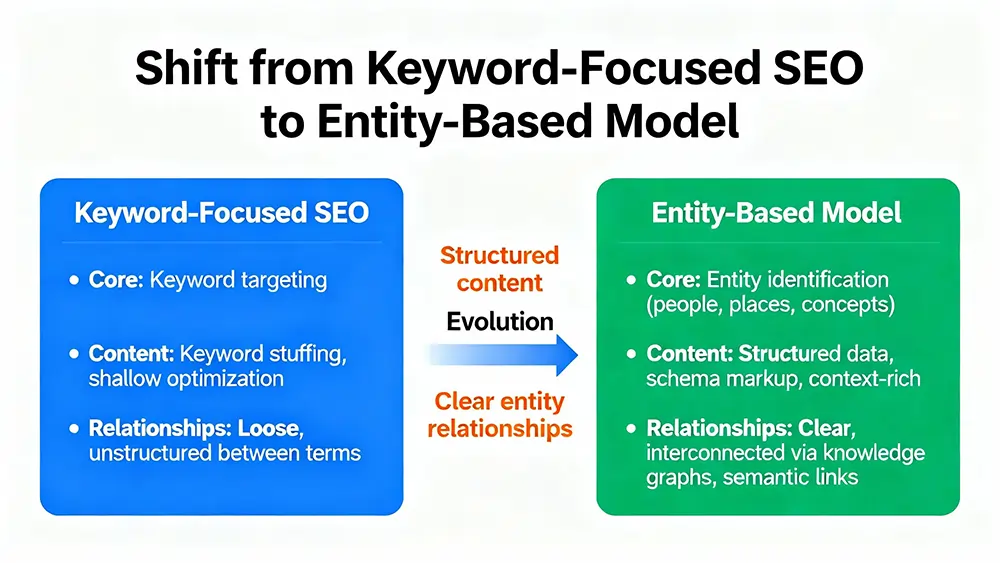
For years, SEO was a game of keywords. Today, it’s a game of entities. An entity is any well-defined person, place, organization, or concept that a search engine can uniquely identify. Think of Google’s Knowledge Graph as a massive, interconnected encyclopedia of these entities. The goal of the AI Visibility Engine Framework is to ensure your business, services, and expertise are clearly and authoritatively represented within that encyclopedia.
This is achieved through semantic search optimization. Instead of creating dozens of pages to target slight variations of a keyword, you build a comprehensive, authoritative resource around a core topic or entity. This demonstrates topical authority and helps AI systems understand the full context of what you offer. For example, a local business can’t just rank for keywords; it must become the definitive entity for its services in its area. This is the principle behind our innovative local SEO services and the core of local business growth through entity authority. When AI understands your entity and its relationships to other concepts, your visibility becomes more resilient and far-reaching.
Real-World Example
Consider a B2B software company that had strong rankings for the legacy keyword “enterprise data management.” Despite this, they were consistently absent from AI-generated answers and competitor comparison features on search results pages. Their traffic was high, but the leads were unqualified. An audit revealed their website was a collection of disconnected blog posts and landing pages, each targeting a different keyword.
Their competitors, however, had structured their sites around clear entities: “Data Integration Platform,” “Cloud Analytics Suite,” and “Data Governance Module.” They used schema markup to define each product, its features, and how it connected to other services. After adopting the AI Visibility Engine Framework, the first company completely restructured its digital presence. They built a central pillar page for “Enterprise Data Solutions” that served as a hub, linking out to detailed, structured pages for each core service entity.
They implemented a robust schema and invested in improving their website performance for digital trust signals. The transformation was profound. They began appearing in AI-powered summaries, and the leads that came in were highly qualified, as users now understood their offerings before even clicking. This is a critical lesson for all local and B2B sites.
Common Mistakes
Many businesses are unknowingly sabotaging their visibility by clinging to outdated SEO practices. These common mistakes create friction for AI systems trying to understand your brand:
- Optimizing for Keywords, Not Entities: Creating thin, repetitive pages for every keyword variation (e.g., “best roofer,” “top roofing company,” “roofing contractor near me”) dilutes your authority. The modern approach is to build one comprehensive page that establishes your business as the definitive entity for “Roofing Services” in your area.
- Publishing Unstructured Content: A 3,000-word blog post without clear headings (H2s, H3s), lists, or data tables is a nightmare for a machine to parse. A modern SEO stack requires content that is organized for both humans and bots.
- Weak or Non-Existent Internal Linking: Pages that exist in isolation are called “orphaned pages.” A weak internal linking architecture fails to signal the relationships between your concepts, leaving it up to AI to guess how your services or topics connect.
- Ignoring Schema Markup: Not using schema.org markup is like refusing to label the chapters in your book. It’s a massive missed opportunity to explicitly tell search engines what your content is about. Effective content marketing for brand growth must include this technical component.
What You Should Aim For
Implementing the AI Visibility Engine Framework moves your business toward a state of clear, consistent, and authoritative digital presence. Here are the desired outcomes you should be aiming for:
- Clear Entity Signals: When a user or search engine encounters your brand, there is zero ambiguity about who you are, what you do, where you operate, and why you are a trusted authority. Your brand becomes a recognized entity.
- Structured Content Architecture: Your website functions like a meticulously organized library, not a messy pile of documents. This logical structure, a key element in top web design trends, allows both users and crawlers to easily find information and understand relationships between topics.
- Intent-Aligned Pathways: The user journey from discovery to conversion is seamless and intuitive. A person asking a question finds a definitive answer on your site, which naturally guides them toward a relevant service or product page.
- Strong Semantic Coverage: You have built a content “moat” around your core areas of expertise. By comprehensively covering a topic and its related subtopics, you establish undeniable authority that AI systems can recognize and reward.
- Visibility Across All Surfaces: Your goal is staying visible in an algorithm-free world. This means you’re not just ranking in the traditional blue links; you’re appearing in AI Overviews, “People Also Ask” boxes, map packs, and other AI-driven features.
Supporting Data & Research
This shift isn’t speculation; it’s a documented evolution in how search technology works. Google’s own advancements, such as the BERT and MUM algorithms, were specifically designed for a deeper, more nuanced understanding of language and context. These systems don’t just see words; they see the meaning behind them.
The rise of Google’s Search Generative Experience (SGE) and other AI answer engines further validates this trend. These tools synthesize information from multiple trusted, well-structured sources to provide a direct answer. If your website isn’t engineered as an authoritative source with clear, machine-readable data, you simply won’t be included in these summaries. This is the essence of Answer Engine Optimization (AEO), a core pillar of the AI Visibility Engine Framework. Success here depends on a flawless technical SEO foundation, as factors like site speed and Core Web Vitals are direct signals of quality and trustworthiness. A high-performing site is the bedrock of a powerful website performance and experience engine.
Frequently Asked Questions
What is the AI Visibility Engine™ Framework?
The AI Visibility Engine™ Framework is a holistic SEO strategy that moves beyond keywords to focus on entity recognition, structured content, and semantic authority. It’s designed to make your business clearly understood and trusted by modern AI-powered search engines.
How is entity-based SEO different from traditional keyword SEO?
Traditional SEO focuses on ranking pages for specific keywords. Entity-based SEO focuses on establishing your entire brand, products, and services as authoritative entities in Google’s Knowledge Graph, leading to broader and more resilient visibility.
What is an "entity" in the context of SEO?
An entity is any unique, well-defined thing or concept, such as a person, company, location, product, or topic. Search engines use entities to understand the real world and the relationships between things.
Why is structured content so important for AI search?
Structured content, using clear headings, lists, tables, and schema markup, makes your information easy for AI systems to parse, understand, and extract for use in answer engines and AI-generated summaries.
What is Answer Engine Optimization (AEO)?
AEO is the practice of optimizing your content to directly answer user questions. The goal is to be featured in AI-powered answer formats like Google’s AI Overviews, featured snippets, and “People Also Ask” boxes.
Does this framework mean keywords are no longer important?
Keywords are still important for understanding user intent, but they are no longer the central focus. They serve as signposts that point to the larger topics and entities you should be building authority around.
How does schema markup help with AI visibility?
Schema markup is a code vocabulary that explicitly tells search engines what your content is about. It’s like a cheat sheet that removes ambiguity, helping AI correctly categorize your business, services, reviews, and events.
What are the first steps to implementing an entity-based strategy?
The first steps are to identify your core business entities (e.g., your main services, products, key personnel), audit your existing content for structure and clarity, and begin mapping out a logical site architecture.
Can I use the AI Visibility Engine™ Framework for my local business?
Absolutely. The framework is especially powerful for local businesses, as it helps solidify your entity as the premier provider for a specific service in a defined geographic area, which is crucial for local search and map pack visibility.
How long does it take to see results from this approach?
Unlike short-term keyword tactics, this is a foundational strategy. While initial technical improvements can yield quick wins, the full benefits of establishing entity authority typically build over several months as AI systems crawl, process, and validate your structured information.
Webpuzzlemaster SEO Services
Webpuzzlemaster Digital Marketing Agency designs AI-ready visibility systems using entity-based SEO, structured content architecture, internal linking strategy, technical optimization, and conversion-focused performance design.
Delivered by Webpuzzlemaster Digital Marketing Agency, led by Ruth Kuttler. We begin by mapping your core business entities and auditing your existing content architecture to identify gaps and opportunities. From there, we engineer a structured content plan and technical SEO foundation designed for maximum machine readability. Our process ensures your brand’s authority is clearly communicated to AI systems, driving qualified traffic and sustainable growth in a rapidly evolving digital landscape.
About the Author
Ruth Kuttler, AI Visibility Engineer™ & Digital Strategy Architect. With over a decade of experience at the intersection of technical SEO and digital strategy, Ruth specializes in future-proofing businesses against algorithmic shifts. She developed the AI Visibility Engine™ to move brands beyond outdated SEO tactics and into a new era of digital discoverability. Her work focuses on building robust, machine-readable systems that create lasting authority and trust with search engines and users alike.
Your Next Step
Classic SEO is no longer enough to sustain visibility as AI-driven search reshapes how authority is evaluated. The next step is to determine whether your digital presence is built for ranking—or for recognition. Book a strategy session to identify the structural gaps limiting your AI visibility.