


Many businesses are facing a frustrating reality: their SEO content ranks well in traditional search results but remains invisible in AI-generated answers, summaries, and discovery engines. This happens because the rules of visibility have changed. Search engines now rely on sophisticated AI models that prioritize authority, context, and structured answers over simple keyword matching. The AI Visibility Engine™ is a framework designed to address this shift, moving beyond outdated SEO tactics to build content that is understood, trusted, and surfaced by modern AI systems. It’s about designing content to answer user intent directly, not just to rank for a keyword.
Key Takeaways
- The principles of the AI Visibility Engine™ redefine traditional keyword-based SEO by focusing on intent, context, and machine-readability.
- Investing in content that ranks but doesn’t appear in AI summaries or answer engines severely limits visibility and leaves valuable traffic on the table.
- Concepts like structured content architecture, topical authority, and entity recognition are crucial for strengthening authority and trust with AI systems.
- In the modern search landscape, sustainable visibility depends on structure, context, and clear entity definition—not just keyword rankings alone.
Why This Concept Matters
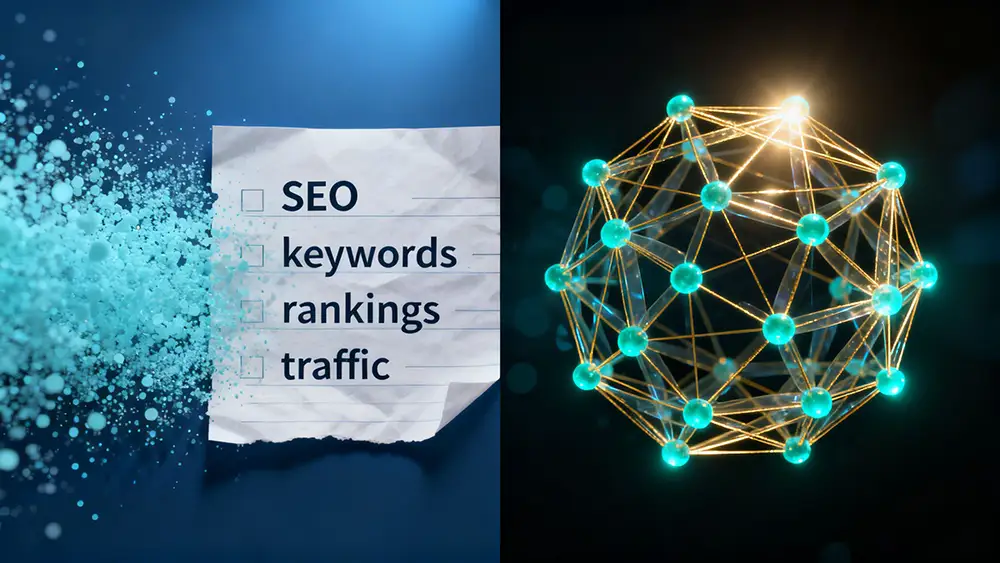
Modern search systems, powered by advanced AI, no longer just scan for keywords. They function as understanding engines, evaluating entities (people, places, concepts), the relationships between them, the context of the information, and the user’s underlying intent. This shift is a key reason why most SEO content fails in AI driven search, as content optimized solely for a target keyword often lacks the structural clarity and contextual depth these systems need to confidently use it in a generated answer. When your website page and post content isn’t structured to be easily parsed and understood by a machine, it fails to surface in AI-driven features like SGE (Search Generative Experience) and answer boxes, effectively making it invisible to a growing segment of search users.
Real-World Example
Consider a financial advisory firm that published dozens of blog posts targeting keywords like “best retirement plan” and “401k advice.” Despite achieving page-one rankings, they saw no traffic from AI-generated search answers or recommendation engines. After an audit, they restructured their content. Instead of isolated articles, they created a comprehensive topic cluster around retirement planning. Each piece was updated to answer specific questions (e.g., “What are the contribution limits for a 401k in 2024?”), marked up with structured data, and internally linked to establish clear relationships between concepts. Shortly after, their content began appearing directly in AI-generated summaries and as authoritative sources in answer engine results, capturing high-intent traffic they had previously missed.
Common Mistakes
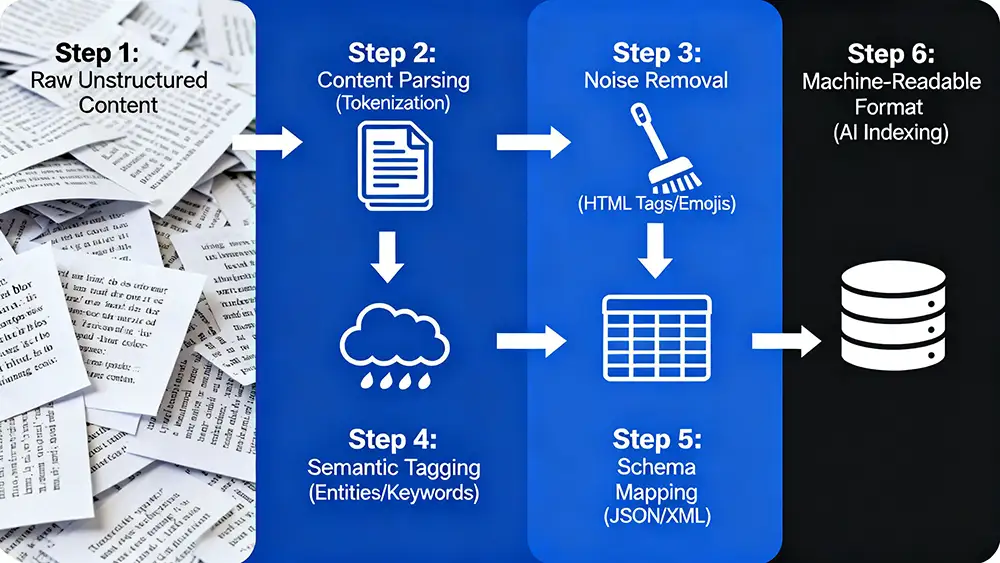
Many content strategies are stuck in the past, which is a primary reason why most SEO content fails in AI driven search. These outdated approaches lead to poor performance in modern search environments that rely on context, structure, and intent rather than simple keyword targeting. Common mistakes include:
- Writing for Keywords, Not Intent: Focusing exclusively on keyword density and placement while ignoring the user’s actual question or goal.
- Publishing Isolated Content: Creating standalone articles that fail to build topical authority or show a deep understanding of a subject.
- Ignoring Content Structure: Neglecting the use of clear headings, lists, and structured data (like schema markup) that make content easy for AI to interpret.
- Lacking Clear Entity Definition: Failing to clearly define who you are, what you do, and what concepts you are an expert on, making it difficult for AI to establish your authority.
What You Should Aim For
Success in the age of AI search is measured by how well your content is understood and utilized by machines. Your goals should be:
- Clear Entity Definition: Your website clearly communicates who you are and what your expertise is, making your brand a recognizable entity for search engines.
- Structured, Machine-Readable Content: Information is organized with logical headings, lists, tables, and schema markup that AI can easily parse and repurpose.
- Intent-Matched Information Architecture: Your site structure and content directly address the questions and needs of your target audience at every stage of their journey.
- Consistent Visibility Across Platforms: Your answers and expertise appear not just in traditional rankings but also in AI-generated summaries, answer boxes, and voice search results.
- Recognized Trust Signals: Your content is supported by clear authorship, citations, and a strong topical footprint that signals authority and trustworthiness to AI systems.
Supporting Data & Research
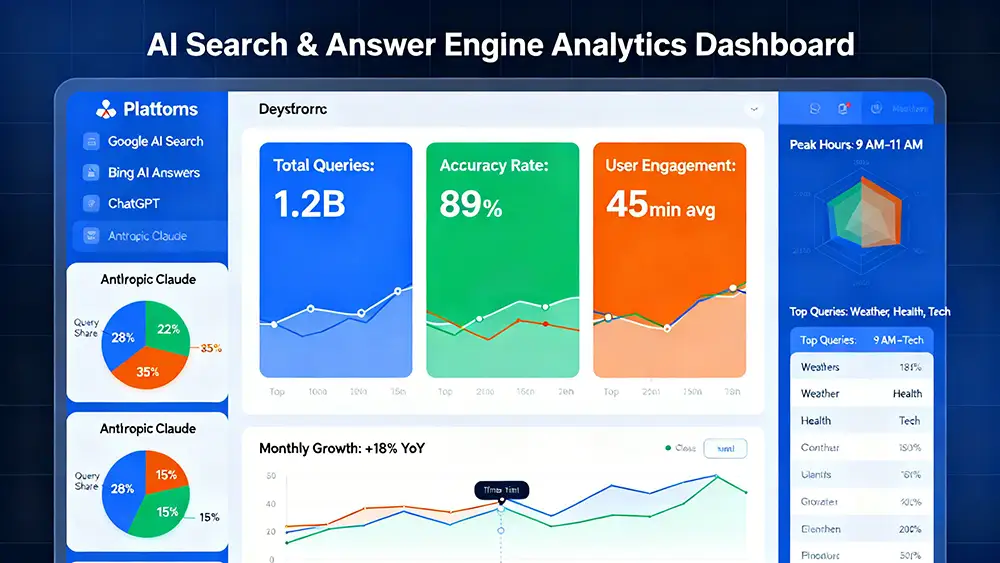
While specific algorithms are proprietary, the industry-wide shift towards semantic search is well-documented. AI models like Google’s BERT and MUM (Multitask Unified Model) are designed to understand language, context, and intent far more deeply than previous systems. These technologies don’t just match keywords; they analyze the relationships between words and concepts to grasp the meaning of a query and the content on a page. This is why entity-based indexing—where search engines build a knowledge graph of interconnected topics and entities—has become central to information retrieval. Content that is well-structured, contextually rich, and clearly defines its relationship to other entities is inherently more valuable to these advanced systems.
Frequently Asked Questions
What's the main difference between traditional SEO and AI search visibility?
Traditional SEO often focuses on ranking for specific keywords, while AI search visibility prioritizes being the source for answers that AI systems use in generative results, regardless of old-school ranking factors.
How does an AI system evaluate a website's content?
AI evaluates content based on its structure, clarity, contextual relevance, the authority of the source (entity), and how well it directly answers a user’s potential question.
What is Answer Engine Optimization (AEO)?
AEO is the practice of optimizing content to be selected by search engines for direct answers in search results, voice assistants, and AI-generated summaries.
How can I start building authority for AI search?
Start by creating comprehensive content on a core topic, clearly defining your expertise, and ensuring your information is accurate, well-structured, and user-focused.
Why does my keyword-optimized content not show up in AI answers?
It likely lacks the clear, concise structure and direct answer format that AI systems need. It may be written around a keyword rather than to resolve a user’s specific intent.
What is the best way to structure content for AI discovery?
Use clear headings (H1, H2, H3), bulleted lists, tables, and schema markup to break down information into logical, machine-readable components.
What is "answer-focused content"?
It’s content written to provide a direct, clear, and comprehensive answer to a specific question, often formatted with the question as a heading.
How can a small business improve its AI search visibility?
Focus on a niche area of expertise. Create detailed, helpful content that answers the most common questions your customers have, and structure it clearly.
Does AI-driven search rank content differently?
Yes. It doesn’t just “rank” content; it selects and synthesizes information from trusted, well-structured sources to construct a new answer. Being the source is the new ranking.
Is keyword research still relevant for AI search?
Yes, but its role has changed. It’s now used to understand user intent and the questions people are asking, rather than just identifying keywords to target.
Webpuzzlemaster Digital Marketing Services
Webpuzzlemaster Digital Marketing Agency helps businesses adapt to the shift from traditional SEO to AI-driven search visibility by developing structured content strategies, authority frameworks, and AI-optimized visibility systems. This shift is a key reason why most SEO content fails in AI driven search, as traditional approaches do not align with how modern search engines interpret and surface information.
Delivered by Webpuzzlemaster Digital Marketing Agency and led by Ruth Kuttler, we apply the AI Visibility Engine™ to audit your existing content, identify structural weaknesses, and build a new information architecture designed for machine understanding. This process is supported by a well-structured website architecture that improves content discoverability and user engagement, ensuring your expertise is transformed into a format that AI-driven search platforms can easily find, trust, and feature in their results. We focus on building sustainable authority that transcends simple keyword rankings.
About the Author
Ruth Kuttler, AI Visibility Engineer and Digital Strategy Architect, specializes in AI-driven search visibility, content architecture, and CRM technologies and automated workflows that save time, money and grow revenues. With a deep understanding of how search engines interpret and utilize information, Ruth develops strategies that align content with the technical requirements of modern AI. Her work focuses on creating robust digital ecosystems where businesses can achieve lasting visibility. She helps clients move beyond outdated SEO tactics to build true digital authority.
Your Next Step
Book an AI Visibility Strategy Consultation to evaluate how your content can be strategically restructured to perform in AI-driven search and answer-engine platforms. A focused review will identify where traditional SEO approaches fall short and how structured, answer-focused content can improve discoverability, authority, and long-term visibility. Strong AI visibility also supports broader marketing outcomes, helping local businesses strengthen digital credibility and improve the pathways that drive consistent local business growth.