


Introduction
For local businesses, professional services, healthcare providers, and retailers, chaos often reigns when customer records live in disconnected silos, are riddled with duplicates, or lack meaningful structure. This unruly data leads to delayed follow-up, missed opportunities, poor segmentation, and unreliable reporting. Most regional service brands and growing businesses rely on manual follow-up and struggle with fragmented workflows—making scalable, predictable growth elusive.
Fortunately, a new approach centered on clean customer data, advanced CRM data architecture, and robust lifecycle automation is transforming how organizations manage relationships. By prioritizing data-driven workflows, automated follow-up, and powerful segmentation, these businesses replace frustrating bottlenecks with rapid response, customer delight, and measurable growth.
Key Takeaways
- Why clean customer data and CRM data architecture enable predictable scaling
- How automation overcomes duplicate records, inconsistent data, and unreliable reporting
- How centralized data systems, CRM workflows, AI-powered SEO, and reputation management improve operational consistency and revenue
- What this shift means for customer experience and the efficiency of your business operations
Why This Concept Matters
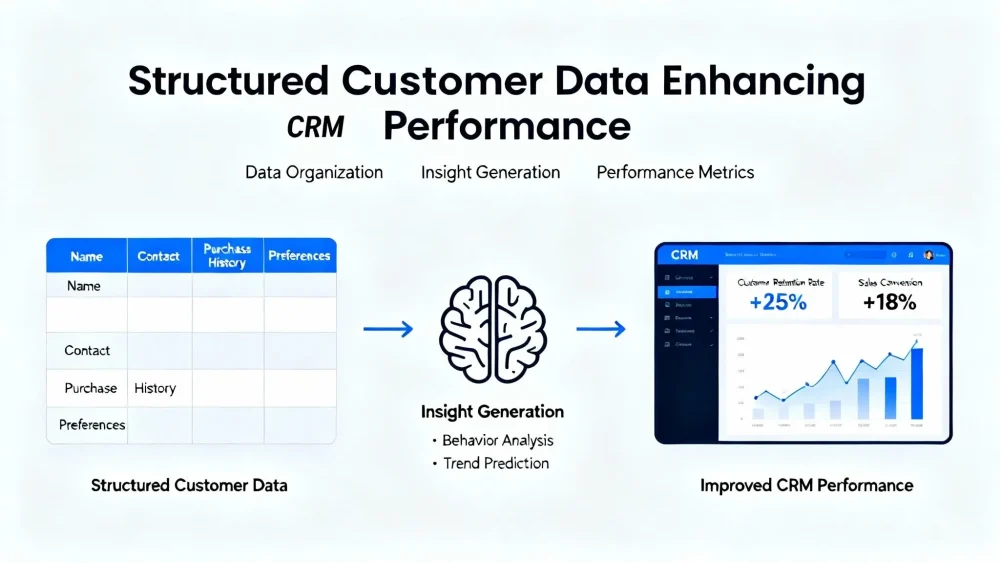
At its core, structured customer data for CRM is the foundation that turns a simple record-keeping tool into a strategic engine for growth. With a focus on:
- Centralized data: All customer information lives in a single, coherent location, eliminating duplication and confusion.
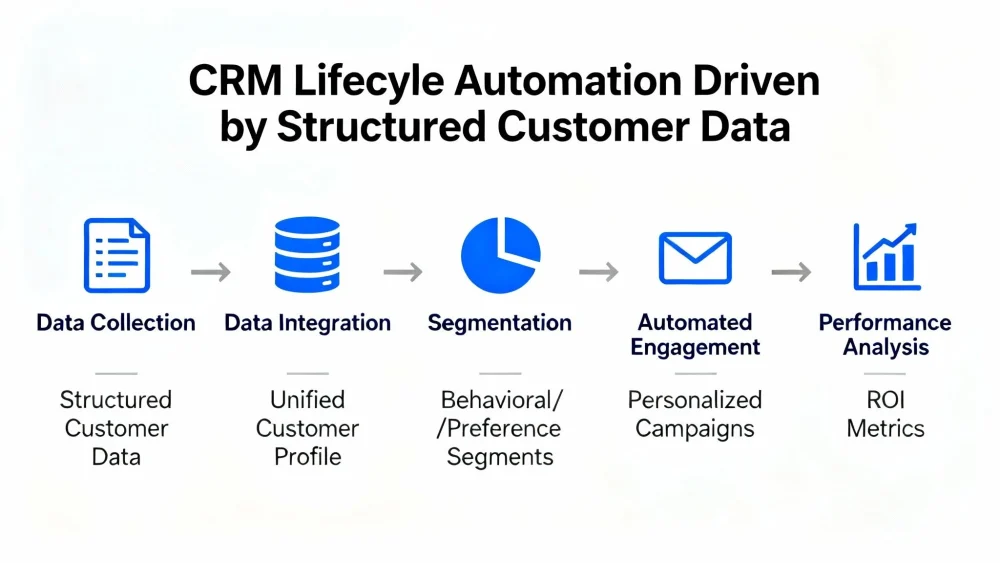
- Lifecycle automation: Every customer journey, from lead to loyalty, is mapped out and triggered automatically—ensuring nothing falls through the cracks.
- Segmentation and personalization: Advanced segmentation allows for relevant, personalized communications and offers, improving engagement and conversion.
- Data-driven workflows: Human guesswork is replaced by intelligent triggers and automation sequences that move customers down the pipeline reliably.
This transformation allows local businesses and professional services to scale predictably, deliver a superior customer experience, and vastly improve operational efficiency. Gone are the days of wondering if an opportunity was missed due to a data mishap.
Real-World Example
Let’s look at a common scenario: A growing regional business finds itself struggling with duplicate customer records, missed opportunities, and unreliable sales forecasting. Their teams spend hours cross-checking spreadsheets, manually updating CRM entries, and trying to cobble together reports that rarely add up.
After recognizing these inefficiencies, the business commits to a structured CRM overhaul. They clean and standardize all customer records, establish clear data architecture, and implement lifecycle workflows that trigger follow-up based on lead behaviors and segmentation.
- Duplicate records are eliminated, providing a single source of truth.
- Automated workflows ensure every inquiry receives a timely, relevant response.
- Segmentation enables targeted messaging—nurturing prospects uniquely and improving conversion.
- Reporting becomes instant, accurate, and actionable, allowing leadership to forecast with confidence.
Engagement and sales improve. The formerly overwhelmed team now leverages automation to handle routine tasks, freeing up energy for higher-value client interactions.

Common Mistakes
Building a high-performance CRM is not about buying the latest tool—it’s about avoiding core pitfalls, like:
- Manual data entry: Prone to human error, creating duplicates and inconsistencies.
- Disconnected tools: Fragmented software stacks keep important data out of sync.
- Poor data hygiene: Outdated or incomplete records clutter the system and obstruct clear reporting.
- Lack of lifecycle logic: Without defined workflows, follow-up is delayed or forgotten entirely.
- Overreliance on spreadsheets: Spreadsheets lack automation, reliability, and scalability.
- No data governance: Absence of clear rules for managing, updating, and verifying data quality leads to chaos as the business grows.
Failure to address these issues means more missed renewals, communication missteps, and a growing mountain of unreliable data.
What You Should Aim For
The gold standard for structured customer data for CRM is a well-orchestrated system that drives everything you do. Your goals should be:
- Clean, centralized customer records: Every detail is accurate, maintained, and accessible from one hub.
- Reliable segmentation: Customers are grouped based on behaviors, needs, or lifecycle stages, allowing for truly personalized nurture.
- Automated lifecycle workflows: Triggered sequences respond instantly to customer actions—think follow-up emails, appointment reminders, or special offers.
- Lead scoring and prioritization: The system intelligently identifies and flags your best opportunities for immediate action.
- Personalized nurturing paths: Emails, texts, and calls are automatically tailored to the recipient’s journey.
- Predictable pipeline visibility: Leaders enjoy accurate, real-time insights into sales health and future growth.
Supporting Data & Research
Industry surveys and field observations indicate that organizations adopting CRM automation built on clean, structured customer data see measurable improvements in follow-up speed, customer engagement rates, and overall reporting accuracy. Businesses with centralized, segmented data consistently outperform their manual counterparts not only in operational efficiency but also in delivering a more consistent customer experience.
Additionally, aligning CRM workflows with website performance optimization and AI-powered SEO (while leveraging local business visibility and modern reputation management systems) ensures that automation doesn’t just stop at internal operations. It extends into every customer touchpoint—supporting sustainable, predictable growth.
Frequently Asked Questions
What is structured customer data in the context of CRM?
Structured customer data means organizing contact information, history, preferences, and engagement signals in a logical, standardized way that is easily accessible and actionable within your CRM.
Why does clean data matter for CRM performance?
Clean data eliminates duplicates and inconsistencies, powering better segmentation, automation, and reporting which in turn drives efficiency and customer satisfaction.
How can lifecycle automation improve my business?
It ensures timely, personalized communication with every prospect and customer, freeing staff from manual follow-up and leading to higher conversion rates.
What is data hygiene, and how do I maintain it?
Data hygiene involves routinely verifying, correcting, and updating customer information to keep your CRM accurate and usable.
How does segmentation relate to structured customer data for CRM?
Good segmentation relies on accurate, up-to-date data; it enables you to group customers by behavior, value, or lifecycle stage for more effective marketing.
Can structured data really improve reporting accuracy?
Yes—when data is standardized and clean, reports become reliable, and leaders can make better decisions based on current pipeline insights.
What are common pitfalls of poor data management in CRM?
Missed opportunities, confused follow-up, marketing to the wrong audience, and wasted time reconciling conflicting reports.
How does a CRM handle duplicates and bad data?
Advanced systems can automate deduplication and set rules for data governance, keeping records healthy as the business grows.
Does automation replace my team?
No—automation liberates your team from routine tasks, allowing them to focus on building relationships and closing business.
What are the first steps to implement structured customer data for CRM?
Start with an audit of your current data, clean and merge records, set governance standards, and implement automated workflows tied to your customer lifecycle.
Webpuzzlemaster CRM & Automation Services
Delivered by Webpuzzlemaster Digital Marketing Agency and led by Ruth Kuttler. we design CRM architectures built on clean, structured customer data, integrated with automation workflows, website performance optimization, AI-powered SEO alignment, local visibility systems, and reputation management to support predictable growth.
About the Author
Written by Ruth Kuttler, AI Visibility Engineer™ & Digital Strategy Architect, and Owner of Webpuzzlemaster Digital Marketing Agency. Ruth designs CRM & automation systems that turn fragmented customer data into clean lifecycle workflows—integrated with high-performance WordPress development, structured content architecture, AI-powered SEO, and local visibility strategies that drive predictable lead flow and measurable ROI.
Your Next Step
Ready to transform your CRM performance with clean, structured customer data?
Book a strategy session to audit your data layer, identify fragmentation and automation gaps, and define a practical roadmap that turns your CRM into a reliable engine for segmentation, follow-up, and measurable revenue growth.