

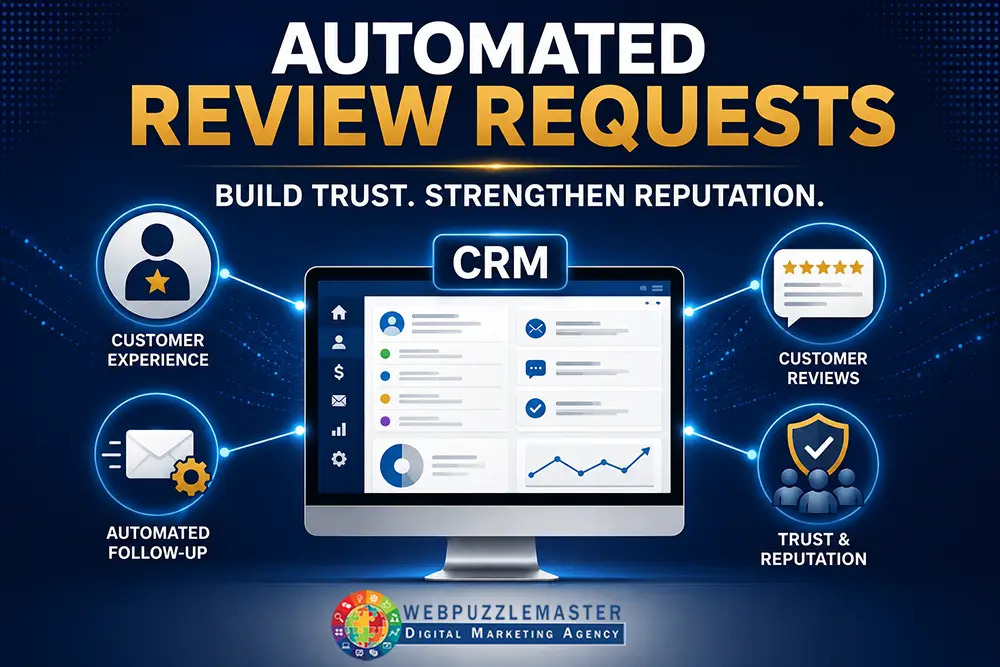
For local businesses, professional services, retailers, restaurants, and other providers, customer feedback can strongly influence whether a prospective customer calls, books, visits, or buys. Yet satisfied customers often do not leave reviews unless someone asks, and employees may not remember to make that request consistently. Automated review requests strengthen customer trust by making appropriate post-service follow-up a reliable part of the customer journey rather than an occasional task.
A thoughtful process can reduce manual work, create a more current and representative review profile, and give customers a convenient way to share authentic feedback. The objective is not to manufacture praise. It is to make it easier for real customers to describe their experiences while helping the business respond responsibly and learn from customer sentiment.
Key Takeaways
What you’ll learn:
- Why a consistent review-request process matters for customer management and business growth
- How it addresses forgotten follow-up, limited social proof, outdated feedback, and inconsistent review activity
- How review automation, CRM workflows, customer experience, and response management reinforce the primary strategy
- How using automated customer communications to strengthen retention and reputation can extend the value of a consistent review-request strategy
- The practical outcomes to seek, including less manual work, more representative feedback, stronger trust signals, and sustainable reputation management
Why This Concept Matters
Automated review requests strengthen customer trust because they help a business maintain a dependable process for inviting feedback after an appropriate customer interaction. The automation itself does not create trust. Trust comes from the quality of the customer experience, the authenticity of the feedback, the business’s response, and the consistency of the overall relationship.
A review request workflow simply helps connect those elements. After a completed service, delivered order, appointment, consultation, or other meaningful interaction, a CRM or connected automation system can send a courteous message at a sensible time. The message can explain why feedback is valuable, make the next step easy, and allow the customer to decide whether to participate.
This is different from treating every automation tool as a CRM. A CRM stores and organizes customer information, interaction history, and relationship details. Marketing automation manages planned communications to groups or segments. An individual automation tool may perform one task, such as sending a reminder after a transaction. These systems can work together, but they serve different purposes and should be designed around the business workflow.
A well-structured process can help address several common business challenges:
- Inconsistent follow-up: Employees no longer have to rely entirely on memory to ask every appropriate customer.
- Limited review recency: A steady process can encourage feedback across a continuing stream of customer interactions.
- Insufficient social proof: Prospective customers gain more current information when authentic customers choose to share their experiences.
- Disproportionate visibility of negative feedback: A broader and more current feedback profile can better represent the full range of customer experiences, while still requiring the business to address legitimate concerns.
- Operational inefficiency: Staff can spend less time tracking who was asked and more time delivering service and responding thoughtfully.
Timing matters. A request sent immediately may arrive before the customer has had an opportunity to evaluate the experience. One sent long after the interaction may be forgotten or feel disconnected. The right timing depends on the type of business, the buying cycle, and when the customer can reasonably assess the service or product.
The message also matters. A useful request should be clear, respectful, and easy to act on. It should not pressure the customer, promise a particular type of review, or imply that only positive feedback is welcome. Ethical review generation means inviting honest feedback from eligible customers without manipulating the outcome.
Reputation management also extends beyond collecting reviews. The business should monitor incoming feedback, thank customers where appropriate, investigate concerns, and respond professionally. A request workflow without response management is incomplete. Reviews are not merely marketing assets; they are customer conversations and potential sources of operational insight.
This reputation activity can support broader digital growth when it is connected to the rest of the customer experience. For example, strengthening search visibility with trustworthy customer and reputation signals is more effective when the business also delivers clear information, accurate contact details, and a credible path from discovery to inquiry.
Real-World Example
Consider a local service business with a large base of satisfied customers but only occasional online reviews. Employees are expected to ask customers manually, yet some remember and others do not. During busy periods, the request is often skipped. As a result, the business’s review profile does not accurately reflect the volume of positive customer experiences.
In this situation, automated review requests strengthen customer trust by creating a consistent post-service step without removing the human element from the relationship. The business can define an appropriate trigger, such as a completed appointment or confirmed service delivery. After a reasonable delay, the system sends a courteous request that gives the customer a clear choice to provide feedback.
The workflow should include safeguards. It should avoid sending requests to customers whose interaction is incomplete, customers who have already received a recent request, or contacts whose communication preferences do not permit that message. It should also provide a process for staff to review unusual situations before an automated message is sent.
The operational improvement is not a guaranteed increase in reviews or revenue. Rather, the business now has a repeatable way to invite feedback, fewer manual reminders for employees, and better visibility into customer sentiment. Staff can use the responses to identify service strengths, recurring issues, and opportunities to improve the customer experience.
The same business might also review whether its digital touchpoints support the trust customers see in its feedback. A clear, accurate website is part of that experience. Creating a website experience that reinforces the trust customers see in your reviews can help prospective customers move from reassurance to action without encountering confusing information or unnecessary friction.
Common Mistakes
A review-request process can weaken customer relationships when it is implemented without enough attention to timing, consent, message quality, and follow-up. Common mistakes include:
- Waiting for reviews to happen naturally: Even very satisfied customers may need a convenient invitation. Passive collection often produces inconsistent results.
- Relying entirely on employee memory: Manual requests may work in a small operation, but they become unreliable as volume, staffing, or service complexity increases.
- Sending requests too early or too late: Customers need enough time to experience the value delivered, but not so much time that the interaction is no longer fresh.
- Using overly promotional wording: A review request should sound like a customer-service communication, not an advertisement or a demand for praise.
- Making the process difficult: Customers are less likely to respond when the request has unclear instructions, too many steps, or a destination that is difficult to use on a mobile device.
- Repeatedly contacting nonresponders: A lack of response is not permission for unlimited reminders. Frequency limits and suppression rules help protect the customer experience.
- Offering questionable incentives: Incentives may conflict with review-platform policies or create doubt about the authenticity of the feedback. Businesses should understand the rules that apply to their industry and platforms.
- Trying to suppress negative feedback: Directing only unhappy customers away from public review channels can be deceptive and may violate platform expectations. A better approach is to invite honest feedback and resolve concerns responsibly.
- Ignoring incoming reviews: Collecting feedback without acknowledging it misses an opportunity to strengthen relationships and identify improvements.
- Automating without monitoring: A workflow can send the wrong message after a cancellation, complaint, billing issue, or incomplete service unless exceptions are considered.
These risks are why automation should support, not replace, appropriate human interaction. A customer may need a personal call, service recovery conversation, or manager review before any automated request is appropriate. The system should make those decisions easier to manage rather than forcing every customer into the same sequence.
Review activity should also be considered alongside the wider customer journey. Reputation signals cannot compensate for a slow response, confusing pricing, poor service, or a website that makes contacting the business difficult. When CRM data, customer follow-up, website performance, and service operations are disconnected, automation may simply accelerate an inconsistent experience.
A coordinated approach can connect building automated customer follow-up into a coordinated CRM strategy with practical rules for customer status, timing, preferences, and staff intervention. That creates a clearer foundation for reputation management without turning review collection into an isolated tactic.
What You Should Aim For
Automated review requests strengthen customer trust when they are part of an ethical, customer-centered system rather than a standalone campaign. Successful implementation should aim for the following outcomes:
- A consistent process for inviting feedback after appropriate customer interactions
- Timely requests that reflect the customer’s experience and buying cycle
- Clear, respectful messages that do not pressure customers toward a particular response
- An easy process for customers who choose to leave feedback
- Less dependence on staff reminders and manual tracking
- A more current and representative view of customer sentiment
- Defined rules for preferences, exceptions, duplicate requests, and nonresponses
- Timely and professional handling of both positive and negative feedback
- Useful information for improving service, communication, and customer retention
- A sustainable reputation-building system connected to broader growth goals
The goal is not to pursue the highest possible review count at any cost. A stronger target is a trustworthy reputation supported by authentic feedback, good service recovery, and consistent customer care. Review volume, ratings, and visibility can be useful indicators, but they should be interpreted alongside response quality, repeat business, customer concerns, and operational performance.
For a local business, reputation can also support discovery when it aligns with accurate business information and a useful digital presence. Using reputation and customer experience to support long-term local business growth means treating reviews as one part of a broader system for attracting, converting, and retaining the right customers.
Frequently Asked Questions
1. What are automated review requests?
Automated review requests are scheduled or triggered messages that invite customers to share feedback after a defined interaction, such as a completed appointment, purchase, or service.
2. Why should a business ask customers for reviews?
Satisfied customers may not think to leave feedback on their own. A respectful invitation makes participation easier and can help create a more current representation of customer experiences.
3. When should a review request be sent?
Send it after the customer has had a reasonable opportunity to experience the product or service. Timing should reflect the business model, service type, and customer journey.
4. How does CRM automation support review collection?
A CRM can use customer status, interaction history, preferences, and service milestones to determine when a request is appropriate and prevent unnecessary or duplicate outreach.
5. Do automated requests feel impersonal?
They can if the message is generic, poorly timed, or excessive. Clear wording, relevant timing, personalization where appropriate, and human follow-up for exceptions help preserve a genuine experience.
6. How often should customers be contacted?
Contact customers only when there is a legitimate reason and use reasonable frequency limits. A customer who does not respond should not receive repeated requests indefinitely.
7. Can a business offer incentives for reviews?
Businesses should be cautious. Incentives may violate platform rules or create concerns about authenticity. Review the applicable policies before offering any incentive, and never require positive feedback.
8. How should a business handle negative feedback?
Respond professionally, acknowledge the concern, investigate the facts, and offer an appropriate path to resolution. Avoid arguing publicly or exposing private customer information.
9. How do reviews influence customer trust and reputation?
Reviews provide social proof and help prospective customers assess credibility. Their value depends on authenticity, recency, relevance, response quality, and the actual customer experience behind them.
10. What makes a review-request process ethical and sustainable?
It invites honest feedback from appropriate customers, respects communication preferences, follows platform policies, avoids manipulation, limits repetition, and connects collection with genuine service improvement.
Conclusion
A reliable review-request workflow helps businesses replace inconsistent manual reminders with a practical customer follow-up process. The strongest systems use automation to handle timing, tracking, and routine communication while leaving room for employees to provide personal attention when circumstances require it.
Business owners should evaluate the entire experience behind the request: service quality, customer communication, CRM data, response procedures, and the ease of leaving feedback. When these pieces work together, reviews become more than promotional content. They become a source of trust, customer insight, operational learning, and long-term reputation development. A consistent digital reputation can also contribute to building the consistent authority signals that support AI visibility when reviews, business information, website content, and customer experience reinforce the same picture of the business.
How Webpuzzlemaster Can Help
Webpuzzlemaster helps businesses connect CRM, marketing automation, lead management, customer follow-up, websites, digital visibility, and customer experience into coordinated systems that support business growth. Our approach focuses on identifying workflow gaps, reducing repetitive manual work, improving how leads and customers move through the business, and implementing practical systems designed to support efficiency, stronger customer relationships, and measurable, sustainable growth.
For a review-request workflow, that may include clarifying the customer journey, defining appropriate triggers, reviewing CRM data, planning human exceptions, and connecting reputation management with the website and broader digital strategy. The right solution depends on the business problem and existing systems rather than on adding automation for its own sake.
Delivered by Webpuzzlemaster Digital Marketing Agency, led by Ruth Kuttler, AI Visibility Engineer™ and Digital Strategy Architect.
Your Next Step
Evaluate how your business currently asks for feedback after a completed service, purchase, or appointment. Identify where requests are missed, where timing could improve, and where staff need a clearer process for responding to customer concerns. A coordinated system can reduce repetitive work while supporting a more consistent customer experience, stronger conversions, better retention, and sustainable growth.
Start with a small, carefully defined workflow and review the results and customer responses before expanding it across the business. This evidence-based approach helps reduce guesswork and ensures the process supports real customer needs.
Ready to build a smarter system for customer follow-up, reviews, and reputation growth?