



When someone needs a local service, restaurant, professional, or retailer, they often investigate online before making contact. They look for accurate information, signs of professionalism, positive customer experiences, and a clear reason to choose one business over another. In this environment, website credibility affects local customer decisions because it helps prospects judge whether a business is legitimate, reliable, and worth their time.
For business owners, this matters when website visitors leave without calling, booking, visiting, or requesting information. Outdated details, weak reputation signals, confusing messaging, or an unprofessional presentation can create uncertainty even when the business provides excellent products or services. A credible digital presence reduces that uncertainty and creates a stronger path from online discovery to customer action.
Key Takeaways
What you’ll learn:
- Why website credibility matters for customer trust, confidence, and business growth
- How credibility gaps contribute to missed inquiries, lost sales, and competitor selection
- How trust signals, accurate information, professional design, and follow-up reinforce the primary strategy
- Which practical outcomes indicate that a website is supporting customer confidence and sustainable growth
Why This Concept Matters
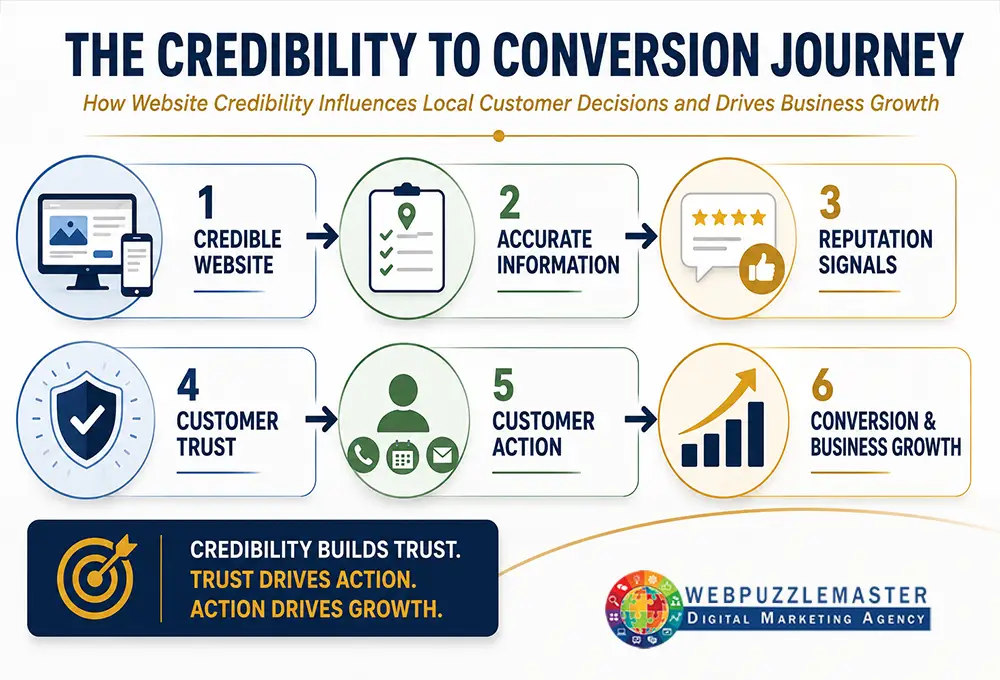
Website credibility affects local customer decisions because customers are managing perceived risk. Before they call a contractor, book an appointment, visit a restaurant, purchase from a retailer, or request professional advice, they want reasonable confidence that the business can meet their expectations.
A website does not need to be elaborate to be credible. It does need to answer important questions clearly:
- What does the business offer?
- Who does it serve?
- Where and when is it available?
- How can someone make contact?
- Why should a prospect believe its claims?
- What happens after the customer reaches out?
When these answers are easy to find, the customer has fewer reasons to hesitate. When the answers are missing or inconsistent, the visitor may interpret the gaps as warning signs. They may wonder whether the business is active, organized, responsive, or trustworthy. Even if those concerns are unfair, customers often make decisions based on the information available to them.
Credibility is created through several connected elements rather than one design feature. A professional layout can establish a positive first impression, but appearance alone will not overcome inaccurate hours, broken forms, vague service descriptions, or outdated contact details. Similarly, a strong review profile may lose impact if the website looks neglected or makes claims that cannot be verified.
The most effective approach is coordinated. The website, business listings, reviews, social profiles, messaging, and customer follow-up should reinforce the same identity and expectations. Accurate business information supports visibility and usability. Clear service pages help qualified prospects understand whether the business is a fit. Reviews and other social proof provide evidence that customers have had real experiences with the business. Secure, mobile-friendly functionality makes it easier to act.
This is also why website credibility should be viewed as a business issue rather than a cosmetic website issue. If the website attracts visitors but does not help them feel confident enough to take the next step, traffic alone will not solve the problem. A professional website experience that reinforces business credibility should support the customer’s decision-making process from the first impression through contact and follow-up.
Search visibility is part of this process, but visibility and credibility are not interchangeable. A business may appear in search results and still lose prospects if its online presence creates doubt. Likewise, reputation signals can be more persuasive when customers can find clear, consistent information that confirms what they have read elsewhere. This makes improving search visibility through accurate and trustworthy business information an important part of building credibility with prospective customers.
Real-World Example
Consider a local service business that receives website traffic but relatively few inquiries. The owner may assume the problem is insufficient promotion, yet prospective customers are encountering outdated information, limited evidence of expertise, and little visible proof of customer satisfaction. Contact details may be difficult to locate, service descriptions may be unclear, and the site may provide no obvious next step.
In this situation, website credibility affects local customer decisions before the owner ever has an opportunity to speak with a prospect. A visitor comparing several providers may choose a competitor simply because that competitor appears easier to verify and more prepared to help.
The improvement process begins with a credibility review. The business can check whether its name, address, phone number, hours, service area, and offerings are accurate and consistent. It can clarify what makes its services appropriate for the customers it wants to serve, replace vague claims with useful explanations, and make contact options visible on both mobile and desktop screens.
The business can also present legitimate reputation evidence, such as current reviews, customer feedback, professional credentials where applicable, examples of completed work, or clear explanations of its process. These elements should be accurate and proportionate. Exaggerated promises may attract attention briefly, but they can damage trust when customers discover that the experience does not match the claim.
Finally, building dependable CRM and follow-up systems for new inquiries helps ensure that the confidence created by the website continues after a prospect makes contact. A credible website creates an expectation that the business is organized and responsive. If a form disappears into an unmonitored inbox or a call is not returned, the digital experience and the real customer experience become disconnected. Reliable follow-up helps turn initial confidence into an actual conversation.
The result is not a guaranteed number of leads or a guaranteed ranking. The practical improvement is that qualified visitors have clearer information, stronger reasons to trust the business, and fewer obstacles between interest and action.
Common Mistakes
Several common mistakes weaken credibility and make it harder for local prospects to choose a business confidently.
- Assuming customers already trust the business. Existing reputation in the community does not automatically transfer to people discovering the company online. New prospects need accessible evidence and consistent information.
- Treating website appearance as purely cosmetic. Design affects usability, clarity, and perceived professionalism. A cluttered or dated presentation can make important information harder to evaluate, especially on a mobile device.
- Leaving outdated information online. Old hours, former locations, discontinued services, expired offers, or inactive team pages create doubt. Customers may question whether other details are reliable.
- Hiding contact and business details. A visitor should not have to search through several pages to find a phone number, address, service area, booking option, or inquiry form.
- Failing to show trustworthy reputation signals. Reviews, testimonials, project examples, and community involvement can help customers assess a business. They should be presented honestly and kept current where possible.
- Making exaggerated claims. Statements that promise perfect results, the lowest price, or universal expertise can sound less credible when they are unsupported. Specific, useful explanations are usually stronger.
- Ignoring mobile usability. Local customers may research a business while traveling, standing in a store, or comparing options from a phone. Small text, difficult menus, slow pages, and unusable forms create avoidable friction.
- Neglecting security and maintenance. Broken pages, browser warnings, expired information, and malfunctioning forms can undermine confidence quickly. Maintenance is part of customer experience, not an optional technical detail.
- Focusing only on traffic. More visitors are not automatically more customers. Business owners should evaluate whether visitors understand the offer, trust the business, and know what to do next.
- Using disconnected marketing messages. If search listings, advertisements, social profiles, and the website communicate different services, names, locations, or promises, prospects must resolve the inconsistency themselves. Many will simply move on.
These problems are often addressable without rebuilding every part of a digital presence at once. A practical review can identify the credibility gaps most likely to affect customer behavior, allowing the business to prioritize improvements according to customer impact and available resources.
What You Should Aim For
Website credibility affects local customer decisions most positively when the entire digital experience reduces uncertainty and makes the next step feel reasonable. Aim for a presence that is professional without being overstated, informative without being complicated, and persuasive because it is useful and believable.
A strong implementation should provide:
- Accurate, consistent business information across important digital channels
- Clear explanations of services, products, locations, availability, and customer fit
- Visible and honest trust signals, including relevant reviews or proof of experience
- Easy-to-use contact, booking, purchasing, or inquiry options
- A secure, mobile-friendly experience that works as expected
- Messaging that reflects the real customer experience
- A reliable process for acknowledging and following up on inquiries
- Ongoing monitoring of reputation, functionality, and customer feedback
The goal is not to make every visitor take action. The goal is to help qualified visitors make an informed decision with less hesitation. Some will decide the business is not right for them, and that is useful. Clear positioning can improve the quality of inquiries by helping the right prospects understand what to expect.
This work should also connect with broader visibility and growth efforts. Structured, accurate information can help with building the authority and clarity AI search systems need to understand a business, while consistent credibility signals support how the business is represented across traditional and AI-powered discovery environments. Reputation, website performance, customer experience, and follow-up work best as parts of one business-first strategy rather than isolated tasks.
Frequently Asked Questions
1. How do customers judge whether a local business is credible online?
They typically review the website, business details, customer reviews, visual presentation, service information, and ease of contact. Consistency across these areas supports confidence.
2. What are important website trust signals?
Clear contact details, accurate information, secure functionality, customer reviews, relevant examples of work, transparent policies, and professional service explanations can all support trust.
3. Does website quality influence customer confidence?
Yes. A clear, functional, current website can make a business appear more organized and dependable. Poor usability or outdated content can create unnecessary doubt.
4. How do reviews and social proof help?
They provide evidence of other customers’ experiences. Reviews are most useful when they are genuine, relevant, current, and supported by information that explains the business’s services.
5. Why is outdated information so damaging?
Customers may assume that outdated hours, pricing, locations, or services indicate the business is inactive or inattentive. They may choose another provider rather than risk an unpleasant surprise.
6. Does a professional design need to be expensive or elaborate?
No. Professionalism depends more on clarity, consistency, usability, and accuracy than on unnecessary visual complexity. The design should support the customer’s needs and the business’s goals.
7. How does security affect online trust?
Security warnings, broken forms, or unclear data practices can make visitors reluctant to submit information or complete a purchase. Basic security and maintenance help protect both trust and usability.
8. Why is mobile experience important for local businesses?
Many prospects use mobile devices to compare businesses, find directions, call, book, or ask questions. A difficult mobile experience can prevent action even when interest is strong.
9. Should every business display customer testimonials?
Relevant testimonials can help, but they should be truthful and appropriate to the business. They work best when paired with clear service information rather than used as a substitute for it.
10. How can stronger credibility improve inquiries and conversions?
It can reduce hesitation, clarify expectations, and make it easier for qualified prospects to contact the business. Results depend on the overall offer, market, customer experience, and follow-up process.
Conclusion
Credibility is one of the foundations of local customer decision-making. Prospects need enough accurate, consistent, and believable information to feel that contacting or buying from a business is a reasonable choice. A professional website helps, but it must work together with reputation signals, mobile usability, clear messaging, dependable functionality, and responsive follow-up.
Business owners should evaluate the experience from a customer’s perspective: Can a new visitor understand the offer, verify the business, see evidence of quality, and take the next step without confusion? This makes building customer trust as part of a broader local business growth strategy an important part of turning visibility into qualified inquiries and customers. Addressing the most important gaps can improve confidence and create a more reliable path from visibility to conversion.
How Webpuzzlemaster Can Help
Webpuzzlemaster helps local businesses, professionals, retailers, restaurants, and entrepreneurs connect marketing, customer acquisition, digital visibility, websites, CRM and automation, customer experience, and follow-up into a coordinated growth strategy. Our approach focuses on identifying opportunities and barriers, reducing guesswork and wasted resources, and building systems designed to support measurable, predictable, scalable growth.
That may include evaluating the website experience, clarifying messaging, strengthening digital visibility, improving customer pathways, organizing reputation signals, or connecting inquiries with more dependable follow-up. The right priorities depend on the business problem, audience, existing systems, and desired outcomes—not on applying disconnected tactics.
Delivered by Webpuzzlemaster Digital Marketing Agency, led by Ruth Kuttler, AI Visibility Engineer™ and Digital Strategy Architect.
Your Next Step
Review your website as if you were a first-time customer comparing several local businesses. Look for uncertainty around your services, contact details, reputation, security, mobile experience, and follow-up process. Prioritize the barriers most likely to affect qualified prospects instead of changing everything at once. A strategic, evidence-based improvement process can support measurable, predictable, scalable growth.
Find out what may be preventing prospective customers from trusting your business, taking the next step, and becoming customers.