

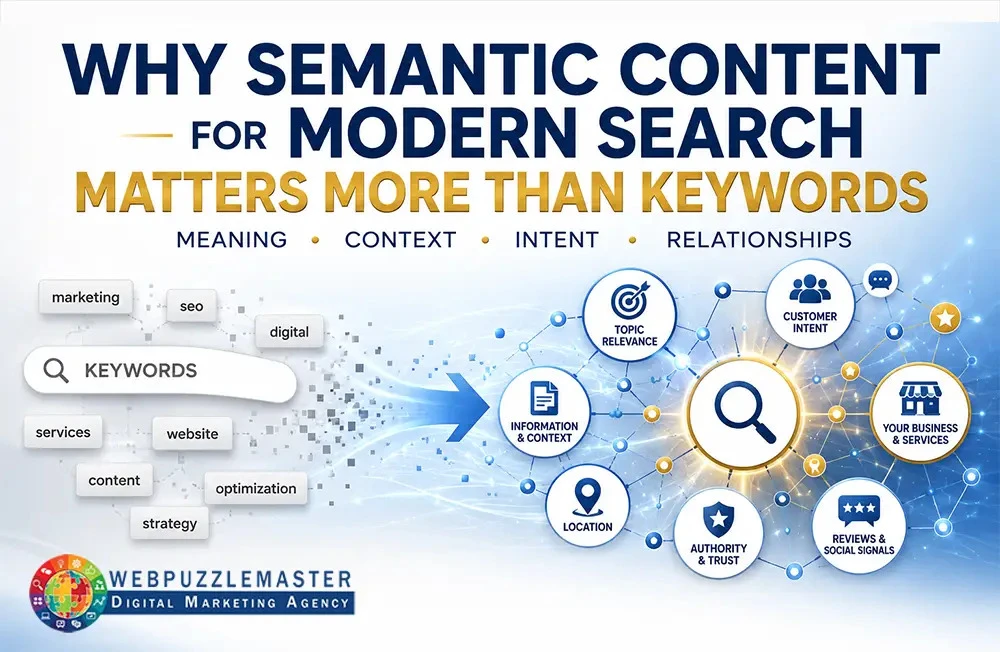
Businesses can publish page after page targeting valuable phrases and still struggle to attract meaningful visibility. The problem is often not a lack of keywords, but a lack of context: content may not fully address customer questions, explain related concepts, or make the business’s expertise clear. Semantic content for modern search helps connect meaning, intent, entities, and relationships so search engines and AI-powered discovery systems can better interpret what a business offers and whom it serves.
This matters especially for local businesses and professional service companies facing repetitive content, inconsistent leads, and uncertainty about how SEO is changing. Customers now search with detailed questions and conversational language across traditional results, answer engines, voice interfaces, and AI tools. Useful, connected content gives those customers clearer pathways from discovery to informed action.
Key Takeaways
What you’ll learn:
- Why meaning, context, and user intent matter for search and AI visibility
- How a connected content strategy addresses thin, repetitive, and poorly targeted pages
- How topical depth, entities, content structure, and internal relationships reinforce the primary strategy
- What stronger relevance, qualified visibility, and better customer decision-making look like in practice
Why This Concept Matters
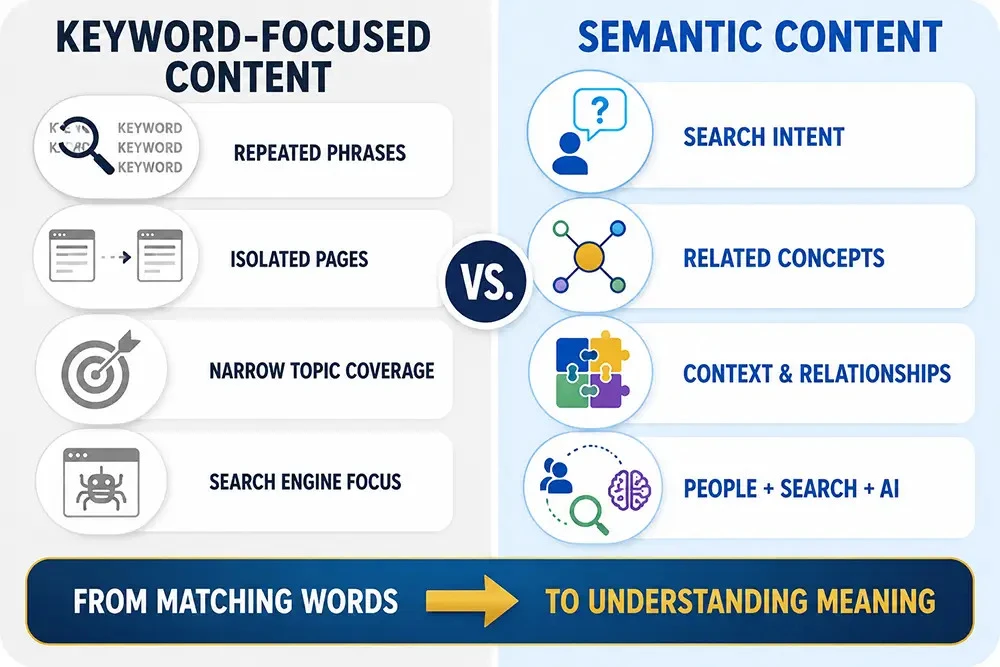
Search has moved beyond a simple process of matching a typed phrase to a page that repeats the same phrase. Keywords still provide useful signals about language and demand, but they are only one part of understanding a search. Modern systems also need to interpret the subject of a page, the audience it serves, the questions it answers, and how its ideas relate to broader topics.
That is the central value of semantic content for modern search: it organizes information around meaning rather than isolated wording. A page about business automation, for example, may need to address workflow problems, lead management, follow-up, customer experience, CRM systems, integrations, implementation considerations, and expected business outcomes. These concepts help explain the subject more naturally than repeating one target phrase throughout the page.
This does not mean businesses should abandon keyword research or fundamental SEO. Keyword research can reveal how people describe their needs, while technical SEO helps ensure content can be accessed, interpreted, and delivered effectively. The difference is that keywords become inputs to a broader strategy instead of the strategy itself.
Search Intent Creates Relevance
Search intent is the reason behind a query. Someone searching for “best accounting software for contractors” may be comparing options, while someone searching “how to organize contractor receipts” may be looking for guidance. Both searches relate to accounting, but they represent different needs and decision stages.
Content becomes more useful when it responds to the actual need behind the wording. Business owners should ask:
- What problem is the customer trying to solve?
- What information would help them compare, plan, or decide?
- What concerns might prevent them from taking action?
- What should they understand before contacting the business?
Answering these questions improves contextual relevance for readers and creates clearer signals about the page’s purpose. It also supports customer acquisition because qualified prospects receive information that matches their situation rather than a generic page built around a phrase.
These relationships become increasingly important in AI-powered discovery, where understanding how semantic relevance and entity relationships influence AI visibility can help businesses create content with clearer meaning, context, and topical connections.
Context and Relationships Strengthen Understanding
A topic rarely exists in isolation. A website about website development may also need to explain performance, accessibility, conversion pathways, content structure, analytics, security, and maintenance. These relationships help visitors understand the service and help systems interpret the business’s broader expertise.
This is where topical depth is more useful than simply making an article longer. Depth means covering the important dimensions of a subject in a focused, organized way. Adding unrelated material to increase word count can weaken clarity. Strong content selects relevant supporting concepts and shows how they connect.
A coordinated content structure can include a primary service page, supporting educational articles, question-based resources, comparison content, and practical guidance. Each piece should have a clear purpose and contribute to the customer journey. Internal linking, when used thoughtfully, can reinforce those relationships for visitors and provide a clearer map of related information. This connected structure can also support helping AI and answer engines understand the context and authority behind your content by making relationships among topics and information clearer.
Traditional Search and AI-Powered Discovery
Traditional search and AI-powered discovery overlap, but they are not interchangeable. Search engine optimization remains important for helping pages become accessible, relevant, and useful in conventional search environments. Answer engine optimization focuses more directly on how information can be understood and used in answer-oriented experiences. AI visibility considers the broader digital context that may influence whether a business is understood, surfaced, or represented across AI-powered systems.
No business can guarantee that an AI system will cite or recommend it. However, a business can make its information clearer, more consistent, more authoritative, and easier to interpret. That includes accurately describing services, demonstrating subject knowledge, maintaining consistent business information, and building a digital presence that supports trust.
Webpuzzlemaster approaches this through building an SEO strategy around meaning, relevance, and customer intent, rather than treating optimization as a disconnected keyword exercise. The goal is to align content and technology with a business outcome: qualified visibility that can support conversations, inquiries, and sustainable growth.
Real-World Example
Consider a local professional service company that has created multiple pages and articles around variations of the same high-value keyword. Each page uses similar phrases, but provides limited explanation of customer questions, service differences, decision factors, and related problems. The business may have content, yet prospective customers still lack a clear reason to trust it or take the next step.
This is a common situation where semantic content for modern search can change the strategy. Instead of creating another thin page, the company can map the customer journey and organize its content around intent. A primary service page might explain who the service is for, what problem it solves, how the process works, what customers should prepare, and what questions to ask before choosing a provider.
Supporting resources can then address related concerns, such as pricing factors, implementation timelines, common risks, comparisons, and maintenance. The content should use natural terminology and explain relationships among the concepts. It should also connect the service to the company’s expertise without making unsupported claims.
The resulting content is more complete for prospective customers and provides clearer context about the subjects the business understands and serves. That does not guarantee a particular ranking, citation, or lead volume. It does create a stronger foundation for discoverability, informed decision-making, and future measurement. The company can evaluate which questions generate engagement, which pages assist inquiries, and where prospects still need clarification.
The same principle applies to the website itself. A business can focus on creating a website structure that helps visitors understand related services and information, ensuring that navigation, page relationships, calls to action, and supporting content work together rather than functioning as isolated assets.
Common Mistakes
Businesses often weaken their visibility by treating content as a collection of target phrases instead of a system for communicating expertise and helping customers. Common mistakes include:
- Treating keyword density as the primary strategy. Repeating a phrase does not substitute for answering the customer’s question or demonstrating relevant knowledge.
- Creating thin pages for every minor variation. Several pages with nearly identical information can create a poor experience and make the website harder to manage.
- Forcing exact-match language into awkward sentences. Natural language is usually clearer and more credible for readers.
- Writing for algorithms instead of customers. Content should help a real person understand a problem, evaluate options, and decide what to do next.
- Ignoring search intent. A page designed to educate should not pretend to be a sales page, and a service page should not leave visitors searching for basic details.
- Covering topics too narrowly. A page may mention a service without explaining the related needs, risks, processes, or outcomes that matter to customers.
- Confusing depth with length. A longer article is not automatically more useful. Relevance, organization, clarity, and completeness matter more than an arbitrary word count.
- Adding unrelated topics to appear comprehensive. Focused coverage is stronger than a collection of loosely connected ideas.
- Assuming semantic strategy replaces SEO fundamentals. Performance, crawlability, page structure, accessibility, and accurate business information still matter.
- Failing to connect content to operations. Search interest should lead somewhere. Connecting search-driven customer interest with automated follow-up and relationship building can help businesses respond consistently once a prospect makes contact.
A further mistake is measuring only impressions or traffic. Visibility matters, but the more useful questions are whether the audience is qualified, whether visitors find the information they need, and whether the content contributes to inquiries, consultations, purchases, or stronger relationships.
What You Should Aim For
The goal of semantic content for modern search is not to produce content that sounds sophisticated. It is to make a business easier to understand and more useful to the people it wants to serve. Successful implementation should create clear connections among customer intent, services, expertise, questions, supporting concepts, and next steps.
Aim for content that:
- Addresses a specific customer need or decision stage
- Uses important terminology naturally and accurately
- Explains related concepts without drifting into unrelated subjects
- Demonstrates topical relevance through useful, people-first information
- Makes the relationships among services, problems, and solutions clear
- Gives visitors practical answers before asking them to contact the business
- Organizes related pages into a coherent customer journey
- Supports both traditional search and AI-powered discovery without promising specific outcomes
- Directs qualified visitors toward an appropriate next step
- Can be measured and improved using evidence rather than assumptions
For local businesses, the context should also reflect the markets, customers, services, and situations the business genuinely serves. Stronger content should support turning stronger digital visibility into sustainable local business growth, not simply generate visits from people who are unlikely to become customers.
Frequently Asked Questions
1. What does semantic content mean?
Semantic content is information organized around meaning, context, relationships, and user needs rather than repeated keywords alone.
2. How does semantic search differ from keyword matching?
Keyword matching focuses primarily on shared wording. Semantic search attempts to interpret the meaning, context, and intent behind a query and a page.
3. Do keywords still matter?
Yes. Keywords help reveal customer language and search demand, but they should guide useful content rather than dictate repetitive writing.
4. How does search intent influence content?
Intent identifies what the searcher wants to accomplish, such as learning, comparing, planning, or contacting a provider. Content should meet that need directly.
5. What are entities and contextual relationships?
Entities are identifiable people, businesses, places, services, concepts, or organizations. Relationships explain how those entities connect within a topic.
6. Can semantic content help AI visibility?
Clear, accurate, well-structured information can make a business easier for AI-powered systems to interpret. It cannot guarantee citation or recommendation.
7. How can a business build topical relevance?
Start with customer needs, map related questions and concepts, create focused resources, connect them logically, and maintain accuracy across the digital presence.
8. Does this strategy require longer content?
No. The appropriate length depends on the subject and customer need. Complete, focused, well-organized information is more important than length alone.
9. How does internal linking support topic relationships?
Relevant links help visitors move between related information and can clarify how pages fit together within the website’s broader subject structure.
10. How should older keyword-focused content be updated?
Review its intent, usefulness, accuracy, depth, structure, and relationship to other pages. Consolidate overlapping content where appropriate and fill important information gaps.
Conclusion
Modern search rewards clarity, relevance, and usefulness more than mechanical repetition. Businesses that organize content around customer intent, related concepts, entities, and meaningful context can create a stronger foundation for traditional search visibility and AI-powered discovery.
The practical starting point is an honest review of existing content. Identify pages that repeat the same ideas, fail to answer important questions, or leave the business’s expertise unclear. Then prioritize improvements that support qualified visibility and real customer decisions. A coordinated approach to content, SEO, website performance, and follow-up is more valuable than a series of disconnected publishing tasks.
How Webpuzzlemaster Can Help
Webpuzzlemaster helps businesses improve how they are discovered, understood, and represented across traditional search engines and AI-powered discovery environments. Our approach connects SEO, AEO, AI visibility, content strategy, website performance, local business visibility, CRM and automation, and customer experience into a coordinated digital growth strategy designed to strengthen authority, attract qualified prospects, and support measurable, sustainable business growth.
That work begins with the business problem and desired outcome. Depending on the situation, the right combination may include content and SEO improvements, website structure, AI visibility strategy, local growth initiatives, or systems that help manage customer relationships after discovery. The objective is to reduce guesswork, identify meaningful gaps, test practical improvements, and scale what the evidence supports.
Delivered by Webpuzzlemaster Digital Marketing Agency, led by Ruth Kuttler, AI Visibility Engineer™ and Digital Strategy Architect.
Your Next Step
Evaluate whether your current content answers customer questions or merely repeats target phrases. Look for gaps in intent, context, topical coverage, page relationships, and the path from discovery to inquiry. Prioritize improvements that make your expertise easier to understand across search engines, answer environments, and AI-powered discovery. With a coordinated strategy, stronger discoverability can support authority, qualified customer acquisition, and sustainable growth over time.
Ready to find out how well your business is positioned for modern search and AI-powered discovery?