



A slow website is more than an inconvenience; it’s a direct drain on your revenue. Hidden costs of a slow website can cost you leads and customers. With users expecting instant results and search engines prioritizing fast, stable experiences, poor website performance is a primary cause of high bounce rates, wasted ad spend, and lost leads. The Website Performance & Conversion Engine focuses on the critical link between technical health (speed, stability) and business outcomes (conversions). It addresses the core issues of website speed optimization, UX performance, and conversion alignment to ensure the traffic you earn actually turns into qualified customers.
Key Takeaways
- Why core concepts like website speed optimization and Core Web Vitals directly impact lead quality and conversion rates.
- How audience pain points like high bounce rates and low ROI are often symptoms of slow page loads and poor mobile performance.
- How supporting concepts like image compression and caching strategies improve user flow and decision clarity.
- Why strong website performance is a non-negotiable prerequisite for success in SEO, paid ads, and AI visibility.
Why This Concept Matters
In high-intent moments—when a potential customer is actively looking for a solution—every second counts. A slow-loading page or a layout that shifts unexpectedly (layout stability) erodes trust and creates friction. These hidden costs of a slow website are especially true on mobile devices, where users are less patient. Clear user paths, fast load times, and a seamless mobile experience signal professionalism and respect for the user’s time, directly influencing their decision to engage, trust, and ultimately convert. For service-based companies, this directly impacts local business growth through higher Google Maps engagement and location-based conversions, where speed and mobile usability influence whether a prospect calls, clicks, or chooses a competitor.
Real-World Example
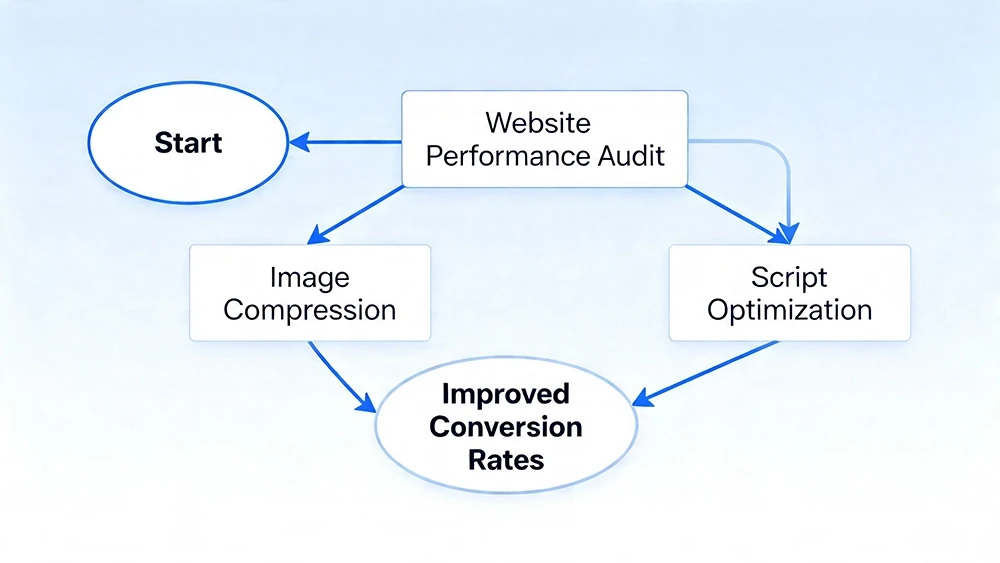
A local service business invests heavily in paid ads but struggles with low conversion rates. An audit reveals the culprit: slow load times caused by large, unoptimized images and an excess of slow-loading scripts. Hidden costs of a slow website make the user journey confusing, especially on mobile. After implementing performance optimizations like image compression, code minification, and improving server response time, the mobile experience became a priority. The result was a significant increase in user engagement, longer session durations, and a measurable lift in qualified leads from the same ad spend. Without a connected backend, even improved performance falls short—true growth comes from CRM and marketing automation systems that capture, segment, and follow up with leads automatically, ensuring every conversion opportunity is tracked and nurtured.
Common Mistakes
Many businesses unknowingly sabotage their own success with common performance mistakes. These include ignoring mobile performance despite its dominance, uploading oversized images that cripple load times, and bloating their site with too many plugins or third-party scripts. Other frequent errors are choosing poor hosting environments, failing to implement caching, creating cluttered layouts with multiple competing calls-to-action (CTAs), and operating without any performance monitoring to catch issues before they impact users.
What You Should Aim For
Success is a website that feels effortless to the user. This means achieving fast, stable load performance with excellent Core Web Vitals scores. Your value proposition should be immediately clear “above the fold” without requiring the user to scroll. The user journey from landing page to conversion should be simple and friction-free. Your site must project strong trust and credibility signals, and every key page should have one primary conversion goal that is tracked and measured.

Supporting Data & Research
Accepted industry principles confirm the direct link between performance and user behavior. Google’s Core Web Vitals (CWV) were introduced as ranking factors precisely because they measure real-world user experience related to loading speed, interactivity, and visual stability.
Research consistently shows that as page load time increases, the probability of a user bouncing skyrockets. This is amplified on mobile, where attention spans are shorter and connectivity can be less reliable. A well-structured site with a clear hierarchy not only helps users but also makes it easier for search algorithms to understand your content, which is a key component of making your website’s entity relationships explicit for AI engines. A fast, technically optimized site is also foundational for AI visibility and SEO-driven entity recognition, because search engines and AI systems prioritize structured, high-performance content when determining which businesses to recommend in answer-driven search results.
Optimizing the user experience is not just about aesthetics; it’s about understanding cognitive load and decision-making. Given that a vast majority of internet users are on mobile, a responsive web design is crucial for sustainable lead generation for any business aiming to capture leads effectively. Ultimately, when you evaluate mobile websites vs. responsive design, the goal is always a seamless experience that meets the user where they are.
Frequently Asked Questions
What is a good page load time?
Ideally, a page should load in under 2.5 seconds to provide a good user experience and meet Core Web Vitals standards.
How do Core Web Vitals affect my website?
Core Web Vitals are Google ranking factors that measure user experience. Poor scores can lower your search rankings and indicate a frustrating experience for visitors.
What is the easiest way to improve website speed?
Compressing images is often the quickest and most impactful first step. Large, unoptimized images are a primary cause of slow load times.
Does my website host affect performance?
Absolutely. A cheap, slow hosting environment can create a bottleneck that no amount of on-site optimization can fully overcome.
What is conversion rate optimization (CRO)?
CRO is the systematic process of increasing the percentage of website visitors who take a desired action, such as filling out a form or making a purchase.
Why is mobile performance so important?
The majority of web traffic now comes from mobile devices. A poor mobile experience will alienate most of your audience and harm your search rankings.
Can too many plugins slow down my site?
Yes. Every plugin adds code that needs to be loaded. Poorly coded or unnecessary plugins are a common source of performance issues.
What is the difference between UX and UI?
UI (User Interface) refers to the visual elements a user interacts with (buttons, menus). UX (User Experience) is the overall feeling a user has while interacting with your site, including its speed and ease of use.
How can I measure my website's performance?
You can use free tools like Google’s PageSpeed Insights and GTmetrix to get a detailed report on your site’s speed and identify areas for improvement.
What is a "user journey"?
A user journey is the path a visitor takes on your website from their entry point to a final action, like converting into a lead. Optimizing this path is key to improving conversions.
Webpuzzlemaster Website Performance Services
Webpuzzlemaster Digital Marketing Agency builds high-performance websites engineered for speed, stability, and conversion. Our approach goes beyond surface-level fixes—we identify bottlenecks at the infrastructure, code, and UX levels to create a seamless user experience that supports lead generation and revenue growth. From performance audits to full optimization strategies, we ensure your website works as a true conversion engine, not a liability.
Delivered by Webpuzzlemaster Digital Marketing Agency, led by Ruth Kuttler, Webpuzzlemaster improves website speed through deep performance audits and the implementation of advanced caching, code minification, and image optimization. We enhance UX clarity by mapping user journeys and designing intuitive interfaces that guide visitors to conversion. Our conversion architecture ensures every page has a clear purpose, supported by robust performance measurement to track progress and ROI.
About the Author
Ruth Kuttler, AI Visibility Engineer™ & Digital Strategy Architect, specializes in transforming standard websites into high-performance digital assets. Her expertise lies in optimizing WordPress for maximum speed, designing user experiences that eliminate friction, and developing conversion strategies that turn traffic into tangible business results – the end result is there are no hidden costs of a slow website – only technical foundations that enable superior visibility and lead generation.
Your Next Step
If your website is slow or underperforming, you’re not just losing speed—you’re losing leads, conversions, and revenue. The real issue is rarely one fix; it’s how performance, user experience, and your lead capture systems work together. A focused strategy identifies what’s slowing your site down, where users are dropping off, and how to turn your website into a streamlined, conversion-driven asset that supports real business growth.