


Are you experiencing declining organic traffic and reduced click-through rates despite solid keyword rankings? You’re not alone. This is a common pain point for businesses still relying on outdated SEO strategies. The search landscape is shifting rapidly as AI-powered engines deliver direct answers and generative results, bypassing traditional blue links. Users now get information directly from the search page, making it harder than ever to earn visibility.
This is where answer engine optimization (AEO) becomes critical. By leveraging structured content, entity recognition, and semantic search principles, answer engine optimization for modern search visibility helps your business adapt, ensuring you are seen not just in search results, but within the AI-generated answers themselves. Businesses implementing AI search visibility and answer-driven content strategies are better positioned to increase authority, discoverability, and lead generation as search continues evolving.
Key Takeaways
- Why answer engine optimization for modern search visibility, AI search results, and structured content redefine traditional keyword-based SEO.
- How declining organic traffic and outdated SEO strategies limit visibility in AI-driven discovery.
- How entity mapping, structured data, and schema markup strengthen authority, trust, and machine understanding.
- Why visibility now depends on structure, context, and entities—not rankings alone.
Why This Concept Matters
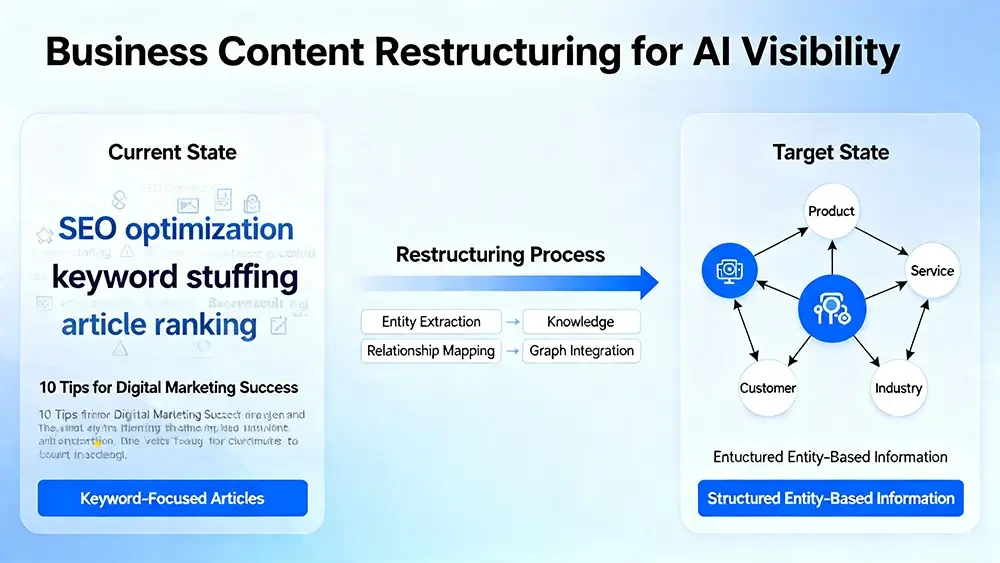
Modern search systems have evolved beyond simple keyword matching. They now function as sophisticated understanding engines that evaluate entities (people, places, things, concepts), the relationships between them, context, and user intent. Content optimized only for keywords often fails to surface in AI-generated answers because it lacks the structural clarity and contextual depth these systems require. To be visible, your content must be organized in a way that machines can easily parse and understand, allowing them to recognize your brand as an authoritative entity on a given topic. This requires a strategic approach that goes beyond rankings and focuses on introducing the AI Visibility Engine to build a machine-readable foundation for your expertise.
Real-World Example
A well-established service-based business noticed a steady decline in website traffic, even though they continued to rank well for their primary keywords. They discovered that AI-powered search results were providing customers with direct answers to common questions, significantly reducing the need to click through to their website. After a strategic overhaul, they restructured their website content for clarity, focusing on entity recognition and formatting key information into answer-based snippets.
As a result, their business began appearing directly in AI-generated responses, regaining lost visibility and capturing high-intent users at the point of discovery. Their improved visibility was further supported by website performance optimization strategies that improve mobile usability, page speed, and conversion-focused user experience, helping retain and convert high-intent visitors.
Common Mistakes
Many businesses unknowingly sabotage their visibility by clinging to outdated practices. Common mistakes include:
- Focusing only on rankings: Ignoring the fact that visibility now happens in answer boxes and generative results.
- Ignoring structured content: Failing to use schema markup and other tools that help search engines understand your content.
- Lack of entity clarity: Not clearly defining who you are, what you do, and what you’re an expert in.
- Producing generic content: Creating articles that don’t directly answer user questions or satisfy intent.
- Failing to adapt to AI search: Continuing with old SEO tactics that are ineffective in the new landscape.
- Over-optimizing without context: Stuffing keywords without building a rich, contextual framework around them.
What You Should Aim For
Success in modern search means achieving sustainable search visibility through a structured and strategic approach. Your goals should include:
- Clear entity definition and alignment: Ensuring search engines unambiguously understand your brand, services, and expertise.
- Structured, machine-readable content: Implementing schema and other data formats that make your information easy for AI to process.
- Intent-matched information architecture: Organizing your site to directly answer the questions your audience is asking.
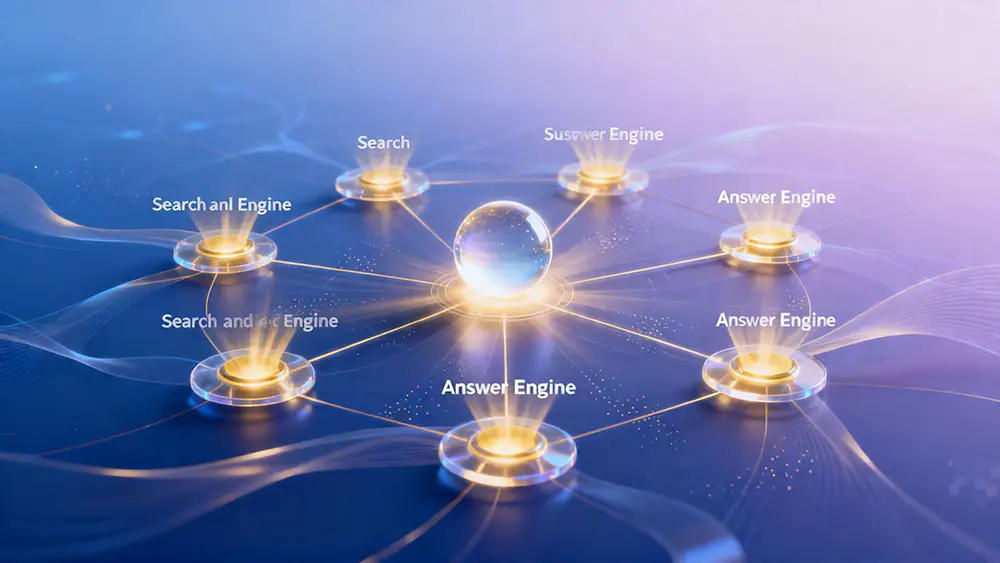
- Consistent visibility across search and answer engines: Appearing in traditional results, featured snippets, and AI-generated answers.
- Trust signals AI systems recognize: Building authority through consistent, clear, and interconnected information while ensuring your site delivers an optimal experience through responsive web design for sustainable lead generation.
Supporting Data & Research
Accepted principles in computer science and information retrieval confirm that answer engine optimization for modern search visibility relies heavily on semantic understanding and knowledge graphs. Instead of just indexing words, AI systems build complex models of the world by identifying entities and mapping their relationships. This allows them to evaluate content for contextual relevance and authority, not just keyword density.
For an AI to feature your content, it must first trust it. This trust is built on clear, structured information that is consistently presented across your digital footprint. As users increasingly access information on mobile devices, it’s also crucial to present this structured data effectively, considering the differences between mobile websites and responsive website design to ensure a seamless user experience that search engines reward.
Frequently Asked Questions
What is Answer Engine Optimization (AEO)?
AEO is the process of optimizing your digital presence to appear in the direct answers provided by AI-powered search engines, chatbots, and voice assistants, going beyond traditional link-based results.
How does AEO differ from traditional SEO?
While traditional SEO often focuses on ranking web pages for specific keywords, AEO focuses on structuring content to directly answer user questions and establishing your brand as a recognized entity for machines.
Why is structured content important for AI search?
Structured content, like schema markup, translates your content into a language that machines can easily understand, allowing them to accurately categorize your information and feature it in relevant answers.
What is an "entity" in the context of modern search?
An entity is any well-defined person, place, organization, or concept that a search engine can identify and understand. Establishing your business as a clear entity is key to building authority.
How can I make my business an entity that AI understands?
Start by ensuring your business name, address, services, and areas of expertise are clear and consistent across your website and other online profiles, supported by structured data.
Will rankings become obsolete because of AI answers?
Rankings are becoming less important as the primary metric for success. Visibility within AI-generated answers and featured snippets is the new frontier for capturing user attention.
What are the first steps to creating an AEO strategy?
Begin by identifying the core questions your audience asks. Then, restructure your content to provide clear, concise, and authoritative answers, and mark it up with relevant schema.
How does user intent affect visibility in answer engines?
Answer engines are designed to satisfy user intent immediately. Content that directly matches the underlying goal of a query—whether it’s informational, transactional, or navigational—is more likely to be featured.
Can I optimize for both traditional search and answer engines?
Yes, and you should. A strong AEO strategy complements traditional SEO. Well-structured, authoritative content performs well in both traditional rankings and AI-driven answer formats.
How has the evolution of search impacted content creation?
Content creation must now prioritize clarity, context, and structure over keyword density. The goal is to create a comprehensive resource that is valuable to both humans and machines.
Webpuzzlemaster AI Visibility Services
Webpuzzlemaster Digital Marketing Agency led by Ruth Kuttler, helps businesses implement advanced AI visibility strategies that go beyond traditional SEO. We structure content for answer engines, improve entity clarity, and align your digital presence with how modern search platforms deliver results. Our approach ensures your business is visible where customers are actually searching today.
Our team maps your key business entities, restructures your content architecture, and implements the necessary technical signals to ensure search engines and AI platforms understand who you are, what you do, and why you are an authority. We move beyond simple rankings to secure your place in the direct, generative answers that modern customers rely on. Through digital strategy architecture, we also design and implement automation systems and chatbots that qualify leads and book appointments.
About the Author
Ruth Kuttler, AI Visibility Engineer™ & Digital Strategy Architect, has 20+ years of experience in SEO and is now at the forefront of AI search technology. Ruth focuses on building digital frameworks that are resilient to algorithm changes. Her work helps businesses achieve sustainable visibility by aligning their content and data structure with the semantic understanding of modern AI systems. She is dedicated to demystifying the complexities of answer engine optimization for modern search visibility that boosts results for clients.
Your Next Step
If your current SEO strategy is not producing the visibility it once did, the issue may not be your effort—it is the shift in how search works. AI-driven platforms are changing how users discover and evaluate businesses, and traditional SEO alone is no longer enough. Now is the time to adapt your strategy to ensure your local business is visible in both search results and AI-generated answers.