

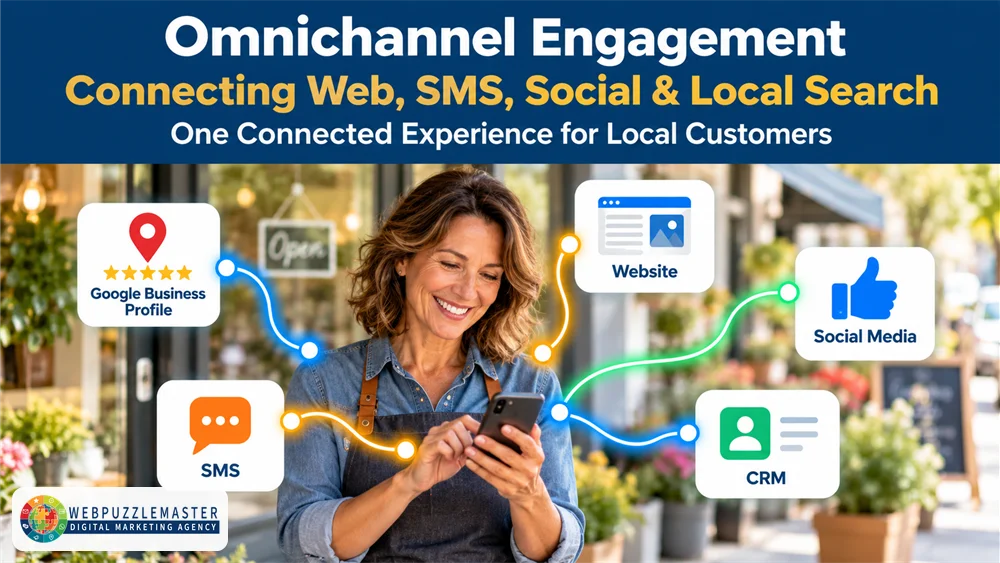
Local customers rarely choose a business after a single interaction. They might find you in Google or an AI answer, check your Google Business Profile and reviews, scroll your social posts, visit your website, and only then call, text or fill out a form. Omnichannel marketing engagement means making those touchpoints work together, so each one picks up where the last left off and the customer never has to start over.
For local service businesses, professional practices and owner-led companies, the problem is usually not a lack of channels. It’s that the website, text messaging, social media and local search profiles were set up at different times, by different people, for different purposes. This article explains how to connect them into one customer experience, what that looks like in practice, and how to avoid the common mistakes that make “being everywhere” expensive without being effective.
Key Takeaways
What You’ll Learn:
- The difference between multichannel marketing (being present on several channels) and an omnichannel approach (connecting them into one experience).
- How your website, SMS, social media and local search each play a distinct role in the local customer journey.
- How a CRM and automation tie the channels together so conversations and context carry over.
- A real local business example showing what changed when the pieces were connected.
- How omnichannel journeys build on the principles of designing customer journeys across email, SMS, website and automated triggers.
Why Disconnected Channels Cost Local Businesses Customers
Most local businesses already have the basics: a website, a Google Business Profile, a Facebook page, maybe Instagram or LinkedIn, and a phone that receives texts. What’s missing is the connection between them.
Here is what that looks like from the customer’s side:
- The Google Business Profile lists different hours or services than the website.
- A message sent through Facebook or Google goes unanswered for two days.
- Someone fills out a website form and receives nothing until a person calls back, sometimes days later.
- Social posts promote an offer the website doesn’t mention.
- A past customer is never asked for a review, so the business’s reputation doesn’t grow with its customer base.
Each gap seems small. Together, they tell the customer that the business is hard to reach or not paying attention, and the customer moves on to a competitor who answered first.
The stakes are higher now because local discovery has spread across more places. AI assistants summarize businesses using information from websites, business profiles, reviews and other sources. When those sources agree and stay current, the business is easier to understand and recommend. When they conflict, both customers and AI systems have reason to hesitate. Strong local business marketing that keeps your profile, reviews and website working together is the foundation of omnichannel marketing engagement.
How a Connected Omnichannel Approach Works for Local Businesses
Connecting your channels doesn’t mean using every platform. It means choosing the channels your customers actually use, giving each one a clear job and connecting them so information flows between them.
Local Search: Where Discovery Starts
Google Search, Google Maps, your Google Business Profile and AI-powered answers are often the first place a local customer encounters your business. Accurate categories, services, hours, photos, posts and a steady flow of reviews help you appear and help people decide to click. Q&A, messaging and booking features on your profile can start the conversation right there.
The Website: Where Customers Decide
The website is where customers check whether you can solve their problem. It needs clear service pages, location information, proof such as reviews and examples, and easy next steps: call, text, form or booking. Every form and button should connect to the systems that handle follow-up.
SMS: Where Conversations Move Fast
Text messaging is often the quickest way to confirm an inquiry, send appointment reminders, answer simple questions and request reviews. Used with permission and a clear purpose, SMS keeps the conversation going without forcing customers to check email or wait on hold.
Social Media: Where Trust and Familiarity Build
Social channels keep the business familiar between needs. Helpful posts, project photos, customer stories and quick answers to messages and comments show that real people stand behind the business. Social should point people toward the website, a booking link or a conversation, not leave them guessing about what to do next.
The CRM: What Connects Everything
The channels only work together if something remembers the customer across all of them. A CRM records where each contact came from, what they asked about and what has already been sent, and automation uses that information to trigger the right next step. This is where CRM and automation that keep conversations and context moving across channels become essential.
A Connected Journey in Practice
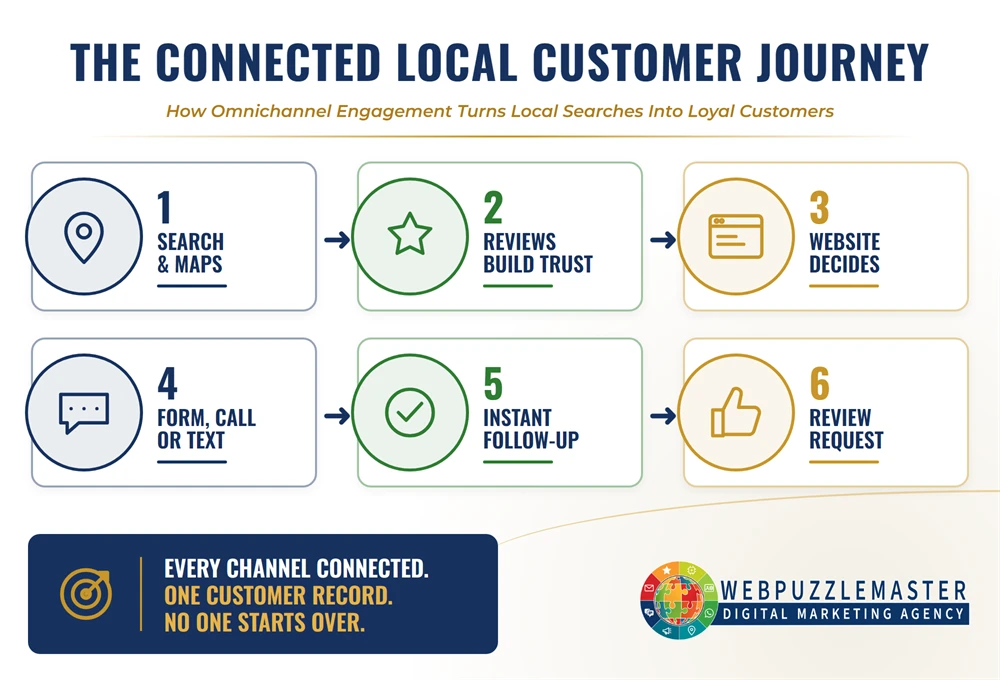
A homeowner searches for a service in their city, finds your Google Business Profile and reads several recent reviews. They visit your website, view a project gallery and submit a quote request. Within minutes, they receive a text confirming the request and an email with what to expect. Your team gets an alert. After the job, an automated text asks for a review, which strengthens your profile for the next person searching. Months later, a seasonal reminder brings them back. No step required someone to remember to do it.
Practical Application: Specialty Surfaces
The situation. Specialty Surfaces is a Southwest Florida surfacing company with 17 years of experience serving residential and commercial customers, including Fortune 100 and Fortune 500 companies. It is also the only authorized installer in Florida of AquaFlex® and PebbleFlex® rubber surfacing products. Despite those advantages, its website was not generating leads, and the company had no consistent system for requesting customer reviews.
What Webpuzzlemaster did. We built a new WordPress website, implemented SEO, local search and AI visibility strategies, and connected the site to a CRM with automations for lead follow-up and review requests. Local search, the website and customer communication were planned as one system instead of separate projects.
Why this approach. The company’s strengths weren’t the problem. The problem was that customers couldn’t easily find, evaluate and contact the business, and satisfied customers weren’t being turned into public proof. Fixing only one channel would have left the other gaps in place.
The outcome. In the first four months, Specialty Surfaces generated 18 qualified residential and commercial leads, with residential leads coming from Naples, Fort Myers and Cape Coral and commercial leads from across Florida. The company earned page-one Google rankings for targeted keywords, achieved AI search visibility within the first two months, and began receiving new 5-star Google reviews once the CRM-driven review automation was turned on.
The lesson. Specialty Surfaces didn’t need one more marketing service. It needed its local search presence, website, follow-up and reputation-building working together.
Omnichannel Mistakes That Make “Being Everywhere” Expensive
- Adding channels before connecting the ones you have. A new platform multiplies the gaps if leads from existing channels already fall through the cracks.
- Inconsistent business information. Different hours, services, phone numbers or descriptions across the website, profiles and social pages confuse customers and AI systems alike.
- Slow or no response on messaging channels. Turning on Google or Facebook messaging and then not monitoring it is worse than leaving it off.
- Treating SMS like a megaphone. Texting without consent, too often or without a useful purpose damages trust and can create compliance problems.
- A website that doesn’t support the journey. If service pages are vague, slow or hard to use on a phone, every other channel sends visitors to a dead end. A mobile-friendly website built to convert local visitors is the hub the other channels depend on.
- No shared record of the customer. When each channel keeps its own list, the business can’t see the whole relationship, and customers get repeated or conflicting messages.
- Never asking for reviews. Happy customers rarely leave reviews unprompted. Without a system, reputation grows much more slowly than the customer base.
What Connected Local Engagement Looks Like
A successful omnichannel approach feels simple to the customer, even though several systems work behind it.
- Consistent everywhere. Business name, services, locations, hours and positioning match across the website, Google Business Profile, directories and social profiles.
- Fast first response. Every inquiry, whether a form, text, call or message, gets an acknowledgment within minutes, and urgent or high-value leads reach a person quickly.
- Context carries over. The CRM knows where the contact came from and what they asked, so later messages are relevant.
- Each channel has a job. Local search drives discovery, the website drives decisions, SMS keeps conversations moving and social builds familiarity and trust.
- Reputation builds automatically. Review requests go out at the right moment after service, and responses to reviews are timely.
- Measured by outcomes. Reporting tracks calls, forms, bookings, reviews and customers by source, not just likes and visits.
This kind of consistency also supports how AI systems understand the business. AI Visibility Engineering™ that strengthens how search and AI systems understand and recommend your business depends on the same clear, consistent and well-supported information that helps customers decide.
Frequently Asked Questions
1. What is omnichannel marketing engagement?
It connects the channels a business uses, such as its website, SMS, social media, email and local search profiles, so customers have one consistent experience and conversations carry over from one channel to the next.
2. How is omnichannel different from multichannel marketing?
Multichannel marketing means being present on several channels. An omnichannel approach means those channels share information and work together, so the customer doesn’t have to start over each time they switch.
3. Does a small local business need to be on every channel?
No. It is better to do a few channels well and connect them than to spread thin across many. Choose the channels your customers actually use.
4. What role does Google Business Profile play?
For many local businesses, it is the most common first impression. It supports discovery in Search and Maps, shows reviews, and can start conversations through calls, messages and booking links.
5. Is SMS marketing appropriate for local businesses?
Yes, when customers have given permission and the messages are useful, such as confirmations, reminders, quick answers, review requests and relevant offers. Consent and frequency matter.
6. How does a CRM keep every channel connected?
A CRM keeps a single record of each customer, including source, interests and past communication, so automation can send the right next message and the team can see the whole relationship.
7. How quickly should a business respond to new inquiries?
As quickly as possible. An automated acknowledgment within minutes, followed by a personal response as soon as practical, keeps the customer engaged and makes it less likely they contact a competitor first.
8. How do reviews fit into an omnichannel strategy?
Reviews connect service delivery with local visibility. Automated review requests after a completed job turn satisfied customers into public proof that helps future customers and supports local search.
9. Does a connected omnichannel approach affect AI search visibility?
It can. Consistent, current information across the website, business profiles, reviews and other sources makes it easier for AI systems to understand a business and reduces conflicting signals.
10. How should a business measure omnichannel results?
Track outcomes by source: calls, form submissions, texts, bookings, reviews and new customers. Engagement metrics such as likes are useful context but shouldn’t be the main measure.
Conclusion
Omnichannel marketing engagement is about meeting local customers where they already are and making sure the experience holds together as they move between search, your website, text messages and social media.
The businesses that win locally are rarely the ones with the most channels. They are the ones whose information is consistent, who respond quickly, who remember each customer’s context and who systematically turn good service into public proof. Start by connecting the channels you already have, then expand only when each new channel has a clear job.
How Webpuzzlemaster Can Help
Webpuzzlemaster helps local businesses connect their Google Business Profile, website, SMS, social media and CRM into one coordinated system. We audit what you have, fix inconsistencies, build the follow-up and review automations that keep conversations moving, and set up reporting that shows which channels produce customers.
Our approach brings together all four pillars: SEO and AI visibility that help local customers find you, websites built to convert, CRM and automation that handle follow-up, and local business success strategies that turn customers into reviews and referrals. We also developed eZ SMS Blaster, a WordPress plugin for interest-based SMS campaigns, so we understand text messaging from both the strategy and the technical side.
About Ruth Kuttler
Ruth Kuttler, AI Visibility Engineer™ & Digital Strategy Architect, helps local and growing businesses connect visibility, websites, CRM, automation and customer communication so they work as one system. Her work with Southwest Florida businesses focuses on fixing the right problem first instead of adding more disconnected tools.
Learn more about Ruth Kuttler and Webpuzzlemaster’s approach to integrated digital growth.
Your Next Step: Plan Smarter Omnichannel Advertising
If you’re thinking about adding paid advertising to the mix, start with a plan instead of a guess. The free AI-Powered Ad Strategy Blueprint compares Google, Meta, YouTube and LinkedIn ad types, shows published cost-per-lead benchmarks by industry, and explains how chat, CRM and SMS follow-up turn ad clicks into conversations. It’s a practical guide to choosing where to advertise, what to budget and how to connect ads to the rest of your customer journey.