

Search is changing. Potential customers no longer rely only on a traditional list of search results to find businesses, compare options, or get answers. AI-powered search experiences and answer engines can synthesize information from multiple sources and present recommendations, explanations, and answers directly to users.
That creates a new question for businesses: Can these systems understand enough about your company to confidently include it in an answer or recommendation?
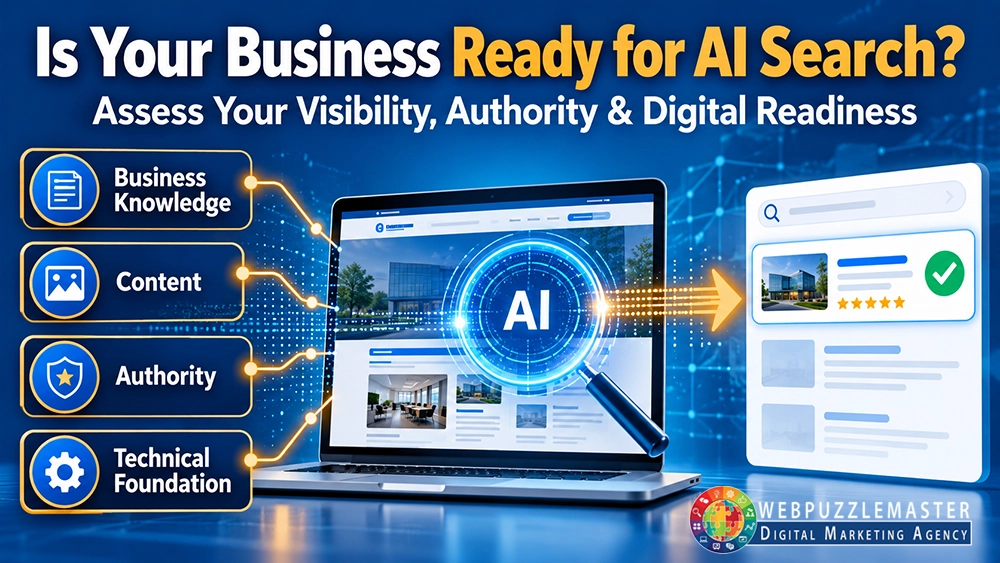
Determining whether your business ready for AI search status is strong enough requires looking beyond traditional rankings. Your website, business information, expertise, authority signals, content, technical accessibility, and broader digital footprint all contribute to how clearly search and AI systems can understand who you are, what you do, who you serve, and why your business may be relevant.
Key Takeaways
What You’ll Learn:
- Why traditional search rankings alone don’t provide a complete picture of AI-search visibility.
- What AI and answer engines need to understand about a business before they can confidently surface its information.
- How website content, business information, authority signals, and technical accessibility contribute to AI visibility.
- Why consistency across your broader digital footprint matters.
- How AI Visibility Engineering™ connects traditional search visibility with the signals AI systems need to understand and evaluate a business.
- How answer engines evaluate and surface business information as search moves beyond traditional result pages.
AI Search Requires More Than Traditional Rankings
Traditional SEO remains important. Search engines still need to crawl websites, understand pages, evaluate relevance, and determine whether content deserves visibility.
But AI-powered discovery adds another layer.
An AI system may need to determine what a business does, where it operates, what problems it solves, what expertise it demonstrates, whether its information is consistent, and whether credible signals support what the business says about itself.
A company can therefore have a technically functional website and even rank for selected search terms while still leaving important questions unanswered.
For example:
- Is the company’s expertise clearly demonstrated?
- Are its services described specifically enough to distinguish them from competitors?
- Is important business information consistent across the web?
- Does the website answer the questions prospective customers actually ask?
- Are relationships among services, expertise, locations, people, and topics clear?
- Are there credible third-party signals supporting the company’s authority?
- Can search and AI systems technically access and interpret the information?
These are not replacements for SEO fundamentals. They extend the visibility challenge beyond rankings into understanding, context, authority, and trust.
That is why assessing AI visibility requires looking at the business as a connected digital entity rather than evaluating isolated webpages.
Start With What AI Systems Can Understand About Your Business
A useful assessment begins with a deceptively simple question:
If an AI system encountered your digital presence today, what could it confidently determine about your business?
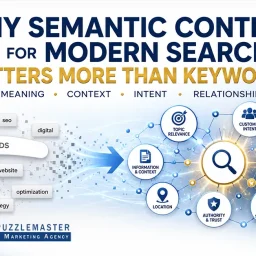
At minimum, the information should make important relationships clear:
- Who the business is
- What products or services it provides
- Who those services are intended for
- Which geographic markets it serves, when location matters
- What expertise or experience supports its claims
- Which problems it solves
- How its services and areas of expertise relate to one another
- What evidence supports its authority and credibility
This is where helping AI and answer engines understand the context and authority behind your business differs from simply inserting keywords into webpages.
The objective is clarity.
If important information is vague, fragmented, contradictory, outdated, or buried across disconnected pages, AI systems have more work to do to interpret the business accurately. Clear relationships and consistent information reduce that ambiguity.
When evaluating your business readiness for AI search, this foundational understanding is one of the first areas to examine.
Evaluate the Information Across Your Digital Footprint
Your website is central to your digital presence, but it is not the only place where information about your business exists.
Search and AI systems may encounter information from business profiles, directories, reviews, social platforms, industry websites, media coverage, citations, professional profiles, and other third-party sources.
Those sources can reinforce what your website communicates—or create uncertainty.
A local business, for example, may have an accurate address and service description on its website but outdated information in directories or business profiles. Another company may describe its primary service differently across multiple platforms. A professional may claim expertise on a company website without developing supporting content or external authority signals around that expertise.
For businesses serving geographic markets, maintaining consistent local business information and reputation signals across the customer discovery ecosystem can strengthen both customer confidence and machine understanding.
The objective isn’t to make every online reference identical. Different platforms serve different purposes. The important facts and positioning, however, should reinforce rather than contradict one another.
Your Content Should Demonstrate What You Know
AI visibility isn’t strengthened simply by publishing more content.
A large library of shallow, repetitive, or disconnected articles may provide less useful context than a smaller body of well-organized content that demonstrates genuine subject knowledge and clearly connects related topics.
Strong content should help answer questions such as:
- What does the business know particularly well?
- Which customer problems does it understand?
- What distinctions or complexities can it explain?
- How do its services address those problems?
- What evidence, experience, or examples support its expertise?
- How do individual articles relate to broader areas of authority?
Content architecture matters here. Pillar pages, supporting articles, service pages, FAQs, case examples, and company information should reinforce one another rather than operate as isolated pieces.
That interconnected structure helps human visitors explore a subject more easily, while also giving search and AI systems stronger contextual signals about the topics and relationships associated with the business.
Technical Accessibility Still Matters
Excellent information has limited visibility if search systems cannot reliably access or interpret it.
Technical issues can interfere with both traditional and AI-powered discovery. These may include poor site architecture, inaccessible content, broken internal links, slow performance, duplicate or conflicting pages, weak mobile experiences, or important information hidden in formats that are difficult to process.
A website built to support accessibility, performance, clear information architecture, and conversion provides the technical foundation that broader visibility efforts depend on.
This is another reason AI visibility should not be treated as a standalone marketing tactic. It intersects with website architecture, SEO, content strategy, business information, authority development, and customer experience.
Practical Example: A Business That Looks Strong but Remains Difficult to Understand
Consider a professional-services company with an attractive website, several years of blog content, active social profiles, positive reviews, and respectable traditional search visibility.
At first glance, the business appears well positioned.
A closer assessment reveals something different.
Its service pages use broad language that could describe dozens of competitors. Blog articles cover many loosely related topics without establishing clear areas of expertise. The About page provides little evidence of experience or authority. Business descriptions vary across external profiles. Older information remains online. The company never clearly explains important relationships among its services.
The business has content, but its digital footprint doesn’t create a strong, consistent picture of what the company should be known for.
The solution isn’t necessarily to publish more.
It may need to clarify positioning, strengthen key service and authority content, improve relationships among existing pages, correct inconsistent business information, and build stronger evidence of its expertise.
That distinction is central to evaluating business ready for AI search criteria: being visible online is not enough if the business remains difficult to understand. Visibility increasingly depends not only on being present online, but on being understandable, credible, and contextually relevant to the questions potential customers are asking.
Where AI Search Readiness Commonly Breaks Down
Many businesses have already invested in SEO, content, websites, reviews, and digital marketing. The problem is often not a complete absence of information. Instead, the information has developed over time without a unified strategy for how the pieces reinforce one another.
Common weaknesses include:
- Vague positioning. The website explains services but does not clearly establish what the business should be known for or why its expertise is distinctive.
- Disconnected content. Articles, service pages, FAQs, case examples, and company information exist but don’t establish clear relationships among key topics.
- Unsupported claims. A business describes itself as experienced, trusted, or authoritative without providing enough evidence to substantiate those claims.
- Inconsistent business information. Services, locations, descriptions, credentials, or other important facts vary across the website and external sources.
- Thin service content. Important offerings are described briefly without enough context to establish expertise or answer meaningful customer questions.
- Weak authority signals. The business has limited third-party validation, citations, reviews, professional recognition, or other credible evidence supporting its expertise.
- Technical barriers. Valuable information exists but search systems struggle to access, interpret, or connect it.
- Publishing without a strategy. More content is added without considering whether it strengthens an established area of authority or fills an identifiable information gap.
These problems can also affect customers. If people struggle to understand what a business does, how its services differ, or why they should trust it, search and AI systems may encounter similar ambiguity.
AI-search readiness therefore isn’t a separate layer added after everything else is finished. It reflects how well the entire digital presence communicates the business.
Assess Authority, Evidence, and Recommendation Signals
Being understandable is only part of the equation. A business also needs credible signals supporting what it says about itself.
Those signals can come from multiple sources: customer reviews, case examples, professional credentials, industry associations, media coverage, citations, authoritative backlinks, expert content, awards, partnerships, and consistent third-party references.
Not every business needs every type of signal. What matters is whether enough credible evidence supports the expertise and reputation the company claims.
This matters most when a potential customer asks an AI system a recommendation-oriented question rather than simply searching for a service.
The question may effectively become:
Why should this business be included among the options?
That shifts the visibility challenge from merely matching a query to establishing enough context and credibility to be considered relevant.
A strong assessment should therefore examine not only what the business publishes about itself but also what the broader digital ecosystem confirms about it.
Look at What Happens After People Find You
Visibility has limited business value if the customer experience breaks down after discovery.
A person who finds a company through traditional search, an AI-generated answer, a referral, or another source still needs to understand the offer, trust the business, find relevant information, and take an appropriate next step.
That means you shouldn’t evaluate AI-search readiness separately from conversion.
Forms, calls to action, navigation, appointment pathways, mobile usability, page performance, lead capture, and follow-up all influence whether increased visibility ultimately produces a business result.
Connecting those interactions through CRM and automation systems that preserve customer context from discovery through follow-up can help businesses understand what happens after someone finds them and create a more coordinated customer journey.
Visibility gets the business considered. The rest of the system has to turn that opportunity into meaningful action.
What an Effective AI Visibility Assessment Should Examine
A useful assessment should provide more than a score. It should identify where the business is strong, where important gaps exist, and which improvements deserve priority.
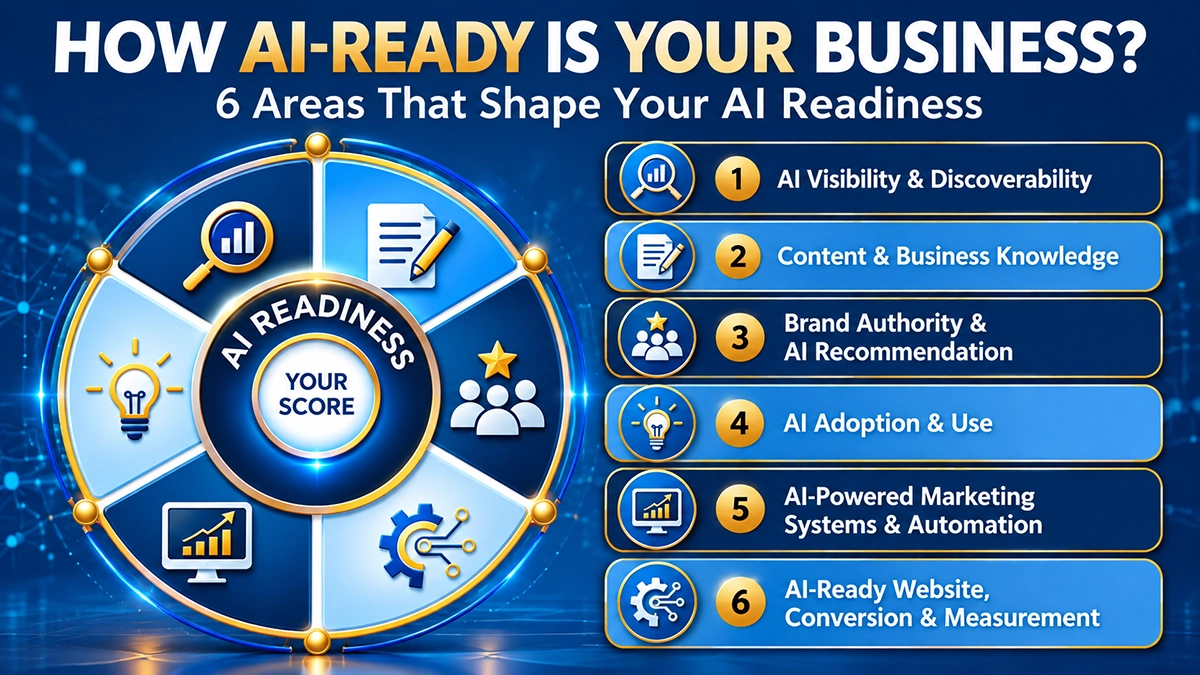
When evaluating business ready for AI search requirements, the Webpuzzlemaster AI Readiness Assessment examines six interconnected areas:
- AI Visibility & Discoverability — How effectively can search and AI systems find, understand, and surface information about the business?
- Content & Business Knowledge — Does the business provide clear, useful, and connected information about its expertise, services, customers, and the problems it solves?
- Brand Authority & AI Recommendation — Are there credible signals that establish the business’s expertise, reputation, and authority and support its inclusion in AI-generated recommendations?
- AI Adoption & Use — How effectively is the business incorporating AI into appropriate areas of its operations, decision-making, and customer experience?
- AI-Powered Marketing Systems & Automation — Is the business using connected marketing, CRM, automation, and AI capabilities to improve customer acquisition, follow-up, and efficiency?
- AI-Ready Website, Conversion & Measurement — Does the website provide the technical foundation, customer experience, conversion pathways, and measurement needed to turn increased visibility into meaningful business results?
These areas work together. Strong AI visibility has limited value if the website doesn’t convert. Good content may not establish sufficient authority on its own. AI tools provide limited strategic advantage when they operate separately from marketing and customer systems. And without meaningful measurement, the business cannot determine whether greater visibility and AI adoption are contributing to growth.
The assessment therefore provides a broader view of AI readiness—not simply whether a business appears in AI search, but whether its digital presence, authority, technology, marketing systems, and measurement are positioned to support growth as AI becomes more deeply integrated into customer discovery and business operations.
Want to see how your business measures up across these six areas? Take the Webpuzzlemaster AI Readiness Assessment.
Frequently Asked Questions
1. What does it mean for a business to be ready for AI search?
It means the business has a digital presence that search and AI systems can access, understand, contextualize, and evaluate with enough clarity to potentially surface its information when relevant.
2. Is AI search replacing traditional SEO?
No. Traditional SEO fundamentals such as technical accessibility, useful content, site architecture, relevance, and authority remain important. AI-powered discovery adds additional considerations around context, relationships, consistency, and recommendation signals.
3. Does ranking well on Google mean business readiness for AI search?
Not necessarily. Strong traditional rankings can be valuable, but AI visibility may depend on additional signals that help systems understand the business, its expertise, relationships, and credibility.
4. Does a business need structured data for AI visibility?
Structured data can help machines interpret certain information, but it is not a substitute for clear content, strong website architecture, consistent business information, authority signals, and useful customer-focused information.
5. Do reviews affect AI-search readiness?
Reviews can contribute useful reputation and customer-experience signals, particularly for local businesses. Their importance varies by business type, query, platform, and context.
6. Does publishing more blog content improve AI visibility?
Not automatically. Content is more useful when it fills meaningful information gaps, demonstrates expertise, answers relevant questions, and strengthens relationships among the topics the business should be known for.
7. Why does business information need to be consistent across different websites?
Consistent core information reduces ambiguity about the business. Contradictory addresses, services, descriptions, credentials, or other important facts can make both customers and machines less certain about what information is accurate.
8. How do authority signals affect AI visibility?
Authority signals can provide external evidence supporting what a business says about its expertise, reputation, and experience. Examples can include credible citations, reviews, professional recognition, media coverage, case evidence, and relevant third-party references.
9. How can a business measure AI-search visibility?
Measurement may include monitoring how the business appears across relevant AI and search experiences; which queries or topics drive visibility; which sources are cited; how competitors appear; and whether AI-driven discovery contributes to website activity, leads, or other meaningful outcomes.
10. How often should AI-search readiness be reassessed?
Review it periodically because the business, its competitors, its digital footprint, search technology, and AI discovery environments keep changing. Significant website, service, positioning, or market changes are also good reasons to reassess.
Conclusion
AI-powered search changes how businesses need to think about visibility, but the underlying objective remains straightforward: make it easy for customers—and the systems helping them—to understand what your business does, why it is relevant, and what evidence supports its credibility.
A business ready for AI search assessment requires examining the entire digital footprint rather than relying on rankings or content volume alone. Website information, technical accessibility, expertise, authority signals, external references, customer experience, and measurement all contribute to the larger picture.
The businesses best positioned for this environment will not necessarily be those producing the most content. They will be those creating the clearest, most credible, and most connected body of information around the problems they solve and the customers they serve.
How Webpuzzlemaster Can Help
AI visibility is not a single tactic or a one-time optimization. It requires understanding how search visibility, website architecture, business knowledge, content, authority, customer experience, and measurement work together.
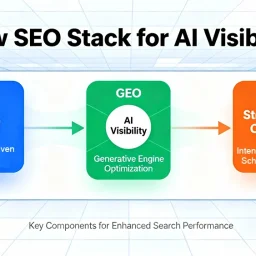
Webpuzzlemaster’s AI Visibility Engineering™ approach evaluates those relationships as part of a connected digital system. Understanding how search and AI visibility work together across the customer discovery process can help identify where traditional search strengths already support AI discovery and where additional gaps need attention.
The objective is not to chase every change in AI search. It is to build a stronger digital foundation that makes the business easier to discover, understand, evaluate, and trust.
About Ruth Kuttler
Ruth Kuttler, AI Visibility Engineer™ & Digital Strategy Architect, helps businesses connect digital visibility with the broader systems that support customer acquisition and growth.
Her work brings together AI visibility, SEO, website strategy, content, CRM and automation, conversion, and measurement so businesses can make decisions based on how the complete digital ecosystem works rather than treating each component as an isolated marketing tactic.
Learn more about Ruth Kuttler and Webpuzzlemaster’s approach to integrated digital growth.
Your Next Step: Assess Your AI Readiness
If you’re unsure whether search and AI systems can clearly understand your business, the most useful next step is to identify gaps before deciding what to change.
The Webpuzzlemaster AI Readiness Assessment helps you evaluate the factors that shape your business’s readiness for an increasingly AI-driven search environment.