

Generating more leads doesn’t necessarily solve a sales problem. If a business cannot distinguish between a strong prospective customer, someone who needs more information, and an inquiry that is unlikely to become a customer, more leads can simply create more work.
This is where lead scoring helps businesses prioritize prospects by using meaningful information about fit, behavior, and readiness to determine which leads deserve immediate attention and which need a different type of follow-up. Done well, lead scoring gives businesses a more structured way to make those decisions without treating everyone who enters the CRM the same.
Key Takeaways
- Lead scoring evaluates meaningful indicators of customer fit, engagement, and readiness rather than assuming every lead has equal value.
- Effective scoring begins with business strategy and qualification criteria—not arbitrary point values created by CRM software.
- Score ranges can help determine whether a prospect should receive immediate personal attention, additional nurture, or another appropriate next step.
- Lead scoring becomes more valuable when CRM, automation, website activity, and customer interactions contribute to a connected view of the prospect.
- Understanding why CRM systems often fail when automation is built on a fragmented customer process helps explain why lead scoring needs a sound strategic foundation before automation is added.
Why Treating Every Lead the Same Creates Problems
A person who downloads an introductory report is not necessarily at the same stage as someone who completes a detailed assessment, visits a service page, and requests a consultation.
Yet many businesses put both people into essentially the same process.
That can create problems at both ends of the customer journey. Strong prospects may wait too long for a meaningful response, while people who are still researching may receive aggressive sales follow-up before they are ready.
The problem becomes more significant as lead volume increases. Someone has to determine:
- Which prospects fit the type of customer the business wants to serve?
- Which have demonstrated meaningful interest?
- Which appear ready to take another step?
- Which need more education or time?
- Which inquiries are unlikely to be appropriate opportunities?
Without a consistent framework, those decisions may depend on who reviews the lead, how busy the team is, or whether someone remembers to follow up.
Lead scoring creates a structure for making those distinctions more consistently.
What Lead Scoring Actually Measures
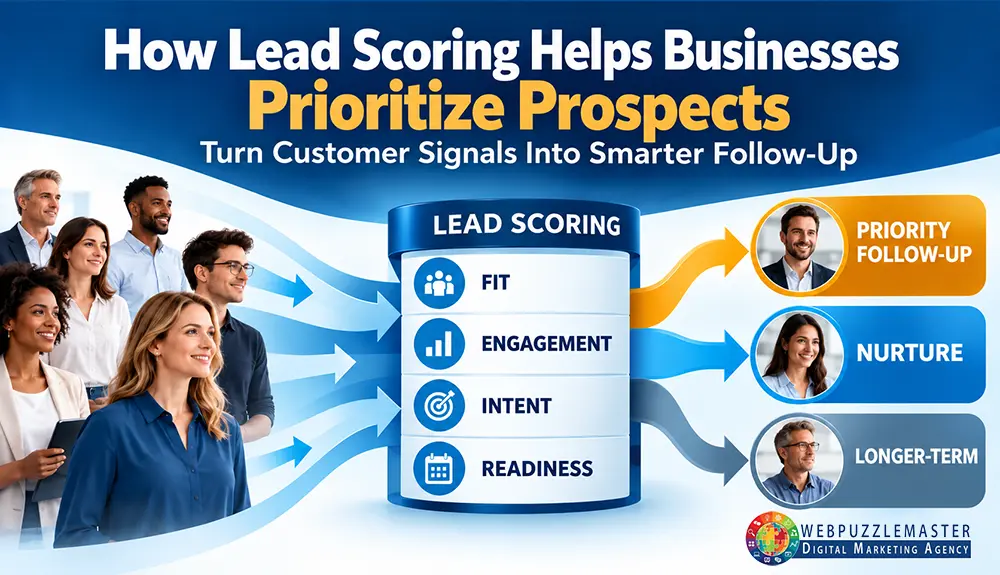
Lead scoring assigns values to selected information or actions that may indicate how closely a prospect aligns with the business’s target customer and how ready that person may be to move forward.
Those signals generally fall into two categories: fit and intent or engagement.
Customer Fit Signals
Fit signals help answer:
Is this the type of customer we are equipped and want to serve?
Depending on the business, relevant criteria might include:
- Type of company or organization
- Industry
- Geographic location
- Company size
- Service needed
- Budget or investment range
- Decision-making authority
- Timeline
- Other qualification criteria specific to the business
The criteria should reflect the economics, capacity, services, and target market of the individual business.
A professional-services firm, contractor, B2B company, healthcare practice, and local retailer would not necessarily score the same characteristics—or assign them the same importance.
Engagement and Intent Signals
Behavior provides another layer of information because it shows what the prospect actually does.
Meaningful actions might include:
- Visiting an important service page
- Downloading an educational resource
- Completing an assessment
- Returning to the website
- Engaging with relevant email content
- Reviewing decision-stage information
- Requesting a consultation
- Responding to follow-up
- Completing additional qualification questions
But activity alone does not equal buying intent.
Opening an email may demonstrate some interest. Requesting a consultation is generally a much stronger signal. Reading several educational articles may show that someone is actively researching while still being months away from making a decision.
Scoring isn’t meant to award points for every digital action. It identifies which characteristics and behaviors provide information useful enough to change what the business does next.
Lead Scoring Should Begin with Strategy, Not Software
Modern CRM and automation platforms can assign points, evaluate conditions, apply tags, change opportunity stages, trigger workflows, notify team members, and automatically route contacts.
Those capabilities are useful only after the business decides what the rules should mean.
Before assigning the first point, the business should determine:
- What defines a strong prospective customer?
- What information indicates poor fit?
- Which behaviors demonstrate meaningful interest?
- Which actions suggest stronger buying intent?
- What should trigger direct human follow-up?
- When is education or nurture more appropriate?
- What information should cause a prospect’s priority to change?
A CRM and automation strategy designed around the actual customer journey provides the infrastructure to turn those decisions into consistent workflows rather than disconnected automated actions.
This distinction matters because software can make a poorly designed process run faster without making the process smarter.
Build the Score Around Meaningful Buying Signals
A useful scoring model does not need dozens of rules.
In fact, too many variables can make it difficult to understand why someone received a particular score or whether the model is actually improving decisions.
A simpler starting model might give greater weight to a small number of meaningful signals:
- A prospect matches important target-customer criteria.
- A detailed qualification form or assessment is completed.
- The prospect visits a high-intent service or consultation page.
- A consultation or appointment is requested.
- Budget or timing information indicates that the service is not currently appropriate.
- Meaningful engagement increases—or disappears—over time.
The specific point values are less important initially than the reasoning behind them.
Every scoring rule should answer:
Why does this information make the prospect more—or less—appropriate for a particular next step?
If the business cannot answer that question, the signal probably should not influence the score.
This is how lead scoring helps businesses prioritize prospects without turning the process into an arbitrary collection of points. The score becomes useful because it represents business logic—not because the CRM happens to be capable of calculating a number.
How Scoring Can Change What Happens Next
The score itself has little business value unless it changes the way a prospect is handled.
A useful scoring model connects different levels of qualification and intent with appropriate next steps. Instead of sending every lead into the same sequence, the business can create different paths based on what is known about the prospect.
For example:
- High-priority prospects may warrant prompt personal follow-up, assignment to a specific team member, or an invitation to schedule a consultation.
- Developing prospects may benefit from educational content, targeted email follow-up, or additional opportunities to demonstrate interest.
- Low-priority prospects may remain in a longer-term nurture process rather than consuming immediate sales resources.
- Poor-fit prospects may receive a respectful alternative next step rather than being pushed further through a process that is unlikely to benefit either party.
This is where scoring becomes operational, not theoretical. The CRM now has a progression of signals, not a single snapshot.
Automation can then respond to those signals by changing contact status, applying segmentation, initiating appropriate workflows, notifying staff, or moving prospects into different follow-up paths.
Connect Website Behavior with What the CRM Already Knows
A CRM may contain information a prospect has explicitly provided: name, company, service interest, budget, timing, assessment answers, appointment history, or previous conversations.
The website can provide another layer of context.
A returning prospect might revisit a particular service, read a case example, complete another form, download a resource, or move toward a consultation page. Those actions can help the business understand how the relationship is developing.
This is one reason a website designed to support conversion and meaningful customer actions should not operate as an isolated marketing asset. Website interactions can become useful inputs to the broader customer-management system when they are captured appropriately and interpreted in context.
Not every page view needs to affect a score. The objective is to identify behaviors significant enough to improve a business decision.
Use Negative Scoring and Score Decay When Appropriate
Lead scoring does not have to move in only one direction.
Some information may indicate that a prospect is less appropriate for immediate attention. A business might reduce a score when:
- Qualification information indicates a poor fit.
- The requested service is outside the company’s scope.
- Budget or timing does not meet established criteria.
- A prospect repeatedly fails to respond to meaningful follow-up.
- Previously strong engagement stops for an extended period.
Score decay can also prevent old activity from permanently making a prospect appear highly engaged.
Someone who visited several important pages and downloaded resources nine months ago but has done nothing since may not deserve the same priority today as someone demonstrating comparable behavior this week.
The model should reflect the current relationship rather than simply accumulating points forever.
Practical Example: From Assessment to Appropriate Follow-Up
Consider a professional-services business that generates leads through educational content, downloadable resources, an online assessment, and consultation requests.
Initially, everyone who submits a form enters essentially the same follow-up process. The business has contact information, but little structure for determining who deserves immediate attention.
It redesigns the process around several meaningful signals.
A prospect receives stronger qualification weight when the person’s needs match the services offered, the budget and timeline are appropriate, and the individual appears to have decision-making authority.
Behavior adds additional context. Completing the assessment demonstrates more engagement than downloading an introductory resource. Visiting service and consultation pages adds useful intent signals. Requesting a consultation is a substantially stronger action.
The CRM combines these signals rather than relying on a single answer or interaction.
A prospect who meets the qualification criteria and demonstrates strong intent can be routed toward personal follow-up. Someone who appears to be a reasonable fit but is still researching can receive relevant educational material. A person whose responses indicate that the service is not currently appropriate can receive a different next step.
This type of system supports local business growth by connecting visibility and customer acquisition with what happens after an inquiry is generated rather than measuring success solely by lead volume.
The business has not created a perfect prediction engine. It has created a more consistent decision framework.
Common Lead-Scoring Mistakes
Lead scoring can become counterproductive when businesses mistake complexity for intelligence.
Giving Points to Everything
If every email open, page visit, click, and download adds points, ordinary activity can make a prospect appear much more qualified than the underlying behavior warrants.
High-intent actions should generally matter more than incidental engagement.
Confusing Interest with Fit
A person can consume a great deal of content and still be a poor potential customer.
Conversely, a strong prospective customer may not spend weeks interacting with content before making contact.
Fit and engagement provide different information and should not automatically be treated as interchangeable.
Building the Model Around Available Data
Businesses sometimes score information simply because their technology collects it.
The better question is whether the information improves a business decision.
Never Testing the Model Against Outcomes
A scoring model is a hypothesis.
If prospects with high scores rarely become qualified opportunities while people with moderate scores frequently become strong customers, the scoring assumptions need review.
Automating Before the Qualification Logic Is Clear
Automation can execute rules consistently, but it cannot determine whether those rules make strategic sense.
The business needs to define qualification and follow-up logic first. Automation should implement that strategy rather than substitute for it.
Measure Whether the Score Predicts Anything Useful
Once enough leads have moved through the system, the business can compare scores with actual outcomes.
Useful questions include:
- Do higher-scoring prospects become qualified opportunities more often?
- Which characteristics appear most frequently among customers?
- Which behaviors tend to occur before consultations or purchases?
- Are salespeople consistently finding high-scoring leads worth pursuing?
- Are potentially valuable prospects being placed in low-priority categories?
- Which nurture paths result in prospects becoming more qualified?
- Are particular lead sources producing stronger prospects even when they generate fewer total inquiries?
That last question is particularly important.
A marketing channel producing 100 leads with very low qualification scores may be less valuable than one producing 25 leads that consistently match the target customer and progress toward a sale.
Scoring therefore becomes more than a sales-management tool. It can also improve marketing measurement and resource allocation.
Lead Scoring and AI Visibility Address Different Parts of the Customer Journey
Businesses increasingly need to understand both who is discovering them and what happens after that discovery occurs.
Search engines, AI-powered search, and answer engines may introduce a business to prospective customers before those people ever enter its CRM. Once they arrive, the business needs a system that can recognize meaningful customer signals and maintain context as the relationship develops.
Building search and AI visibility around clear, authoritative information about the business supports the discovery side of that journey. Lead scoring addresses a different question: once prospects identify themselves, how should the business distinguish among them and respond?
Those systems should ultimately support the same business objective—attracting the right prospects and helping them move toward useful next steps.
AI Can Expand Lead Scoring, but It Doesn’t Eliminate the Need for Strategy
Traditional scoring models typically rely on business-created rules: add points for one characteristic, subtract them for another, or trigger an action when a defined threshold is reached.
AI and predictive models can potentially analyze larger sets of behavioral and customer data to identify patterns that may be difficult to capture through manually created rules.
That can make scoring more sophisticated, but sophistication does not automatically make it better.
An AI system still depends on the quality and relevance of its data, the outcomes it is asked to optimize, and the assumptions embedded in the process. Historical customer data can also reinforce patterns that no longer reflect the customers a business wants to attract.
The same principle that applies to helping AI and answer engines understand and evaluate a business applies here in a different context: better inputs and clearer context generally support more useful outputs.
Businesses should therefore understand what a predictive model is evaluating, periodically compare its recommendations with actual outcomes, and retain appropriate human oversight.
Frequently Asked Questions
1. What is lead scoring?
Lead scoring is a method for assigning values to prospect characteristics and behaviors so a business can distinguish among different levels of fit, engagement, and readiness. The resulting score can help determine an appropriate follow-up path.
2. How does lead scoring help businesses prioritize prospects?
It creates a consistent framework for identifying which prospects appear to warrant immediate attention and which may need education, nurture, or another next step. This can help teams allocate limited time more effectively.
3. What information should be included in a lead score?
That depends on the business. Relevant information may include customer fit, service need, budget, timing, decision-making authority, assessment responses, website behavior, resource engagement, and other meaningful indicators.
4. Should every website action add points to a lead score?
No. Scoring every minor interaction can exaggerate ordinary activity. Businesses should emphasize actions that provide meaningful evidence about fit, interest, or intent.
5. What is negative lead scoring?
Negative scoring reduces a prospect’s score when information suggests lower fit or declining interest. Examples might include incompatible service needs, unsuitable timing, or prolonged inactivity.
6. Can lead scores decrease over time?
Yes. Score decay can reduce the influence of older behavior so the score better represents the prospect’s current level of engagement.
7. Can CRM automation follow up differently based on lead score?
Yes. Score ranges, or qualification conditions, can trigger different workflows, notifications, assignments, nurture sequences, or other follow-up actions.
8. Does a high lead score mean someone will become a customer?
No. A score represents the criteria and signals included in the model. It can help prioritize attention, but it cannot guarantee a purchase or replace appropriate human judgment.
9. How often should a lead scoring model be reviewed?
Review it periodically against actual lead and customer outcomes, especially when services, pricing, target markets, qualification requirements, or customer behavior change.
10. Can AI improve lead scoring?
AI can potentially help identify patterns across larger volumes of customer and behavioral data, but the usefulness of those models depends on data quality, appropriate objectives, and ongoing evaluation. Businesses still need to understand what the system is optimizing and whether its outputs support appropriate business decisions.
Conclusion
Lead scoring is most valuable when it helps a business make better decisions about limited time and attention.
The objective isn’t to reduce every prospect to a number. Instead, lead scoring helps businesses prioritize prospects by ensuring strong opportunities receive timely attention, developing prospects receive useful nurture, and people who are not currently a fit receive a more appropriate experience.
When the scoring criteria reflect genuine business priorities, lead scoring helps businesses prioritize prospects while creating a more consistent framework for qualification, follow-up, and customer development.
The technology can calculate the score and automate the response. The quality of the result still depends on the strategy behind it.
How Webpuzzlemaster Can Help
Effective lead scoring sits at the intersection of strategy, CRM architecture, automation, website behavior, qualification, and measurement.
Webpuzzlemaster helps businesses design those elements as parts of a connected customer acquisition system rather than isolated tools. That includes determining what information matters, how to segment prospects, which interactions should influence follow-up, and how automation can support the customer journey without replacing sound business judgment.
The objective is not simply to automate more activity. It is to build a system that helps the business recognize meaningful opportunities and respond appropriately.
About Ruth Kuttler
Ruth Kuttler, AI Visibility Engineer™ & Digital Strategy Architect, helps businesses connect visibility, websites, CRM, automation, conversion, and measurement into more coherent systems for customer acquisition and growth.
Her approach focuses on how the complete digital ecosystem works together—from how prospects discover a business to what happens after they become a lead—so technology supports the strategy rather than dictating it.
Learn more about Ruth Kuttler and Webpuzzlemaster’s approach to building connected digital growth systems.
Turn Better Lead Information Into Better Follow-Up
If your business generates leads but struggles to determine which prospects deserve immediate attention, which need additional nurture, or how follow-up should differ, the issue may be the system rather than the volume of leads.
A well-designed CRM and automation strategy can help connect qualification, scoring, segmentation, follow-up, and measurement into a more manageable process.
Start with a Marketing Strategy Consultation to identify where your current lead-management process may be losing opportunities.