


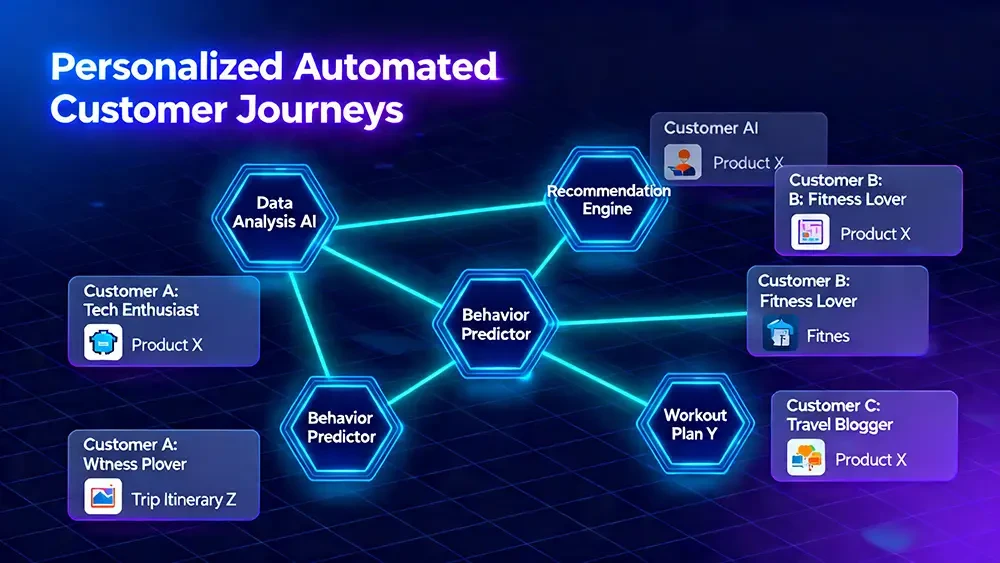
Businesses are moving beyond static automation toward intelligent systems that adapt to user behavior. This is where AI enhances personalization in automated customer journeys, enabling businesses to deliver relevant experiences at every stage.
Instead of sending generic messaging that leads to low engagement and missed opportunities, companies can now leverage AI-driven personalization to create highly relevant experiences. This level of detail involves building structured profiles for each customer to enable personalization at every touchpoint. By implementing clean data, structured CRM workflows, and intelligent automation logic, businesses can achieve consistency, efficiency, and scalable growth. Businesses that implement CRM automation strategies that improve customer engagement and lead conversion efficiency are better positioned to create scalable and personalized customer experiences.
Key Takeaways
- Why AI enhances personalization in automated customer journeys, behavioral triggers, and predictive analytics are foundational to effective CRM and automation.
- How generic messaging, low engagement, and poor conversion rates stem from fragmented data and manual processes.
- How data-driven segmentation, trigger-based workflows, and behavioral tracking enable precise segmentation, automation, and follow-up.
- Why CRM structure determines lead quality, attribution, and lifecycle outcomes from the very first interaction.
Why This Concept Matters
CRMs function as the operational backbone for marketing, sales, and retention. While many businesses have a CRM, few use it to its full potential. Automation often fails not because the tools are ineffective, but because it runs on unclean data and lacks intentional system design. Without a structured approach, automated messages remain generic and disconnected from the customer’s actual journey.
A well-designed system functions similarly to structured content and entity relationships that improve AI search visibility and answer engine recognition, helping define and clarify service categories, creating a structured foundation for all marketing and sales activities. AI enhances this by interpreting behavioral data to deliver personalized messages at the perfect moment, turning a simple database into a dynamic engine for growth.
Real-World Example
A company uses basic automation to send the same follow-up messages to every lead, resulting in low engagement. Leads who downloaded a whitepaper receive the same generic email sequence as those who requested a demo, causing frustration and high unsubscribe rates. After implementing AI-driven personalization, messages are tailored based on user behavior, preferences, and timing. The system now identifies the lead’s specific interest and automatically adjusts the messaging, content, and follow-up schedule. This shift significantly increases open rates, engagement, and conversions because every interaction is relevant. This level of personalization also supports consistent business data and optimized Google Business Profile signals that drive local search visibility and qualified leads, especially for businesses targeting local markets.

Common Mistakes
Many businesses struggle to implement effective personalization due to common pitfalls. These mistakes include:
- Using generic automation that treats all customers the same.
- Lack of segmentation based on behavior, demographics, or lifecycle stage.
- Ignoring valuable behavioral data from website interactions or email engagement.
- Over-automation without a clear strategy, leading to spammy or irrelevant communication.
- Poor CRM structure with inconsistent or missing data fields.
- Delayed follow-up that misses the window of high intent.
- Using disconnected tools that prevent a unified view of the customer.
What You Should Aim For
Success with AI-powered personalization is defined by achieving specific, measurable outcomes. Your goal should be a system that delivers:
- Centralized, clean customer data in a single source of truth.
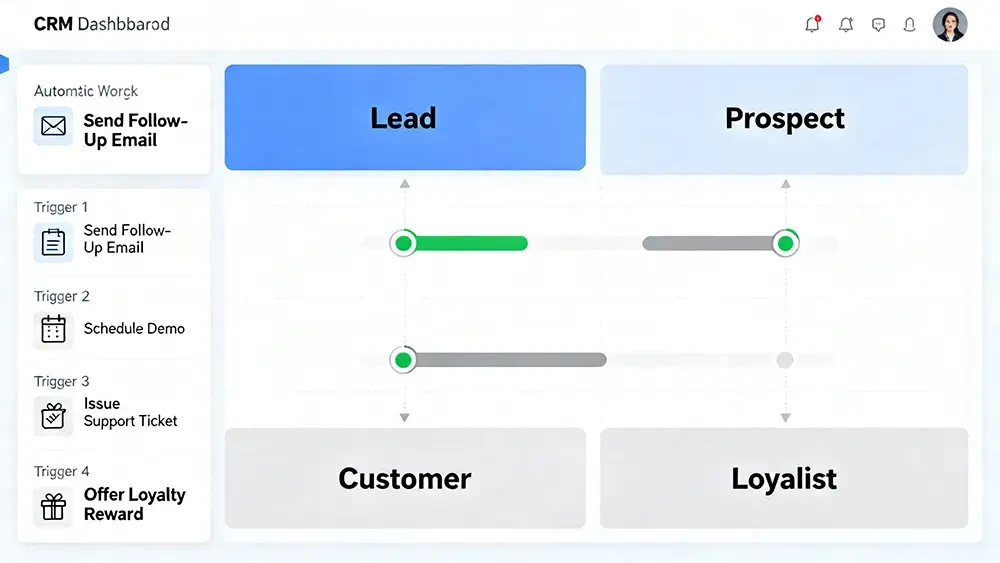
- Clearly defined lifecycle stages that track a customer’s journey from awareness to advocacy.
- Automation aligned to user intent and real-time behavior.
- Consistent, timely follow-up that nurtures leads effectively.
- Scalable workflows that operate efficiently without constant manual overhead.
Supporting Data & Research
Accepted industry principles confirm that effective CRM adoption and data hygiene are critical for success. Businesses that prioritize clean, structured data are better positioned to leverage automation efficiently. The core idea is to manage the customer lifecycle with precision, ensuring that marketing and sales efforts are aligned. This is where AI enhances personalization in automated customer journeys by helping businesses deliver relevant messaging based on behavior and engagement patterns. Given the overwhelming majority of people using a mobile device exclusively, personalization must extend across all platforms to be effective. This aligns with the trend for users to find professional services on a smartphone or tablet, making responsive website design that supports fast load times, mobile usability, and conversion-focused user experience non-negotiable for modern businesses.
Frequently Asked Questions
How does AI improve customer journey personalization?
AI analyzes customer data—such as browsing history, past purchases, and engagement—to predict behavior and automatically tailor messaging, product recommendations, and content for each individual.
What is behavioral targeting in marketing automation?
It is the practice of using a customer’s online actions, such as pages visited or links clicked, to trigger specific, relevant automated marketing campaigns.
Why is segmentation important for automated campaigns?
Segmentation groups customers with similar characteristics or behaviors, allowing you to send more relevant and effective messages instead of one-size-fits-all communication.
Can AI help predict customer needs?
Yes, predictive analytics, a component of AI, can forecast future customer behavior, such as churn risk or likelihood to purchase, enabling proactive engagement.
What are the first steps to implementing AI in a CRM?
Start by ensuring your data is clean, centralized, and structured. Then, define clear goals for what you want to achieve with personalization, such as increasing engagement or conversions.
How does CRM automation reduce manual work?
It handles repetitive tasks like sending follow-up emails, updating contact records, and assigning leads, freeing up teams to focus on high-value activities.
What's the difference between static and dynamic customer journeys?
Static journeys are pre-defined paths that don’t change, while dynamic journeys use AI to adapt in real-time based on a customer’s behavior and interactions.
How do you ensure data is clean enough for AI personalization?
Implement data validation rules, regularly merge duplicate records, standardize field formats, and enrich data from reliable third-party sources.
Can small businesses benefit from AI in their CRM?
Absolutely. Many modern CRM platforms offer affordable, built-in AI features that help small businesses compete by working more efficiently and delivering personalized experiences.
What are some examples of trigger-based automation?
Examples include sending a welcome email when a user signs up, a cart abandonment reminder after a user leaves a site, or a follow-up offer after a user visits a pricing page.
Webpuzzlemaster CRM & Automation Services
Webpuzzlemaster Digital Marketing Agency designs advanced CRM and automation systems that leverage AI to create highly personalized customer journeys. We align your data, workflows, and messaging to ensure every interaction is relevant, timely, and conversion-focused. Our strategies help you move beyond basic automation to intelligent systems that drive measurable growth.
Delivered by Webpuzzlemaster and led by Ruth Kuttler, we focus on creating a unified data ecosystem where your CRM, website, and marketing tools work in concert. Our team implements intelligent workflows that adapt to customer behavior in real-time, ensuring your messaging is always relevant. This strategic approach demonstrates how AI enhances personalization in automated customer journeys by transforming your CRM from a simple database into a powerful engine for growth and customer retention.
About the Author
Ruth Kuttler, AI Visibility Engineer™ & Digital Strategy Architect has 20+ years of experience in digital systems architecture and specialized training and certification in AI and automation systems. Ruth specializes in designing and implementing CRM and automation frameworks that deliver tangible results. Her expertise lies in translating complex business needs into streamlined, data-driven workflows. She helps organizations harness the power of AI to create scalable, personalized customer experiences that drive engagement and revenue.
Your Next Step
If your automation is not delivering personalized experiences, you are likely missing opportunities to engage and convert your audience. AI-driven personalization allows you to connect with customers at the right time with the right message, creating a more effective and scalable system. Now is the time to evaluate your customer journeys and implement strategies that truly drive results.