

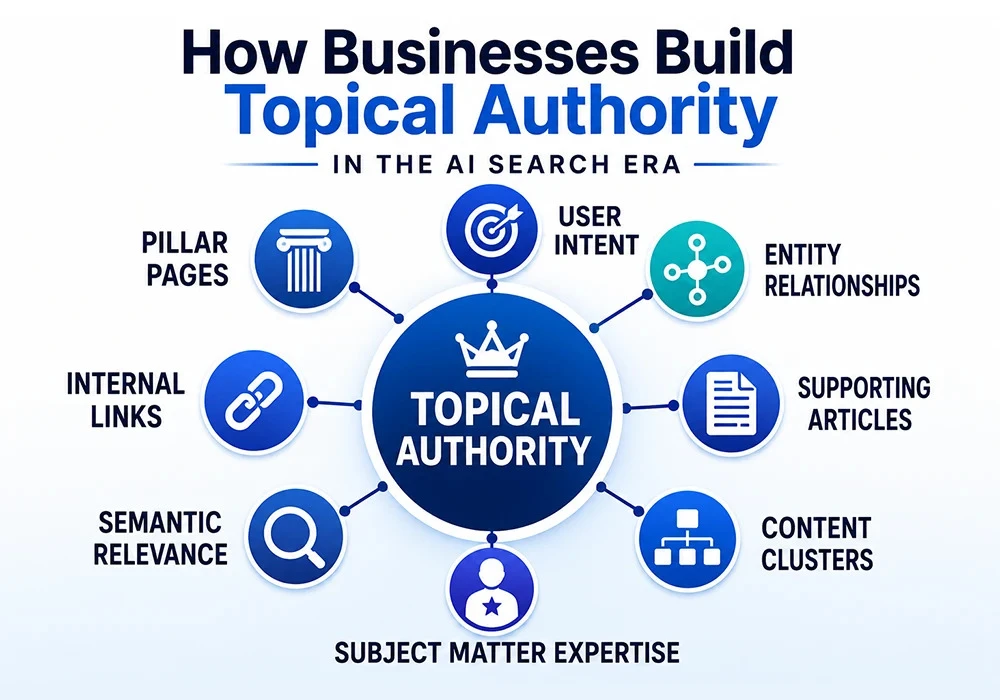
In the current digital landscape, the age of AI search has fundamentally shifted how information is discovered. Businesses across industries are competing for visibility in AI-powered search environments where context, relationships, and expertise matter more than isolated keywords. Businesses build topical authority in the AI search era by creating a comprehensive digital presence that demonstrates expertise, authority, and trust.
Traditional SEO often focused on ranking for specific terms, but today, AI search, answer engines, and generative results prioritize topical authority, content clusters, and entity relationships. When users face weak rankings, scattered content, and inconsistent messaging, they struggle to compete with established brands. By focusing on semantic relevance and contextual depth, companies can ensure their expertise is recognized by machine learning models, ultimately improving their AI search visibility. Businesses that understand the hidden signals AI uses to evaluate content quality and relevance are better equipped to establish lasting authority.
Key Takeaways
- Why topical authority, content clusters, and entity relationships redefine traditional keyword-based SEO
- How weak rankings and scattered content limit visibility in AI-driven discovery
- How pillar pages, semantic SEO, and structured information architecture strengthen authority, trust, and machine understanding
- Why visibility now depends on structure, context, and entities—not rankings alone
Why This Concept Matters
Modern search systems have evolved beyond simple keyword matching. They now evaluate entities, the relationships between those entities, the context of the information, and the underlying user intent. Content optimized only for keywords often fails to surface in AI-generated answers because it lacks the depth required to demonstrate true subject matter expertise. By implementing content strategies designed for AI-generated answers, companies can ensure their information is surfaced in generative experiences and answer engines.
Real-World Example
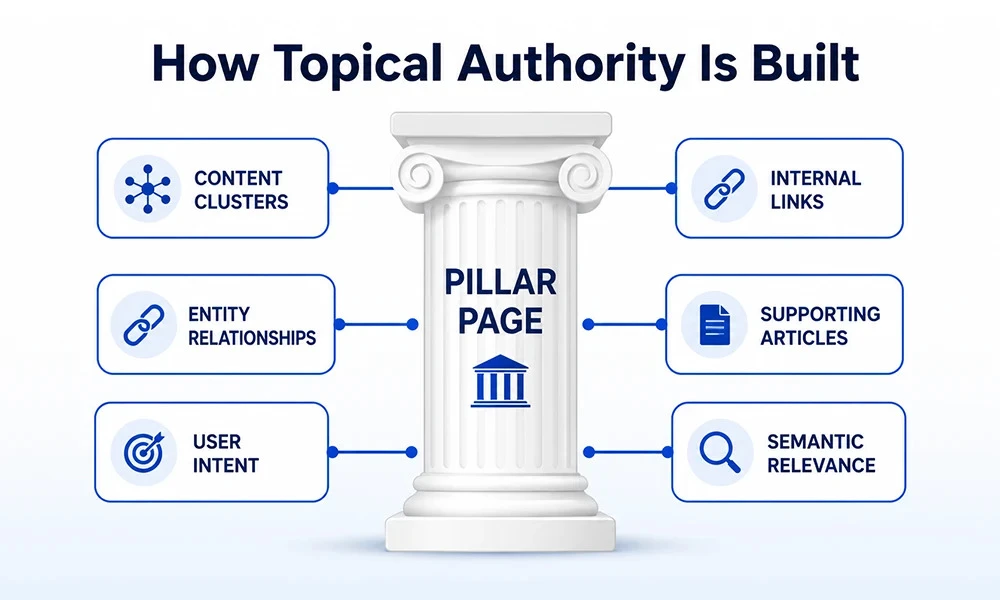
A digital marketing agency published dozens of disconnected articles with little internal linking and inconsistent themes. By organizing content into pillar pages supported by related articles and strengthening entity relationships, the agency improved topical authority, increased AI visibility, and attracted more qualified visitors. The improved content architecture made it easier for both search engines and AI systems to recognize the agency’s expertise, resulting in stronger visibility and a steady increase in qualified inquiries. This example demonstrates how businesses build topical authority in the AI search era through strategic content organization, semantic relevance, and connected internal linking.
Common Mistakes
Many businesses continue to rely on outdated SEO practices that hinder their growth. Common mistakes include publishing disconnected articles, targeting unrelated topics, and relying solely on keywords. Furthermore, neglecting internal linking, creating shallow content, ignoring entity relationships, and failing to establish clear topical relevance can prevent AI systems from understanding the depth of your expertise. A fast site is essential, so prioritize website performance and conversion-focused design to ensure your structured content is easily crawled and indexed by modern search engines.
What You Should Aim For
Success in the AI search era requires a shift toward:
- Clear entity definition and alignment
- Structured, machine-readable content
- Intent-matched information architecture
- Consistent visibility across search and answer engines
- Trust signals AI systems recognize
For those focused on Local Business Success, topical authority acts as a multiplier for geographic relevance, ensuring that your business is the primary entity associated with your specific industry and location.
Supporting Data & Research
Accepted industry principles suggest that AI search behavior is driven by semantic understanding rather than keyword density. Contextual evaluation allows search engines to determine the quality of information by analyzing how well a piece of content fits into a broader topic. Entity-based indexing ensures that when a user asks a question, the AI can retrieve the most relevant, authoritative source based on the strength of the entity’s connections within a knowledge graph.
This shift emphasizes the need for comprehensive content hubs that cover a subject from multiple angles. Businesses serving specific geographic areas can further strengthen these results by building authority within their service area, reinforcing geographic relevance and customer trust. These principles demonstrate how businesses build topical authority in the AI search era by creating comprehensive content ecosystems that AI systems recognize as authoritative and trustworthy.
Frequently Asked Questions
What is topical authority?
Topical authority is the measure of how much expertise a website demonstrates on a specific subject, established by creating comprehensive, high-quality content that covers all aspects of a topic.
How do content clusters improve SEO?
Content clusters organize information into a central pillar page linked to supporting articles, which helps search engines understand the depth and breadth of your expertise on a specific topic.
Why is semantic SEO important for AI?
Semantic SEO focuses on the meaning behind search queries and the relationships between entities, allowing AI systems to better understand and categorize your content for relevant answers.
What are pillar pages?
These are comprehensive pages that cover a broad topic in depth, serving as the foundation for a cluster of related, more specific articles that link back to the pillar.
How do entity relationships affect search?
AI systems use entity relationships to map out how different concepts, people, and businesses are connected, which helps determine the relevance and authority of your content.
Why is internal linking critical?
Internal linking creates a logical structure for your website, helping search engines crawl your content and establishing the contextual relationships between your pages.
How does AI search visibility differ from traditional SEO?
Traditional SEO focuses on ranking for keywords, while AI search visibility focuses on being the authoritative source that AI systems cite in their generative answers.
What is contextual relevance?
Contextual relevance refers to how well your content addresses the specific intent and surrounding information of a user’s query, ensuring it provides a helpful and accurate answer.
How do I demonstrate subject matter expertise?
You demonstrate expertise by consistently publishing high-quality, well-researched content that answers user questions thoroughly and establishes your brand as a reliable source of information.
What is content architecture?
Content architecture is the strategic organization of your website’s information, ensuring that content is structured in a way that is easy for both users and search engines to navigate and understand.
Webpuzzlemaster AI Visibility Services
Delivered by Webpuzzlemaster Digital Marketing Agency, led by Ruth Kuttler, Webpuzzlemaster applies a modern AI search model for discoverability by auditing your existing content structure and identifying gaps in your topical coverage. We then implement a strategic linking framework that reinforces your entity authority across the web. This proven approach demonstrates how businesses build topical authority in the AI search era. By strengthening entity relationships, content architecture, and semantic relevance across your digital presence, we help position your business as a trusted authority for both search engines and AI-driven discovery platforms.
About the Author
Ruth Kuttler, AI Visibility Engineer™ and Digital Strategy Architect. Ruth specializes in designing search architectures that align with the evolving requirements of AI and machine learning models. Her work focuses on bridging the gap between technical SEO and semantic content strategy to drive sustainable visibility. By leveraging her deep understanding of entity-based indexing, she helps businesses build the digital foundations necessary to thrive in the AI search era. Learn more about Ruth Kuttler’s experience building AI visibility strategies for modern search.
Your Next Step
If your content feels fragmented or struggles to gain traction, it may be time to rethink how information is organized across your website. Building topical authority helps search engines and AI systems understand your expertise and trustworthiness. A strategic content architecture creates stronger relationships between topics and improves long-term visibility.
As your visibility grows, it’s equally important to have CRM automation and lead nurturing systems in place to capture, qualify, and nurture the increased number of prospects your content attracts. Businesses that invest in semantic depth and contextual relevance, along with a system to engage with leads and customers, are better positioned for sustainable growth.