


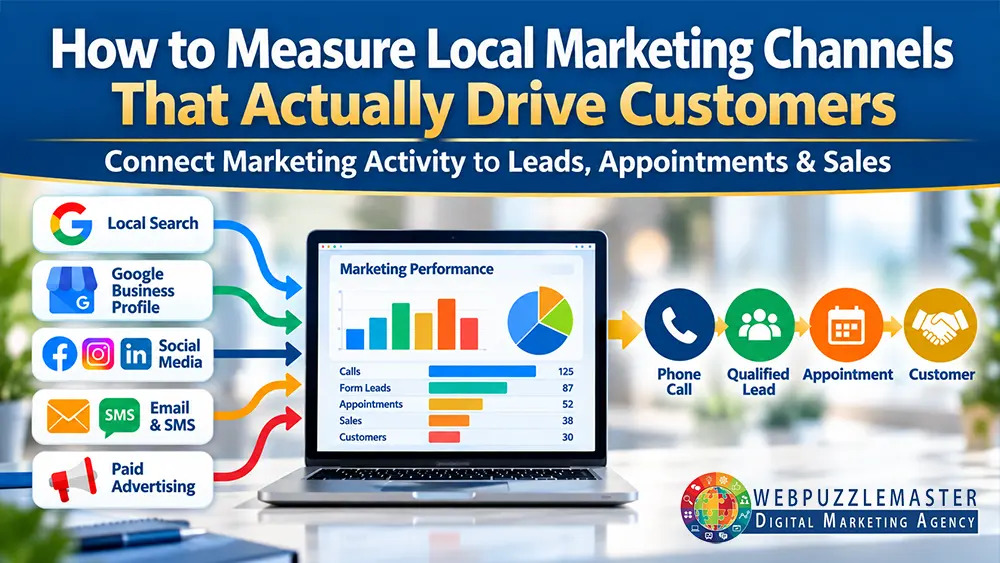
Local businesses have more ways than ever to attract customers—Google search, Google Business Profile, social media, email, SMS, paid advertising, referrals, directories, and other channels. The challenge is knowing which of those activities actually contribute to calls, appointments, leads, and sales rather than simply generating clicks, views, or impressions.
Learning how to measure local marketing channels gives business owners a clearer picture of where customers come from and which marketing investments deserve attention. The goal isn’t to collect more data. It’s to connect marketing activity with meaningful business outcomes so decisions are based on evidence rather than assumptions.
Key Takeaways
What You’ll Learn:
- Why clicks, impressions, traffic, and engagement don’t necessarily tell you which marketing channels generate customers.
- How to connect calls, forms, appointments, leads, and sales with the marketing activity that helped produce them.
- Why attribution becomes more complicated when customers interact with a business through multiple channels before converting.
- Which tracking methods can help local businesses make better marketing decisions without creating an unnecessarily complex measurement system.
- How understanding the factors that actually drive local visibility and lead generation provides useful context for deciding what should be measured.
More Visibility Doesn’t Automatically Mean More Customers
A local business may see encouraging numbers in several places at once. Website traffic is increasing. A Facebook post receives strong engagement. Google Business Profile views rise. An email campaign generates clicks. Paid advertising reports conversions.
Those numbers can be useful, but they don’t all represent the same thing—and they don’t necessarily tell the business what produced a customer.
A person may discover a company through Google, visit its website, leave without taking action, see the company again on social media, read a review, return directly to the website several days later, and finally call. Which channel gets credit?
That is why local marketing measurement has to move beyond isolated platform metrics. Businesses need to understand both visibility and customer action.
This matters especially for local businesses because discovery often happens across multiple touchpoints. A strong local business marketing strategy built around visibility, reputation, and customer acquisition should include a practical way to determine which activities contribute to real business opportunities.
Without that connection, it is easy to spend more money on the channel with the most impressive dashboard rather than the one contributing most meaningfully to growth.
Start With the Business Outcomes That Matter
Before deciding what to track, define what a successful marketing outcome actually looks like.
For one business, the primary conversion may be a scheduled appointment. For another, it could be a phone call, an estimate request, an online purchase, a consultation, a store visit, or a completed lead form. Some businesses may have several valuable conversion actions with different levels of importance.
The measurement system should begin with those outcomes and work backward.
Useful outcomes might include:
- Qualified phone calls
- Contact or estimate requests
- Appointment bookings
- Consultation requests
- Online purchases
- In-store visits when they can be reasonably attributed
- Qualified leads entered into the CRM
- New customers
- Repeat purchases or returning customers
This distinction matters because marketing activity can look successful long before it produces business value.
For example, 500 visits from one channel may generate fewer qualified opportunities than 75 visits from another. A campaign with a high click-through rate may produce poor leads. A channel with modest traffic may consistently generate high-lifetime-value customers.
When businesses measure local marketing channels against meaningful outcomes rather than surface-level activity, those differences become much easier to see.
Connect Marketing Sources to Leads and Customers
Once you define meaningful outcomes, the next step is preserving enough information to understand where those opportunities originated.
Website analytics can identify traffic sources and visitor behavior. Forms can capture source information. Dedicated landing pages can distinguish campaigns. Call tracking can help connect phone inquiries to specific marketing activities. Appointment systems can preserve referral information. CRM records can link marketing sources to leads as they move toward becoming customers.
The CRM becomes especially important because a marketing source has limited value if the business loses that information once a prospect submits a form or makes contact.
A well-designed CRM and automation system can connect lead sources with follow-up and customer progression, allowing the business to evaluate more than the initial conversion.
That creates a much more useful question than Which channel generated the most leads?
The business can begin asking:
- Which channels generated qualified leads?
- Which produced appointments?
- Which leads became customers?
- Which channels attracted repeat customers?
- Which sources generated customers with greater long-term value?
Those questions turn marketing measurement into business intelligence.
Why Customer Journeys Make Attribution Complicated
Marketing attribution would be easy if every customer saw one advertisement, clicked once, and immediately purchased.
Real customer behavior is rarely that simple.
A prospect may first encounter a business in local search, read several website pages, check reviews, return through a branded Google search, subscribe to an email list, click an email weeks later, and eventually book an appointment.
Different analytics systems may give credit to different interactions depending on how attribution is configured. One platform may claim the conversion because it recorded the last click. Another may report its own campaign as responsible because the customer interacted with it earlier.
Neither view necessarily tells the entire story.
The objective is not to force every customer journey into a perfectly linear attribution model. For many local businesses, that level of precision isn’t realistic or necessary.
Instead, the business needs enough reliable information to identify patterns: which channels consistently introduce qualified prospects, which help move them toward a decision, and which appear repeatedly in journeys that ultimately produce customers.
That broader view helps prevent an important marketing mistake—eliminating a channel simply because it doesn’t receive last-click credit even though it may play a significant role earlier in the customer’s decision process.
Practical Example: When the Highest-Traffic Channel Isn’t the Best Performer
Consider a local professional-services business investing in organic search, Google Business Profile, social media, email marketing, and paid advertising.
Its monthly reports show that social media generates substantial website traffic. Based on traffic alone, social appears to be one of its strongest channels.
But once the company connects website sources with forms, phone calls, appointments, and CRM records, a different picture emerges.
Social media may be helping people discover and remember the business, while local search and Google Business Profile generate fewer website sessions but a greater proportion of consultation requests. Email may generate relatively little traffic while helping existing prospects return and finally schedule an appointment.
None of those channels is necessarily failing. They may simply perform different jobs within the customer journey.
That is the value of attribution. The business can stop judging every channel by the same metric and begin evaluating whether each channel is accomplishing the role it is intended to play.
The purpose of measurement isn’t to identify one universally “best” marketing channel. It is to understand how the marketing system contributes to customer acquisition so the business can make better decisions about where to invest, what to improve, and what to stop doing.
Where Local Marketing Measurement Commonly Goes Wrong
Marketing measurement becomes unreliable when businesses collect numbers without first deciding what those numbers should tell them.
One common problem is relying too heavily on reports from individual marketing platforms. Each platform is designed to report activity within its own environment, and several platforms may claim influence over the same customer journey. Looking at those reports independently can create an inflated or fragmented picture of performance.
Other common problems include:
- Tracking traffic instead of business outcomes. More website visitors do not automatically mean more qualified leads or customers.
- Losing the original lead source. If source information disappears when someone enters a CRM or scheduling system, the business may never know which marketing activity initiated the relationship.
- Treating every lead as equally valuable. A large number of poor-fit inquiries can make a channel look more productive than one generating fewer but better-qualified prospects.
- Ignoring phone calls. Local customers often call rather than complete a form, making call attribution an important part of the measurement picture.
- Using inconsistent tracking. Different naming conventions, campaign parameters, forms, or systems can fragment data and make comparisons unreliable.
- Expecting perfect attribution. Customers may interact with several channels, devices, and offline touchpoints before buying. You can’t assign every interaction precisely.
- Failing to connect marketing data with sales results. Knowing where a lead came from is useful; knowing whether that lead became a customer is far more valuable.
Technical problems can also undermine measurement. Forms that do not record properly, broken analytics events, incorrect redirects, slow pages, or poorly configured tracking can create misleading data. Maintaining a website that supports accurate measurement and conversion is therefore part of the attribution process, not separate from it.
The objective is not perfect data. It is reliable enough data to make better decisions.
What an Effective Local Marketing Measurement System Should Accomplish
An effective system should give a business a practical view of how people discover the company, what actions they take, and which marketing activities contribute to qualified leads and customers.
When businesses measure local marketing channels consistently, they can begin comparing marketing activity against outcomes that matter rather than relying on whichever platform reports the most attractive numbers.
A useful measurement system should help answer questions such as:
- Where are qualified prospects first discovering the business?
- Which sources generate calls, forms, appointments, or purchases?
- Which channels assist customers earlier in the decision process?
- Which sources produce the strongest qualified leads?
- Which marketing activities contribute to actual customers?
- Which channels deserve additional investment?
- Where is performance declining or creating unnecessary cost?
- Which parts of the customer journey need improvement?
The system does not have to be elaborate. For many local businesses, a smaller set of consistently tracked metrics is more useful than an enormous dashboard nobody uses.
The important requirement is continuity. Source information should move with the prospect whenever reasonably possible—from initial discovery to website interaction, lead capture, CRM, appointment, sale, and subsequent customer activity.
Visibility Data and Customer Data Answer Different Questions
Marketing measurement also needs to distinguish between discovery and what happens after.
Search visibility, website content, business information, reputation signals, and other digital assets can influence whether a business appears when potential customers are looking for information or solutions. Website and CRM data can then help show what those prospects do after they find the business.
The same distinction increasingly applies to AI-powered discovery. Businesses need clear, consistent, authoritative information that search and AI systems can understand, but visibility alone doesn’t show whether that exposure ultimately contributes to a lead or customer.
Webpuzzlemaster’s approach to helping AI and answer engines understand and evaluate a business addresses the visibility side of that equation. Attribution and customer tracking address what happens after discovery.
Businesses need both perspectives. Otherwise, they may know they are visible without knowing whether visibility contributes to growth—or know that customers are converting without understanding how those customers initially found them.
Frequently Asked Questions
1. What are local marketing channels?
Local marketing channels are the platforms and methods businesses use to reach customers in their service area. They can include local and organic search, Google Business Profile, paid advertising, social media, email, SMS, directories, referrals, direct traffic, and offline marketing.
2. What is the most important local marketing metric to track?
No single metric applies to every business. The most useful metrics are tied to meaningful business outcomes such as qualified calls, leads, appointments, purchases, and new customers.
3. How can a business tell where a lead came from?
Businesses can capture source information through website analytics, tracking parameters, dedicated landing pages, forms, call tracking, appointment systems, CRM records, and direct source questions when appropriate.
4. Should businesses track leads or customers?
Both are useful, but customer data drives stronger business outcomes. Tracking only leads can make a channel appear successful even when those leads rarely become customers.
5. How should phone calls be included in marketing attribution?
Call-tracking systems can link phone inquiries to specific campaigns or traffic sources. Businesses can also record lead-source information in their CRM when they handle calls manually.
6. What is marketing attribution?
Marketing attribution is the process of identifying which marketing interactions contributed to a lead, conversion, or customer. Because customers often interact with multiple channels, attribution may involve more than one touchpoint.
7. Why do different marketing platforms report different conversion numbers?
Platforms may use different attribution rules, tracking methods, conversion windows, and definitions. Multiple platforms may also claim influence over the same customer journey.
8. Can local businesses measure offline customers?
Sometimes. Appointment records, point-of-sale information, CRM data, call tracking, promotional codes, customer surveys, and source questions can help connect offline activity with marketing sources, although attribution may not always be exact.
9. How often should local marketing performance be reviewed?
The appropriate frequency depends on the business and marketing volume. The key is to review performance consistently enough to identify meaningful patterns rather than reacting to short-term fluctuations.
10. Does the channel with the most leads deserve the largest marketing investment?
Not necessarily. Consider lead quality, conversion to customers, acquisition cost, customer value, and the channel’s role in a multi-touch journey.
Conclusion
Local marketing becomes easier to manage when businesses stop treating platform activity as the final measure of success. Traffic, clicks, impressions, rankings, and engagement can provide useful signals, but they need to connect to calls, qualified leads, appointments, sales, and customers to show meaningful business impact.
Knowing how to measure local marketing channels also makes it easier to distinguish between activities that create visibility, those that influence a customer’s decision, and those that directly generate conversions. That broader view supports better decisions about where to invest, what to improve, and which marketing activities are no longer earning their place in the strategy.
The goal isn’t perfect attribution. It is enough reliable information to replace guesswork with evidence.
How Webpuzzlemaster Can Help
Marketing measurement works best when visibility, website performance, lead capture, CRM data, automation, and conversion tracking are designed to work together.
Webpuzzlemaster helps businesses evaluate those connections so marketing information does not disappear between systems. That can include reviewing how prospects reach the website, how conversion actions are tracked, how source information enters the CRM, and how businesses can connect marketing activity with meaningful customer outcomes.
Measurement also needs to account for how customers discover businesses as search continues to evolve. Understanding how search and AI visibility contribute to customer discovery can help businesses strengthen discoverability while the measurement system provides the evidence needed to understand what happens after that visibility is created.
The result is a more useful view of marketing performance: not simply Where are we getting attention? but which activities are helping us attract the right people and turn that attention into business?
About Ruth Kuttler
Ruth Kuttler, AI Visibility Engineer™ & Digital Strategy Architect, works with businesses to connect digital visibility, website performance, CRM and automation, customer acquisition, and measurement into a more cohesive growth strategy.
Her work replaces disconnected marketing tactics with systems that help businesses understand what is working, make smarter decisions, and improve how prospects move from discovery to customer.
Learn more about Ruth Kuttler and Webpuzzlemaster’s integrated approach to digital strategy.
Your Next Step
If you invest in multiple marketing channels but cannot clearly determine which activities drive leads and customers, the first step is to identify where the measurement gaps occur.
Webpuzzlemaster’s free report, HOW TO GET AND STAY AHEAD IN THE AI ERA — 8 Strategies to Attract Better Customers, Make Smarter Marketing Decisions, and Build Predictable Growth, provides practical strategies for making better marketing decisions such as search, AI, customer behavior, and digital marketing continue to evolve.